
***** FINAL DECISION BY U.S. SUPREME COURT, MARCH 31, 2009:
http://www.supremecourtus.gov/opinions/08pdf/07-1372.pdf
***** TRANSCRIPT OF ORAL ARGUMENTS AT U.S. SUPREME COURT ON FEBRUARY 25, 2009:
http://supremecourtus.gov/oral_arguments/argument_transcripts/07-1372.pdf
QUICK BACKGROUND on the ceded lands and this lawsuit
The ceded lands of Hawaii are the former crown lands and government lands of the Kingdom of Hawaii.
Following the revolution of 1893 which overthrew the monarchy, the nation of Hawaii continued as an independent nation under the new government of the Republic of Hawaii.
Since the crown lands had been held by the Kingdom government to provide income to support the monarch in his/her capacity of head of state (i.e., King or Queen), and there was no longer a monarch, the crown lands now became public lands that were legally and politically indistinguishable from the rest of the government lands.
Four years later, in 1897, the Republic of Hawaii offered a treaty of annexation, which the U.S. accepted in 1898. The bargain agreed to by the two governments was that Hawaii would cede the public lands of Hawaii to the U.S. in return for the U.S. paying off the accumulated public debt of the Kingdom and Republic, on condition that the ceded lands would be held as a public trust with all income being used for the benefit of the people of Hawaii for education and other public purposes.
The Hawaii statehood admission act of 1959 returned ownership of the ceded lands to the new State of Hawaii, except for national parks and military bases. According to the admission act, revenue from the ceded lands could be used for any one or more of five purposes. One of those purposes is "the betterment of native Hawaiians" as defined in the Hawaiian Homes Commission Act of 1920;, i.e., people with at least 50% native blood quantum. This provision in section 5(f) of the admission act appears to give the State of Hawaii permission to use ceded land revenues for the exclusive benefit of a racial group.
In 1978 a state constitutional convention created the Office of Hawaiian Affairs whose mission was to provide benefits exclusively for ethnic Hawaiians (of any blood quantum). Although the admission act did not require that any ceded land revenue be used for any particular purpose, the state legislature decided to provide permanent funding for OHA defined as 20% of ceded land revenues.
OHA now claims that the 20% allocation of ceded land revenues gives OHA the right to veto any sale of ceded lands, because ceded lands that are sold will no longer produce government revenue and OHA's entitlement will therefore be diminished. (Additionally, but not a part of this lawsuit, OHA claims that it has a right to complain and perhaps to sue the State when the State leases ceded lands for less than full market value, even to non-profit or charitable or public uses, because doing so diminishes OHA's revenue. Additionally, but not part of this lawsuit, OHA and other Hawaiian sovereignty groups claim that ethnic Hawaiians communally own all the ceded lands and, perhaps, all the lands of Hawaii).
For further general background on the ceded lands, see "Ceded Lands Belong to All the People of Hawai'i; There Should Be No Racial Allocation of Ceded Lands or Their Revenues"
https://www.angelfire.com/hi2/hawaiiansovereignty/cededlands.html
When the State of Hawaii tried to sell a parcel of ceded lands, OHA filed a lawsuit to stop that particular sale and to prohibit the state from any further sales.
On December 5, 2002 Hawaii circuit court judge Sabrina McKenna ruled against OHA, concluding that the State of Hawaii has a right to sell ceded lands.
OHA appealed Judge McKenna's decision. On January 31, 2008 the Hawaii Supreme Court ruled 5-0 that Judge McKenna was mistaken. The Hawaii Supreme Court ruled that the State of Hawaii is permanently prohibited from selling any ceded lands until such time as a settlement has been reached regarding the claims of Native Hawaiians. That decision was based on the 1993 U.S. apology resolution in which the U.S. "confessed" to helping overthrow the monarchy in 1893, and the U.S. acknowledged that Native Hawaiians have never relinquished their claims to Hawaii lands.
The State of Hawaii filed a petition for certiorari with the U.S. Supreme Court asking it to review and overturn the state Supreme Court decision. Twenty-nine other states shortly thereafter filed an amicus brief supporting Hawaii's petition for certiorari. On October 1, 2008 the U.S. Supreme Court granted the petition for certiorari, and will probably hear oral arguments (and perhaps issue a ruling) during the term that runs from October 2008 through June 2009.
Below are some of the legal documents and news reports concerning this lawsuit, in chronological order.
=============
On December 5, 2002 Hawaii circuit court Judge Sabrina McKenna issued a decision of 149 pages in pdf format dismissing OHA's lawsuit against the State of Hawaii, ruling that the State has the right to sell ceded lands. Her decision can be downloaded at:
https://bigfiles90.angelfire.com/CededNoSellMcKenna120502.pdf
Judge McKenna's decision has very lengthy portions which recite false and twisted interpretations of Hawaii history, because those arguments were submitted in legal briefs by attorney William Meheula and because the State of Hawaii chose not to provide any rebuttal to those historical claims. The State is in an awkward position -- indeed, a conflict of interest -- because, on one hand, the State is obligated to defend OHA against lawsuits that provide contrary historical arguments in an effort to abolish OHA; but on the other hand, when OHA sues the State, then the State must defend itself. The State Attorney General's office speaks with forked tongue.
----------
http://the.honoluluadvertiser.com/article/2002/Dec/06/ln/ln06a.html
Honolulu Advertiser, Friday, December 6, 2002
Judge allows ceded lands sales
By Vicki Viotti
The Native Hawaiian rights movement suffered another blow yesterday when a circuit judge ruled that the state can sell ceded lands for a public purpose without it constituting a breach of trust.
However, an attorney representing opponents to the sale said the state faces legal hurdles before any of the land can change hands, including an appeal before the Hawai'i Supreme Court.
The decision by Circuit Judge Sabrina McKenna concerns ceded land on Maui and the Big Island where the state had planned to develop affordable housing projects. The case — which is unrelated to the ongoing dispute over revenue owed to the Office of Hawaiian Affairs from the state's use of ceded lands — concerns land on Maui and the Big Island where the state had planned to develop affordable housing projects.
Ceded lands are nearly 2 million acres of former crown and government lands transferred to the state under the 1959 Admission Act, to be held in trust for public benefits, including improving the lot of Native Hawaiians.
Judge McKenna's opinion acknowledges that thousands of acres have been sold since statehood, and that since the late 1970s with the creation of the Office of Hawaiian Affairs, some revenue from these lands has been earmarked for OHA.
State land officials later established a moratorium on sales to avoid diminishing the revenue stream to OHA, according to the opinion, but former Gov. Ben Cayetano lifted the moratorium for the housing projects in this case.
OHA joined by a group of Native Hawaiians represented by attorney William Meheula, sued in 1994 to block the projects — in Leiali'i near Lahaina and at the La'i'opua project in North Kona — in which the ceded lands would be sold to the Housing and Community Development Corp. of Hawai'i for development.
In the decision yesterday, McKenna denied their request for a court order that would bar further sale of ceded lands until the issues of ownership and valuation are resolved.
Sherry Broder, the attorney representing OHA in the case, did not return calls seeking comment.
Haunani Apoliona, chairwoman of the OHA board of trustees, said the judge "erred" in her decision but took hope in the judge's call to lawmakers "to enact legislation that gives effect to the right of Native Hawaiians to benefit from the ceded land trust."
Meheula said the plaintiffs plan to appeal McKenna's decision to the state's high court, but added he couldn't predict when that might happen. He maintained that the Congressional Apology Resolution of 1993 acknowledged the illegality of the overthrow of the Hawaiian monarchy and throws the state's ownership of former crown lands in question.
"We're disappointed with the decision, and we disagree with the decision," he said.
"The basic case is that the Apology Resolution has admitted that ceded lands were taken illegally. That means that the U.S. does not have good title to the land, and they shouldn't be allowed to sell it."
State attorneys yesterday were consulting with the newly inaugurateted Gov. Linda Lingle on a response to the decision.
In court hearings a year ago, Broder had argued that international law also protects the property rights of indigenous peoples. At that time, John Komeiji, a private attorney hired by the state to defend Housing and Community Development Corp., countered that the state's laws and constitution take precedence over those international laws, which are in draft form before the United Nations and never endorsed by the United States.
Komeiji declined yesterday to comment on the decision.
Among her findings, McKenna disputed the claim that there is a legal cloud over ceded land title because of the overthrow, calling it "a non-justiciable political question" that can't be decided by the court.
McKenna also dismissed the plaintiff's argument that Native Hawaiian land rights are comparable to Native American claims and thus should be given the same treatment in this case.
"Cases dealing with recognition of Native American claims or fiduciary duties with respect to land or assets are based on federal statutes or treaties that allow such claims," she wrote.
Meheula said appealing the decision may have to wait until the second part of the case — a trial to set a fair market value for the land — takes place. That trial is necessary because under law, OHA is entitled to 20 percent of the proceeds from a sale of ceded lands, Meheula said.
Attorneys for title insurance companies have indicated through court filings that no title insurance would be issued for the land transactions until the state wins this case on appeal, Meheula said, so nobody expects immediate land transfers to take place.
---------------
http://starbulletin.com/2002/12/06/news/story1.html
Honolulu Star-Bulletin, Friday, December 6, 2002
Court OKs ceded-lands sale
DECISION: The court denies an OHA request to stop the sale of ceded lands, the revenue from which is the basis of OHA's funding
REACTION: The OHA chairwoman says the judge erred and the decision may be appealed
By Pat Omandam
In a setback to native Hawaiian entitlements, state Circuit Judge Sabrina McKenna denied a request by the Office of Hawaiian Affairs for a moratorium on the sale of ceded lands.
McKenna also ruled yesterday the sale of these lands is not a breach of trust and does not violate the state Constitution.
"We believe the judge erred, and our attorney is carefully reviewing her lengthy decision," said a disappointed Haunani Apoliona, OHA chairwoman. "When the case was filed, it was expected then that the case, no matter who prevailed, would be appealed to a higher court."
OHA had argued if ceded lands are sold, it would forever diminish the revenue to which the agency is entitled.
Also, OHA trustees wanted the moratorium so it and the state could resolve their dispute over revenue payments from these lands. By law, OHA's funding is based on ceded-land revenues.
In the 107-page opinion issued yesterday, McKenna said the state has the legal authority and sovereign immunity to sell public-trust or ceded lands. The judge added that the creation of OHA and other changes in 1978 to the state Constitution do not alter this power.
The ruling on this 8-year-old case, filed by OHA and four individual Hawaiians against the state Housing and Community Development Corp., was originally triggered by two stalled state affordable-housing projects on Maui and Hawaii: Leialii in Wahikuli on Maui, and Laiopua in North Kona on the Big Island.
Leialii is a planned 4,813-home project built over a 20-year period on 1,120 acres of land. Laiopua is a master-planned community with 4,263 housing units, a high school and support infrastructure.
Both projects are on ceded lands and are on standby pending the outcome of the case.
Attorney John Komeiji, who was hired by the state Attorney General's Office for this case, said yesterday he was not authorized to comment on the ruling.
The Attorney General's Office said last evening it could not issue a statement on it until it was reviewed by Gov. Linda Lingle.
McKenna said the case involved fundamental issues concerning ceded lands and the trust responsibilities of the state in relation to the native Hawaiian people.
Ceded or public-trust lands make up about 1.8 million acres, or about 43 percent of the land in Hawaii.
"The court fully appreciates the importance of the aina to the native Hawaiian people and recognizes the distinct possibility of the creation and recognition of a sovereign Hawaiian government," McKenna said. "The court also recognizes that the state, as trustee of the ceded-lands trust, owes a high standard of fiduciary duty to the beneficiaries of the ceded-lands trust."
But she concluded the 1959 state Admissions Act and the state Constitution "expressly place" responsibility for and decisions on ceded lands with the state Legislature.
"What we glean from the opinion immediately is that the judge is recommending the matter be referred back to the Legislature and must go through the political process," Apoliona said. "We look forward to working with Gov. Lingle and the Legislature for a just resolution."
Finally, McKenna said Congress, the state Legislature and the courts have all recognized the illegality of the overthrow of the Hawaiian kingdom and the historical injustices toward native Hawaiians.
Even so, she said, the state's sovereign immunity and the fact that the courts cannot settle matters of a political nature prohibited her from considering OHA's claim that there is a cloud on the state's title to these ceded lands.
What are ceded lands?
Public trust or ceded lands make up about 1.8 million acres, or about 43 percent of the land in Hawaii. They were given or ceded to the United States shortly after the 1893 overthrow of the Hawaiian kingdom.
Upon statehood, Hawaii became trustee for about 1.4 million acres.
The statehood act set aside five purposes for their use, one of them being the betterment of native Hawaiians. In 1978 the state Constitution was amended to create the Office of Hawaiian Affairs and to fund it with ceded-land revenue.
In 1980 the Legislature set that share at 20 percent.
A 1990 state law that calculated those payments was ruled moot by the Hawaii Supreme Court in September 2001. OHA plans a major lobbying effort next session to enact a new law.
Land dispute
The dispute over the sale of ceded lands between the state and the Office of Hawaiian Affairs and native Hawaiians extends back eight years, based on court documents:
>> Feb. 5, 1990: The state Housing and Community Development Corp. holds an organizational meeting for the Leialii and Laiopua projects.
>> July 1991: OHA seeks 20 percent of the proceeds from the sale of Leialii land from state.
>> May 1992: Legislature passes Act 318, which creates a process for the sale of the Leialii and Laiopua parcels to HCDC from the state Department of Land & Natural Resources. It also determines how much OHA and the state Department of Hawaiian Home Lands should be compensated from the sale.
>> 1993-1994: OHA and DHHL begin talks with state regarding fair market value of Leialii land.
>> February 1994: State decides to transfer Leialii property to HCDC from DLNR before reaching an agreement with OHA on its value. Negotiations continue.
>> July 11, 1994: All sides agree the value of Leialii is $27.8 million.
>> Nov. 4, 1994: OHA refuses payment of $5.5 million for 20 percent of Leialii land because of how payment was calculated. It sues the state, saying the claims on the land by native Hawaiians defeat the public-purpose use of the land for affordable housing.
>> Nov. 30, 1994: Title Guaranty of Hawaii refuses to provide title insurance based on the allegations in the complaint.
>> July 17, 1995: Attorney General Margery Bronster issues an opinion saying the state has been and remains empowered to sell public-trust lands.
>> Aug. 10, 1995: Gov. Cayetano informs HCDC to proceed with the project and tells the attorney general to litigate the case, based on Bronster's opinion.
>> May 1997: Laiopua property is transferred to state DHHL to partially satisfy the state's obligation to pay the $600 million settlement with the homelands agency.
>> March 16, 1999: Title Guaranty again refuses to issue title insurance based on the allegations in this case.
>> Nov. 20, 2001: Trial begins before Circuit Judge Sabrina McKenna.
>> Dec. 5, 2002: McKenna rules against OHA and says state can sell ceded lands.
===============
On January 31, 2008 the Supreme Court of the State of Hawaii reversed Judge McKenna's decision, by a 5-0 vote.
The decision is available in a 93-page pdf document at
http://www.state.hi.us/jud/opinions/sct/2008/25570.pdf
and also as a html document (which is easier to copy/paste) at
http://www.state.hi.us/jud/opinions/sct/2008/25570.htm
A collection of news reports and commentaries about this decision can be found at
https://www.angelfire.com/planet/big60/HawSupCt2008RulesCannotSellCededLands.html
Here is the Hawaii Supreme Court's conclusion:
CONCLUSION
Based on the foregoing, we hold that:
(1) the Apology Resolution and related state legislation, give rise to the State's fiduciary duty to preserve the corpus of the public lands trust, specifically, the ceded lands, until such time as the unrelinquished claims of the native Hawaiians have been resolved;
(2) the trial court correctly determined that this court's unpublished decision in Trustees of the Office of Hawaiian Affairs v. Board of Land and Natural Resources, No. 19774 (Haw. Mar. 12, 1998) (mem.), did not collaterally estop the plaintiffs' claims in this case inasmuch as the elements of collateral estoppel, see Keahole Def. Coal., Inc. v. Bd. of Land & Natural Res., 110 Hawai‘i 419, 429, 134 P.3d 585, 595 (2006), are not present;
(3) the plaintiffs' claim for injunctive relief with regard to the Leiali‘i parcel is not barred by sovereign immunity based on our conclusion that the $31 million expenditure on infrastructure for the Leiali‘i parcel had only an ancillary effect -- albeit a substantial one -- on the state treasury, see Kahoohanohano v. State, 114 Hawai‘i 302, 337, 162 P.3d 696, 731 (2007);
(4) inasmuch as the Apology Resolution and related state legislation give rise to a fiduciary duty by the State, as trustee, to preserve the corpus of the public lands trust until such time as the unrelinquished claims of the native Hawaiians have been resolved, the trial court's conclusion that OHA's actions between 1987 and 1994 constituted a waiver of the plaintiffs' claims was clearly erroneous and, therefore, the plaintiffs did not waive their claim for injunctive relief with regard to the Leiali‘i parcel;
(5) the plaintiffs were not estopped from challenging the transfer of the Leiali‘i parcel based on their pre-1993 actions because it was not until the Apology Resolution was signed into law on November 23, 1993 that the plaintiffs' claim regarding the State's explicit fiduciary duty to preserve the corpus of the public lands trust arose;
(6) inasmuch as the plaintiffs' requested relief is clearly prospective in nature, the plaintiffs' claims with regard to the sale or transfer of the ceded lands in general are not barred by sovereign immunity;
(7) the question whether an injunction is appropriate to allow resolution of the plaintiffs' unrelinquished claims without further diminishment of the trust res is ripe for adjudication;
(8) the question whether an injunction should issue presents a type of dispute that is traditionally resolved by the courts and, therefore, does not present a non-justiciable political question;
(9) the appropriate test in this jurisdiction for determining whether a permanent injunction is proper is: (a) whether the plaintiff has prevailed on the merits; (b) whether the balance of irreparable damage favors the issuance of a permanent injunction; and (c) whether the public interest supports granting such an injunction; and
(10) the plaintiffs have established that injunctive relief is proper pending final resolution of native Hawaiian claims through the political process.
Accordingly, we vacate the trial court's January 31, 2003 judgment and remand this case to the circuit court with instructions to issue an order granting the plaintiffs' request for an injunction against the defendants from selling or otherwise transferring to third parties (1) the Leiali‘i parcel and (2) any other ceded lands from the public lands trust until the claims of the native Hawaiians to the ceded lands have been resolved.
=============
In April 2008 the State of Hawaii filed a petition for certiorari with the U.S. Supreme Court, asking the Court to review the decision of the Hawaii Supreme Court. The petition is available as a 17-page pdf at
https://bigfiles90.angelfire.com/CededNoSellStatePetnCertSupCt.pdf
QUESTION PRESENTED
In the Joint Resolution to Acknowledge the 100th
Anniversary of the January 17, 1893 Overthrow of the
Kingdom of Hawaii, Congress acknowledged and apologized
for the United States' role in that overthrow.
The question here is whether this symbolic resolution
strips Hawaii of its sovereign authority to sell, exchange,
or transfer 1.2 million acres of state land -- 29
percent of the total land area of the State and almost all
the land owned by the State -- unless and until it
reaches a political settlement with native Hawaiians
about the status of that land.
===============
The Office of Hawaiian Affairs filed a defendant's brief in opposition to the state's petition for certiorari. The brief can be downloaded as a 28-page pdf at
https://bigfiles90.angelfire.com/CededNoSellOHAOpposCertSupCt.pdf
QUESTION PRESENTED
Whether the Hawaii Supreme Court acted within
its authority in relying upon Hawaii laws and
Constitution as well as principles of trust law and the
1993 federal Joint Resolution to Acknowledge the
100th Anniversary of the January 17 1893 Overthrow
of the Kingdom of Hawaii to impose an injunction on
the sale or transfer of the lands conveyed in trust to
the State of Hawaii until the ongoing reconciliation
process between the state and federal governments
and native Hawaiians is completed
===============
On June 2, 2008 the attorneys general of 29 states filed an amicus brief in support of the State of Hawaii petition for certiorari. The amicus brief is available as a 10-page pdf at
https://bigfiles90.angelfire.com/CededNoSellCertAmicus29states.pdf
QUESTION PRESENTED
In the Joint Resolution To Acknowledge the 100th Anniversary of the January 17, 1893, Overthrow of the Kingdom of Hawaii, Congress acknowledged and apologized for the United States' role in that overthrow. The question presented is whether this resolution stripped Hawaii of its sovereign authority to sell, exchange, or transfer 1.2 million acres of state land -- twenty-nine percemt of the total land area of the state and almost all the land owned by the state -- unless and until it reaches a political settlement with native Hawaiians about the status of that land.
=============
In June 2008 the Pacific Legal Foundation filed an amicus brief in support of the State of Hawaii petition for certiorari. The amicus brief is available as an 18-page pdf at
https://bigfiles90.angelfire.com/CededNoSellCertAmicusPacifLeglFndn.pdf
Note that these two questions significantly broaden the issues which the State asked the Court to consider. If the Court were to take up either or both of question #1 and question #2 and answer "No," it would lay the basis for abolishing the Office of Hawaiian Affairs.
QUESTIONS PRESENTED
1. Whether Congress by the Admission Act and
the Apology Resolution, may, without violating the
Fifth Amendment, require or permit the State of
Hawaii, Trustee of the Federally-created Ceded Lands
Trust, to discriminate between trust beneficiaries on
the basis of race?
2. Whether the State of Hawaii, Trustee of the
Ceded Lands Trust, may, without violating the
Fourteenth Amendment, discriminate between trust
beneficiaries on the basis of race?
===============
On October 1 the U.S. Supreme Court docket showed that the petition for certiorari has been granted.
Supreme Court Docket:
http://www.supremecourtus.gov/docket/07-1372.htm
No. 07-1372
Title:
Hawaii, et al., Petitioners
v.
Office of Hawaiian Affairs, et al.
Docketed: May 2, 2008
Lower Ct: Supreme Court of Hawaii
Case Nos.: (25570)
Decision Date: January 31, 2008
Questions Presented
~~~Date~~~ ~~~~~~~Proceedings and Orders~~~~~~~~~~~~
Apr 29 2008 Petition for a writ of certiorari filed. (Response due June 2, 2008)
May 7 2008 Order extending time to file response to petition to and including July 2, 2008, for all respondents.
Jun 2 2008 Brief amicus curiae of Pacific Legal Foundation filed.
Jun 2 2008 Brief of respondents Office of Hawaiian Affairs, et al. in opposition filed.
Jun 2 2008 Brief amicus curiae of Commissioner of Public Lands for the State of New Mexico filed.
Jun 2 2008 Brief amici curiae of Washington, et al. filed.
Jul 14 2008 Reply of petitioners Hawaii, et al. filed.
Jul 16 2008 DISTRIBUTED for Conference of September 29, 2008.
Oct 1 2008 Petition GRANTED.
============
** THE NEXT LEGAL DOCUMENT ON THIS WEBPAGE IS THE BRIEF ON THE MERITS BY THE STATE OF HAWAII, SUBMITTED DECEMBER 15, 2008. A LINK APPEARS, IN CHRONOLOGICAL ORDER, FOLLOWING SEVERAL NEWS REPORTS.
http://www.honoluluadvertiser.com/article/20081001/BREAKING01/81001013
Honolulu Advertiser, BREAKING NEWS/UPDATES
Updated at 8:21 a.m., Wednesday, October 1, 2008
U.S. Supreme Court to hear ceded lands case
The U.S. Supreme Court today agreed to hear a case involving attempts by the state of Hawaii to sell portions of ceded lands on Maui and the Big Island to private, residential developers.
The state attempted to sell the land in the mid-1990 but was sued by the Office of Hawaiian Affairs and several individuals who sought to block the sale.
In December 2002, a state court ruled in favor of the state, saying it could sell the lands in question.
That ruling was appealed, and in January of this year, the Hawaii Supreme Court overturned the earlier ruling, and the case was appealed to the U.S. Supreme Court.
Ceded lands are former crown lands that were deeded over to the United States when Hawaii was annexed as a U.S. territory in 1898. Under an agreement signed at that time, revenues generated from ceded lands were to be used for the betterment of Native Hawaiians.
Today's announcement by the Supreme Court did not indicate how soon the court will hear the matter.
** Comment from Ken Conklin: The next-to-last paragraph gives a totally false impression. It gives the impression that the revenues from the ceded lands must be used for the betterment of Native Hawaiians. In the annexation of 1898, there was no mention of "betterment of Native Hawaiians" in regard to the ceded lands. In the statehood admission act of 1959, "betterment of native Hawaiians" was mentioned as one of five purposes for which ceded land revenues might be spent, but there was no requirement to spend any of the money for any particular purpose. The newspapers constantly spread lies and distortions like this.
-------------------
http://www.starbulletin.com/news/bulletin/US_Supreme_Court_to_hear_ceded_lands_case.html
Honolulu Star-Bulletin, news bulletin POSTED: 10:34 a.m. HST, Oct 01, 2008
U.S. Supreme Court to hear ceded lands case
The state is appealing a lower court decision barring the transfer of lands
By Star-Bulletin staff
and Associated Press
The U.S. Supreme Court will hear the state's appeal of a lower court decision that forbid the state from selling or exchanging ceded lands until a political settlement was reached with Native Hawaiians.
Hawaii Attorney General Mark Bennett announced this morning that the nation's top court would likely hear oral arguments State of Hawaii et al. vs. Office of Hawaiian Affairs early next year, and likely issue a decision by June.
The Lingle administration is appealing a January state Supreme Court decision that Congress, in its 1993 Apology Resolution for the overthrow of the Hawaiian kingdom, had forbidden the transfer of land until Native Hawaiian claims against the government were settled.
The Hawaii Supreme Court decision barred the state from disposing of 1.2 million acres on Maui and the Big Island that once belonged to the former Hawaiian monarchy.
The case started with a 1994 lawsuit by the state Office of Hawaiian Affairs and four individuals who want the state to hold onto the land until Native Hawaiian claims are settled.
"It is our hope that the United States Supreme Court will reverse the decision of the Hawaii Supreme Court. Hawaii's ceded lands are held by the state for the benefit of all of Hawaii's citizens, and for a number of purposes, including the betterment of the conditions of Native Hawaiians," Bennett said.
---------------------
http://www.forbes.com/feeds/ap/2008/10/02/ap5501663.html
FORBES MAGAZINE, October 2, 2008
Associated Press
US Supreme Court to rule on Hawaiian lands
By HERBERT A. SAMPLE
HONOLULU - The U.S. Supreme Court has decided to hear a case that will determine if the state of Hawaii can sell or exchange land once owned by the former Hawaiian monarchy or have to wait until the claims of Native Hawaiians are resolved.
The justices will rule on an appeal of an injunction last January by the Hawaii Supreme Court that barred the state from disposing of 1.2 million acres on Maui and the Big Island until those claims are settled.
"We believe the Hawaii Supreme Court was incorrect in its holding," Hawaii Attorney General Mark Bennett said in a statement. "Prudent management of those lands for the benefit of all of Hawaii's citizens must include, on occasion, the right to sell or exchange land."
But a leader of the Office of Hawaiian Affairs, which brought the original suit against the state on behalf of Native Hawaiians, said she expects the high court to back up the Hawaii court's ruling.
"We firmly stand behind the state Supreme Court's opinion, which says the state should keep the ceded land trust intact until Native Hawaiian claims to these lands are settled," said Haunani Apoliona, OHA board chairwoman.
The underlying lawsuit started in 1994 when OHA and four individuals sought to force the state to retain the lands until native claims were settled. At the time, the state was planning to sell about 1,500 acres on Maui and the Big Island. Royal lands make up about 29 percent of the state and include almost all state-owned lands.
The unanimous Hawaii Supreme Court ruling prohibited the state from selling or otherwise disposing of the properties to private parties, based on a 1993 action by Congress known as the Apology Resolution. In it, Congress acknowledged wrongdoing in the federal government's participation in the 1893 overthrow of the Hawaiian monarchy and recognized the inherent sovereignty of indigenous islanders over their land.
The state appealed the injunction to the U.S. Supreme Court, supported by 29 other states that filed a friend-of-the-court brief in June. They contended that the Apology Resolution was symbolic and thus has no bearing on how Hawaii determines the future of the lands.
The court decision on Wednesday to hear the case, titled Hawaii v. Office of Hawaiian Affairs, was made without comment. Oral arguments are likely to occur early next year, with a decision expected by June.
Legislation pending in Congress would create a federally recognized Native Hawaiian government, giving Hawaiians autonomy rights similar to those provided American Indians and Native Alaskans. The proposal passed the U.S. House of Representatives last year and awaits a vote in the Senate.
Bennett said the measure would not resolve Native Hawaiian land claims, but would establish a framework by which they would be negotiated. That process could take several years.
--------------------
http://www.starbulletin.com/news/20081002_US_high_court_will_hear_isle_land_case.html
Honolulu Star-Bulletin, October 2, 2008
U.S. high court will hear isle land case
State ceded lands transfer gets test before high court
By Ken Kobayashi
The U.S. Supreme Court will likely rule next year on whether the state can transfer or sell lands that once belonged to the Hawaiian monarchy.
What is at stake in ceded-lands case
The U.S. Supreme Court will rule on whether the state can sell or transfer ceded lands that once belonged to the Hawaiian monarchy.
ISSUE: Was the Hawaii Supreme Court correct when it ruled on Jan. 31 that the state cannot sell or transfer any of the 1.2 million acres of ceded lands until pending claims by native Hawaiians to the lands are settled and resolved?
STATE: The Hawaii court is wrong in interpreting Congress' 1993 Apology Resolution as prohibiting the transfer or sales until a settlement. Even if that is what Congress intended, the ruling infringes on the state's sovereign rights involving its lands.
OHA: The Office of Hawaiian Affairs believes the ceded lands are irreplaceable and hugely important to native Hawaiians. The Hawaii Supreme Court's Jan. 31 decision was a landmark ruling that correctly interpreted the Apology Resolution. OHA had urged the U.S. Supreme Court to reject the state's appeal.
At least four of the nine high-court justices granted the state's request yesterday to hear an appeal of a Hawaii Supreme Court ruling that blocked the transfer of what are known as crown or ceded lands for a housing development on Maui.
The state high court ruled that the lands should not be transferred or sold until a settlement is reached of native Hawaiian claims to the ceded property.
The ruling by the U.S. Supreme Court, which is expected before the end of its term in June, will be considered significant. Ceded lands make up 1.2 million acres throughout Hawaii, or about 29 percent of the total land in the state.
The state maintains that states have a sovereign right to sell or transfer lands without interference by the federal government. Twenty-nine states joined the state attorney general's office in urging the high-court justices to take the case.
"We believe that prudent management of those lands for the benefit of all of Hawaii's citizens must include, on occasion, the right to sell or exchange land," Attorney General Mark Bennett said.
But the Office of Hawaiian Affairs, which filed a lawsuit seeking to block the transfer, believes the preservation of the land is critically important to native Hawaiians.
"Each piece of land is unique and irreplaceable," said Office of Hawaiian Affairs lawyer Sherry Broder.
OHA officials say they believe the U.S. Supreme Court will uphold the state court's ruling.
"We firmly stand behind the state Supreme Court's opinion, which says the state should keep the ceded land trust intact until native Hawaiian claims to these lands are settled," said OHA board Chairwoman Haunani Apoliona.
The case involves the state's attempt to transfer ceded lands for low-cost housing on Maui.
The ceded lands were transferred to the federal government following the overthrow of the Hawaiian monarchy in 1893 and later given to Hawaii upon statehood in the 1959 Admission Act.
The state holds the land in trust for public purposes and the betterment of native Hawaiians.
In 1992 the state transferred 500 acres to the predecessor of the state Housing and Community Development Corp. for the low-cost housing development at Leialii on Maui.
The corporation tried to give OHA a check for $5.6 million, 20 percent of the land's worth, but OHA refused to accept the money because it did not want to give up any claims to the property.
OHA later filed a lawsuit to block the transfer.
On Jan. 31 the Hawaii Supreme Court agreed with OHA in a 93-page unanimous decision. The state court interpreted Congress' 1993 apology resolution as preventing the transfer or sale of ceded lands until native Hawaiian claims to those lands are resolved.
The U.S. Supreme Court grants only an estimated 1 percent of all requests to review cases, and agreed yesterday, without comment, to review the Hawaii Supreme Court decision.
Bennett said he was pleased.
"We believe that the Hawaii Supreme Court was incorrect in its holding that the Congress, in the Apology Resolution, barred the state of Hawaii from selling or transferring ceded lands," he said.
He said Congress gave the state that right by the Admission Act.
Apoliona noted that the Hawaii Supreme Court cited the Apology Resolution, which said the overthrow of the Hawaii monarchy was "illegal" and apologized to native Hawaiians for the U.S. military's participation.
In the state high court's decision, Chief Justice Ronald Moon wrote that the state justices believe the Apology Resolution mandated that the state has a duty to preserve the ceded lands "until such time as the unrelinquished claims of the native Hawaiians have been resolved."
Bennett said he believes he has a "strong case" and hopes the other states will also file briefs with the high court urging it to overturn the Hawaii Supreme Court decision.
Broder also said they have "strong arguments" in upholding the state high court's ruling.
There are no other pending attempts to sell or transfer ceded lands because the administrations of former Gov. Ben Cayetano and Gov. Linda Lingle refrained from any such moves until the issue involving the Maui land transfer is resolved, according to Bennett.
Broder said it shows the sale of ceded lands is not that critical to the state because it has been "able to continue doing its business without selling any ceded lands."
---------------------
http://www.honoluluadvertiser.com/article/20081002/NEWS01/810020353/1001/LOCALNEWSFRONT
Honolulu Advertiser, Thursday, October 2, 2008
Fate of ceded lands in hands of high court
U.S. justices may eventually determine whether state can sell
By Gordon Y.K. Pang
What the state can or cannot do with some 1.2 million acres of ceded lands is at stake in a lawsuit the U.S. Supreme Court yesterday agreed to hear on appeal.
The appeal was filed by state Attorney General Mark Bennett in a case that pits the state against the state Office of Hawaiian Affairs. In January, the state Supreme Court ruled that the state cannot sell or otherwise transfer ceded lands, once belonging to the Hawaiian government, which the U.S. has ceded to the state.
The state's argument is that the Admission Act of 1959 grants it the authority to manage the 1.4 million acres as it sees fit for the benefit of all Hawai'i residents.
But the argument of OHA and four Native Hawaiians who brought the 1994 lawsuit is that Congress' 1993 Apology Resolution and subsequent action by the state Legislature effectively bar the state from selling or transferring ceded lands to an outside entity until "unrelinquished claims" regarding compensation for the use of those lands are resolved.
The U.S. Supreme Court did not say when it would hear the case, although Bennett said he believes it will be sometime between January and March.
At the center of the case are plans by Gov. John Waihee's and Gov. Ben Cayetano's administrations in the early 1990s to sell about 1,500 acres of developable land in Lahaina and Kona to private interests in order to finance affordable housing projects for moderate- and lower-income families — regardless of whether they have Hawaiian blood.
Four Hawaiians — Pia Thomas Aluli, Jonathan Kamakawiwo'ole Osorio, Charles Ka'ai'ai and Keoki Kamaka Ki'ili — sued to block the sale.
OHA PRESSES ONWARD
Bill Meheula, their attorney, said the streets, water and sewer pipes and other infrastructure have been ready for a decade and the lands could likely have been sold by now if not for the injunction brought on by the lawsuit.
"It's admitted that Hawaiians have a claim to the ceded lands arising out of the overthrow," Meheula said.
The state Supreme Court decision backed the position of OHA and the four Hawaiians that the state not be allowed to sell any ceded lands until those claims are resolved, he said.
OHA Chairwoman Haunani Apoliona echoed Meheula's comments in a prepared statement: "We firmly stand behind the state Supreme Court's opinion, which says the state should keep the ceded land trust intact until Native Hawaiian claims to these lands are settled."
Apoliona added: "OHA will continue its tireless efforts to protect and defend the rights and entitlements of its beneficiaries, the Native Hawaiian (p)eople."
Bennett said the state should be allowed as much flexibility as possible in managing the ceded lands in order to meet its mandate to the beneficiaries of the trust — both Native Hawaiians and non-Hawaiians.
"Prudent management sometimes involves exchanging land, or transferring land, or theoretically even selling land or buying other land or other assets," he said. "So what the state wants to be able to do is to prudently and judiciously exercise the rights it was granted under the Admission Act."
In June, the attorneys general of 29 other states filed a brief with the U.S. Supreme Court backing Bennett's position. They worry about the precedent being set if a state is barred from selling or exchanging lands received from the U.S. government.
Bennett said he does not know of any plans by Gov. Linda Lingle's administration to sell the lands on Maui or the Big Island, or ceded lands anywhere else, noting that the state has been under a "self-imposed moratorium" pending the outcome of the litigation with OHA.
The 1.2 million acres represents about 29 percent of the state's nonsubmerged land base, Bennett said.
Ceded lands were once controlled by the Hawaiian monarchy but taken over by the U.S. when Hawai'i was annexed in 1898. The federal government turned over the land when Hawai'i became a state in 1959, with an agreement that it be used generally to benefit the public and specifically the Native Hawaiian people.
2002 DECISION KEY
In 2002, a state court ruled in favor of the state, saying it could sell the lands. That was the decision overturned in January by the state Supreme Court and that will be heard by the U.S. Supreme Court.
As required by the Admission Act, a portion of the revenue from leases of ceded lands is used to finance OHA.
The high court's decision to hear the state's case is not expected to have a bearing on ongoing negotiations between OHA and the state over how much the agency should receive for the use of ceded lands.
Earlier this year, a settlement proposal for the state to transfer three parcels of land valued at $187 million and $13 million to OHA, as well as a minimum of $15.1 million annually in ensuing years, was shot down by the Legislature.
But in the waning days of the session, legislators tacked onto the state budget a nonbinding proviso requiring the Lingle administration and OHA to resume negotiations on the 30-year-old dispute.
Opposition to the plan came largely from parties who said they did not trust OHA trustees to properly manage the assets for Native Hawaiians.
-----------------
http://www.honoluluadvertiser.com/apps/pbcs.dll/article?AID=/20081003/OPINION01/810030344&s=a
Honolulu Advertiser, Friday, October 3, 2008
EDITORIAL
High court can bring clarity to land dispute
Hawai'i is soon to receive some much-needed interpretation of the Apology Resolution, the congressional act that passed in 1993, a century after the overthrow of the Hawaiian monarchy.
At least the state will have a judicial reading — by the highest court in the land — answering this question: Does the resolution strip the state of the freedom to sell or transfer any of the kingdom's "ceded lands" it was given upon Hawai'i's admission to the union?
The state's hope, and it's a reasonable one, is that the justices will say: No, the resolution acknowledges unresolved claims without yielding the state's right to manage land in the meantime.
This should not be seen as erasing the state's commitment to negotiating a settlement on ceded lands with Native Hawaiian representatives, which remains the final goal.
But it's unreasonable and unnecessary to tie the state's hands in the management of the lands until the settlement is reached. After all, that could take decades.
Major hurdles must be cleared:
* Congress must pass a bill to give Native Hawaiians a way to organize themselves into a political entity that the federal government can recognize as a negotiating partner.
* The Native Hawaiian electorate must choose governing representatives.
Talks must produce a final settlement of Native Hawaiian claims to that land.
The legal dispute that drew the U.S. Supreme Court's attention stems from a land deal with a private developer to build affordable homes. According to the Admissions Act, residential development was one of the ways ceded lands were to benefit the people of the state — Hawaiians and non-Hawaiians alike.
* Native Hawaiians won't be precluded from negotiating their share of the land assets, once the legal framework for those talks are in place.
In the meantime, the state is right to work toward protecting its power to manage the land, for the benefit of all its citizens. The high court should affirm that right.
------------------
http://www.starbulletin.com/editorials/20081006_court_should_reverse_freeze_on_land_sales.html
Honolulu Star-Bulletin, October 6, 2008
EDITORIAL
Court should reverse freeze on land sales
THE ISSUE
The U.S. Supreme Court has agreed to review a state ruling on the use of ceded land.
THE Lingle administration should be encouraged by the U.S. Supreme Court's decision to review an unconscionable state ruling that prohibits the sale or transfer of virtually all state-owned land in Hawaii. Overturning of the ruling would restore the successful formula for devoting part of the land sales revenue to improving conditions for native Hawaiians.
The Hawaii Supreme Court ruled in January that the 1993 congressional apology for the overthrow of the Hawaiian monarchy prohibits the sale of any of the 1.2 million acres of former crown land that was taken over by the federal government and ceded to Hawaii at statehood.
The case was among 10 that the nation's high court agreed to review of about 2,000 appeals that had accumulated over its summer break. A final ruling is expected by the end of the court's term in June.
The Office of Hawaiian Affairs challenged the state's decision to develop 500 acres of ceded land on Maui as affordable housing. OHA rejected the state's offer of nearly $5.6 million in compliance with the Admission Act's provision that one-fifth of the benefits from ceded land be dedicating to improving conditions for Hawaiians.
In the state high court's ruling, Chief Justice Ronald Moon wrote that the Apology Resolution "dictates that the ceded lands should be preserved" until reconciliation between the United States and the native Hawaiian people is achieved. The Apology Resolution does not precisely say that.
Reconciliation will not be achieved until Congress approves Sen. Daniel Akaka's Hawaiian sovereignty bill and it is signed into law by the next president. Democratic presidential candidate Barack Obama has agreed to do so, but Republican candidate John McCain has declared his opposition.
** Note from website editor Ken Conklin:
This editorial contains falsehoods and distortions which the Star-Bulletin has also printed on previous occasions. Whoever wrote it is either ignorant of the facts or is knowingly telling lies in order to propagandize for the Akaka bill.
Editorial says "... the Admission Act's provision that one-fifth of the benefits from ceded land be dedicating to improving conditions for Hawaiians." FALSE. The Admission Act says ceded land revenues can be used for ANY ONE OR MORE of five purposes. None of the money is required to be used for any particular purpose. When OHA was created in 1978, the Legislature passed a law to give OHA 20% of ceded land revenue. That law can be repealed anytime the Legislature chooses to do so, and that would be a good way to produce "reconciliation." Editorial says "Reconciliation will not be achieved until Congress approves Sen. Daniel Akaka's Hawaiian sovereignty bill and it is signed into law by the next president." FALSE. Reconciliation can be achieved when the Legislature repeals the law to give OHA 20% of revenues, and when the upcoming Constitutional Convention abolishes OHA, and when the university and the newspapers stop cheering for racial separatism and ethnic nationalism.
---------------------
http://www.hawaiireporter.com/story.aspx?cc9baa81-0f7d-4138-9d6d-a81aa66b69e2
Hawaii Reporter, October 13, 2008
Land, Power and Money at Stake in Hawaii's Ceded Land Case Now Before the U.S. Supreme Court
By Leon Siu
The US Supreme Court justices announced recently that they have accepted the writ of certiorari filed by the State of Hawaii seeking to reverse the Hawaii State Supreme Court's decision of January 31, 2008, that curtails the State's ability to sell or otherwise dispense, what is commonly referred to as "the Ceded Lands." The acceptance of the "cert" means that the US Supreme Court will review the submitted arguments and render its decision.
The State of Hawaii is counting on a favorable ruling from the U.S. Supreme Court. At stake is the very survival of the 50th State of the union.
The land in question is the 1.8 million acres (nearly half the total land area of the Hawaiian Archipelago) that was hijacked from the government and the crown heads of the Hawaiian Kingdom in 1894 by the illegal, self-declared, rebel government, the Republic of Hawaii. A few years later, in 1898, the Republic of Hawaii "annexed" itself to the United States, and in the process, passed off ("ceded") the stolen lands to the U.S. The puppet government, the State of Hawaii, is now holding the bag of stolen property deceptively called the "Ceded Lands."
The salient point is, the Republic of Hawaii did not have lawful title (or rights) to these lands when they were handed over ("ceded") to the U.S. Thus, no lands lawfully transferred. Although this act of "cession" was clearly unlawful, any objections were summarily ignored, overruled or dispatched by the bully power of the U.S. In 1959, the U.S. magnanimously passed on the stolen property (the "Ceded Lands") as the land base for the newly created puppet government called the State of Hawaii.
The Apology Law
The January 31, 2008 Hawaii State Supreme Court's decision surprised everyone. It was the first time that a state court acknowledged that United States Public Law 103-150 (commonly called "The Apology Law," passed by the U.S. Congress and signed by President Clinton in 1993) carries the force of law. Until this decision in January, all previous efforts by Hawaiian Kingdom nationals to invoke USPL 103-150 in state and federal courts in Hawaii had been summarily rejected by those courts.
In essence, the State Supreme Court's decision says that the State's ownership of the "ceded lands" is questionable because the Apology Law clearly indicates that these lands were improperly acquired. The court thus concluded that until the State of Hawaii settles this ownership question with the "native Hawaiians" the State cannot sell or otherwise transfer any portion of those "ceded lands." In its ruling, the court parrots the prevailing assumption that "native Hawaiians" are the default claimants to the lands.
The Rightful Claimants
While it is true the State of Hawaii does not own the "ceded lands" neither do the so-called "native Hawaiians."
By citing "native Hawaiians" as the default claimants to the "ceded lands" the State Supreme Court perpetuates a critical error, ignoring the historical and lawful fact that the lands in question belong to the Hawaiian Kingdom, not the "native Hawaiians."
This mis-direction is employed to avoid addressing the actual crime — the theft of the national autonomy and the national lands of the Hawaiian Kingdom. It also avoids the rightful remedy — the return of the national autonomy and national lands to the Hawaiian Kingdom.
The rightful owners of the land are the parties from whom they were stolen: the crown (ruling monarch) and the government of the Hawaiian Kingdom. The monarch and the national government hold these lands in trust to benefit the people of Hawaii.
Misdirection
By projecting the "native Hawaiian" as the injured party, the State Supreme Court follows the lead of the Apology Law and deliberately misdirects the issue, framing it as a mere domestic problem rather than a significant international violation.
When the United States landed armed troops to support the 1893 seizure of the Hawaiian Kingdom by insurrectionists, the U.S. brazenly violated the sovereignty of the Hawaiian Kingdom, a peaceful nation with close, friendly, treaty-guaranteed relations to the U.S. There were no complaints, no disputes and certainly no hostilities to justify the invasive action by the U.S.
Aside from acknowledging the unlawfulness of the violation, the U.S. did nothing to rectify the situation. Instead, in 1898, the initial violation of Hawaii's sovereignty was shockingly amplified when the U.S. commenced its hostile occupation with the fraudulent "annexation." Today, the State of Hawaii perpetuates the fraud in order to cover up its inherent illegitimacy as a puppet government installed under the illegal occupation of the U.S.
This "ceded lands" case represents a desperate effort by the State of Hawaii and the U.S. to overcome the problem caused by the illegal "annexation" and the lack of clear title to the so-called "ceeded lands" — officially implicated in the Apology Law as lands having been stolen from the Hawaiian Kingdom.
What's at stake for the State?
The State of Hawaii is counting on the U.S. Supreme Court to:
(1) ignore the fact that the lands claimed by the State is actually stolen property and
(2) somehow remove the cloud over the State's claim to these lands.
The State's primary obstacle is the Apology Law. Thus, to overcome this obstacle, the State of Hawaii is seeking to have the U.S. Supreme Court dismiss or otherwise invalidate the Apology Law; to render it as a noble sentiment, but having no force of law.
Failure to convince the U.S. Supreme Court to nullify the Apology Law would destroy the very basis of the existence of the State of Hawaii. If the Hawaii Supreme Court ruling is upheld, it implies the State of Hawaii has no land! No land, no State.
Furthermore, the Apology Law's implication that the State of Hawaii has no land, also indicates that the State of Hawaii has no lawful standing as a political entity. This is because the same set of events, circumstances and illegal actions that produced the "ceded lands" fraud, also implicates the various puppet governments from the Republic of Hawaii to the State of Hawaii as frauds. Since they all stemmed from the same illegal acts, they are all unlawful frauds.
Therefore, the default owner and the default governing authority is the one that was in place before the unlawful actions started, January 16, 1893. The lawful default government is the Hawaiian Kingdom.
Other ramifications
Not only is the very existence of the State of Hawaii at stake, this landmark case portends dire ramifications for any lands "acquired" from Native Americans all across the U.S. Seeing the potential danger, twenty-nine other states have filed friend-of-the-court briefs supporting the State of Hawaii in its effort to strike down the Apology Law.
These states rightfully fear that if the Apology Law is not overturned, much of their lands would be placed in serious jeopardy, especially those gained from the Native American through broken treaties, deception and theft.
Either way it goes, the outcome of this case will generate tremendous repercussions throughout the United States.
Perhaps this would be a good opportunity for the U.S. State Department to begin negotiating with officials of the Hawaiian Kingdom for a peaceful transitional process to restore Hawaii as an independent nation.
Leon Siu is the Minister of Foreign Affairs for Ke Aupuni O Hawaii, the Hawaiian Kingdom, and has served in that capacity since 2000. Prior to that, he served as the Deputy Minister of Foreign Affairs for four years.
---------------------
http://www.hawaiireporter.com/story.aspx?db15d2a5-bb39-4568-b0fa-b1cac74d80d5
Hawaii Reporter, October 14, 2008
Ceded Lands Supreme Court Case
What is this case about? How does the apology resolution of 1993 factor in? Who rightfully owns Hawaii's ceded lands?
By Kenneth R. Conklin, Ph.D.
(1) WHAT IS THIS CASE ABOUT ?
On Wednesday October 1, 2008 the U.S. Supreme Court granted certiorari (i.e., it agrees to hear the case) in a lawsuit that is very important to Hawaii. It also has nationwide significance, as evidenced by the fact that the attorneys general of 29 other states submitted an amicus brief supporting the State of Hawaii's petition.
In January the Supreme Court of the State of Hawaii issued a 5-0 ruling prohibiting the State from selling any of the ceded lands (nearly all the State's public lands are in that category) "until such time as the unrelinquished claims of the native Hawaiians have been resolved." The ruling explicitly and repeatedly placed heavy reliance on the U.S. apology resolution of 1993.
The State's petition for certiorari frames the issue this way for the U.S. Supreme Court:
"In the Joint Resolution to Acknowledge the 100th Anniversary of the January 17, 1893 Overthrow of the Kingdom of Hawaii, Congress acknowledged and apologized for the United States' role in that overthrow. The question here is whether this symbolic resolution strips Hawaii of its sovereign authority to sell, exchange, or transfer 1.2 million acres of state land -- 29 percent of the total land area of the State and almost all the land owned by the State -- unless and until it reaches a political settlement with native Hawaiians about the status of that land."
The State's way of phrasing the question tiptoes around a very delicate conflict of interest which has plagued Hawaii's Attorneys General ever since 1978 when OHA was created. On one hand the State is obligated to defend its plethora of racially exclusionary programs for ethnic Hawaiians, including the Office of Hawaiian Affairs; and the State vigorously supports the racially exclusionary admissions policy of Kamehameha Schools and zealously pushes for the Akaka bill. On the other hand the State wants to defend itself against OHA in this case and in other cases regarding disputed claims for ceded land revenues.
The Pacific Legal Foundation in its amicus brief phrased the (2) question(s) more accurately and more broadly, as follows:
"1. Whether Congress by the Admission Act and the Apology Resolution, may, without violating the Fifth Amendment, require or permit the State of Hawaii, Trustee of the Federally-created Ceded Lands Trust, to discriminate between trust beneficiaries on the basis of race?
"2. Whether the State of Hawaii, Trustee of the Ceded Lands Trust, may, without violating the Fourteenth Amendment, discriminate between trust beneficiaries on the basis of race?"
Let's hope the U.S. Supreme Court will use the PLF formulation of the issues, and will take this opportunity to put an end to government-approved racial discrimination in allocating government lands and moneys to one racial group to the exclusion of others.
A webpage has assembled many of the legal documents, news reports, and commentaries about this lawsuit; including the state Supreme Court's decision, the state petition for certiorari, the brief in opposition to certiorari by OHA, the amicus briefs in favor of certiorari by the attorneys general of 29 states and by the Pacific Legal Foundation. The compilation of news, commentary, and legal documents will continue on this webpage going forward. See
http://tinyurl.com/49sx9j
(2) HOW DOES THE APOLOGY RESOLUTION OF 1993 FACTOR IN ?
The Hawaii Supreme Court ruling relied heavily on the apology resolution of 1993 in which the U.S. apologized to ethnic Hawaiians for sending peacekeepers ashore in January 1893 during the revolution which overthrew the Hawaiian monarchy. The apology resolution blames the U.S. for instigating the revolution, and says the revolution could not have succeeded without the help of the U.S.
The resolution, written by Hawaiian sovereignty activists, is filled with falsehoods and distortions of history, some of which are convincingly refuted by nationally famous Constitutional law attorney Bruce Fein in his 45 page monograph "Hawaii Divided Against Itself Cannot Stand" at
http://tinyurl.com/7d6xq
The apology resolution is also refuted by Thurston Twigg-Smith's entire famous book "Hawaiian Sovereignty: Do the Facts Matter," especially Chapter 10.
What exactly does the apology resolution say about the ceded lands? It says that during the revolution, and the annexation to the U.S. five years later, "the indigenous Hawaiian people never directly relinquished their claims to their inherent sovereignty as a people or over their national lands to the United States, either through their monarchy or through a plebiscite or referendum" and therefore the U.S. "expresses its commitment to acknowledge the ramifications of the overthrow of the Kingdom of Hawaii, in order to provide a proper foundation for reconciliation between the United States and the Native Hawaiian people."
(3) WHO RIGHTFULLY OWNS HAWAII'S CEDED LANDS ?
A general explanation of what the ceded lands are and why there should be no racial allocation of the lands themselves or the revenues they generate can be found at
http://tinyurl.com/356xy
Hawaiian sovereignty activists proclaim that the apology resolution is a confession of a crime under international law. They say that by means of the apology the U.S. admits it illegally overthrew the Hawaiian Kingdom. They say that since the 1890s Hawaii has been under a belligerent military occupation by the U.S. They say that under international law the U.S. is required to withdraw from Hawaii, and pay huge reparations. Therefore, they say, not only the ceded lands but all the lands of Hawaii belong to ethnic Hawaiians (or else belong to today's descendants of Hawaiian Kingdom subjects).
The Hawaii Supreme Court says that the apology resolution clouds the title to Hawaii's public lands, and therefore the State of Hawaii is prohibited from selling any ceded lands until such time as the claims of ethnic Hawaiians have been settled. Also, after OHA was created in 1978, the Legislature passed a law permanently giving OHA 20% of ceded land revenues from that time forward; so OHA asserts that it has standing to prevent the sale of ceded lands on the grounds that such sales would diminish its future income. Some sovereignty activists, including some OHA trustees and bureaucrats, claim that ethnic Hawaiians as a racial group collectively own all the ceded lands.
In a thoughtful essay published in Hawaii Reporter on October 13, 2008, Leon Siu correctly points out that the Kingdom of Hawaii was multiracial and therefore the apology resolution is misdirected in being addressed solely to ethnic Hawaiians. See
http://tinyurl.com/4mfq7r
The essay's tagline describes Mr. Siu this way: "Leon Siu is the Minister of Foreign Affairs for Ke Aupuni O Hawaii, the Hawaiian Kingdom, and has served in that capacity since 2000. Prior to that, he served as the Deputy Minister of Foreign Affairs for four years."
Not surprisingly, Siu concludes that the effect of the apology resolution should not be to give money and land to the racial group of ethnic Hawaiians under the sovereign authority of the U.S., but rather to restore the sovereign independence of the multiracial nation of Hawaii.
Where Mr. Siu goes wrong is his claim that "The land in question is the 1.8 million acres (nearly half the total land area of the Hawaiian Archipelago) that was hijacked from the government and the crown heads of the Hawaiian Kingdom in 1894 by the illegal, self-declared, rebel government, the Republic of Hawaii. A few years later, in 1898, the Republic of Hawaii "annexed" itself to the United States, and in the process, passed off ("ceded") the stolen lands to the U.S. The puppet government, the State of Hawaii, is now holding the bag of stolen property deceptively called the "Ceded Lands." The salient point is, the Republic of Hawaii did not have lawful title (or rights) to these lands when they were handed over ("ceded") to the U.S. Thus, no lands lawfully transferred."
The truth is this. The revolution of January 17, 1893 was real. The monarchial form of government was replaced by a temporary Provisional Government, which was immediately given temporary, de facto recognition by all the governments of the world who had local consuls in Honolulu. By April 1, 1893, the few remaining U.S. peacekeepers had all returned to their ship and there was no U.S. military presence. The Provisional Government stood on its own despite a hostile U.S. President Grover Cleveland, who made every effort to destabilize it and to put the ex-queen back on the throne. There was not any U.S. puppet regime.
In July, 1894 the permanent successor government was created, the Republic of Hawaii. During the remainder of that year the Republic received permanent diplomatic recognition de jure as the rightful government of Hawaii. Letters of de jure recognition were personally signed by emperors, kings, queens and presidents of at least 20 nations on four continents in 11 languages. Photographs of the originals, plus Liliu'okalani's letter of abdication and loyalty oath to the Republic from January 1895, are at
http://tinyurl.com/4wtwdz
A webpage explaining the significance of these letters is at
http://tinyurl.com/2pxqgz
Hawaiian sovereignty zealots will claim that the letters recognizing the Republic were merely attempts to curry favor with the U.S., or to solidify exploitative relationships by foreign businessmen who owned land and buildings in Hawaii. However, those same sovereignty zealots claim the Kingdom of Hawaii had international recognition as an independent nation precisely because the Kingdom had enjoyed the same kind of diplomatic recognition which the successor Republic received.
If foreign recognition established the independence of Hawaii as a member of the family of nations, then recognition also established the Republic as the legitimate successor government of the still-independent nation of Hawaii. That independent nation remained independent for four more years, standing alone without being anybody's puppet regime, even withstanding an attempted violent counter-revolution.
Sovereignty zealots like Leon Siu want to stop the clock in 1893. But the plain fact is that governments change from time to time in all nations throughout the world. Some governments change peacefully; some through revolution. Changes of government are given legitimacy under international law precisely because the successor government receives full diplomatic recognition de jure, exactly as happened with the Republic of Hawaii.
Just imagine today's descendants of the Russian Tsar or the French Kings claiming that they remain the rightful rulers because their ancestors once upon a time had international recognition. Imagine that on January 21, 2009 George W. Bush refuses to vacate the White House because he once was the recognized leader of the U.S.
The letters of de jure recognition are especially compelling because some of them were sent by Kings, Queens, and Emperors who themselves were worried about revolutions which might unseat them; yet they recognized the Republic of Hawaii and used the word "friend" to greet President Dole who had ousted the Queen. Even Queen Victoria addressed President Dole as "friend", despite the fact that Victoria had been a personal friend of Lili'uokalani and of Queen Emma, and had been godmother to Emma's baby Prince Albert.
Some revolutions are accomplished with outside assistance. For example, the American revolution could never have succeeded without the help of French and Polish generals (for example, Lafayette and Pulaski) leading tens of thousands of troops, and dozens of warships, and huge amounts of armaments, all sent from Europe.
By contrast the U.S. sent ashore in Honolulu 162 armed sailors who served as peacekeepers, who never fired a shot or took over any buildings or gave any guns or ammunition or supplies to the local revolutionaries. The Queen gamely addressed her surrender to the U.S. rather than to the revolutionary forces who had actually overthrown her, hoping her friend Grover Cleveland would come to her rescue; but she had her letter delivered to the President of the Provisional Government Sanford B. Dole because she knew he was the man in charge.
As Leon Siu said, the apology resolution should not have been directed to a racial group. If indeed any apology is owed (which is extremely unlikely), it should be addressed to the people of all races whose government was overthrown in the revolution of 1893, not to ethnic Hawaiians. Throughout the Kingdom's history most cabinet ministers and department heads, most judges, and about 1/4 to 1/3 of the members of the Legislature (both Nobles and Representatives) had no Hawaiian native blood. By 1893 60% of the population had no Hawaiian native blood. Let the U.S. send zillions of dollars in reparations if it wishes -- not to ethnic Hawaiians alone but to all the people of Hawaii. We could surely use the money in these times of economic uncertainty.
In conclusion, today the public lands of Hawaii are owned by the government of Hawaii on behalf of all the people of Hawaii without racial distinction, just as was true during the Kingdom. When Hawaii was an independent nation and its government changed from Monarchy to Republic, the public lands remained under government control; only the government changed (in fact, only five people lost their jobs: the Queen and four cabinet ministers).
The Republic of Hawaii was internationally recognized de jure as the rightful government, legally entitled to cede the public lands to the U.S. as part of a merger. The U.S. agreed to pay off Hawaii's national debt and to hold the ceded lands as a public trust solely to benefit the people of Hawaii for education and other public purposes. In 1959 the lands once ceded to the U.S. were ceded back to the new State of Hawaii (except for national parks and military bases).
The U.S. Supreme Court will undoubtedly rule that the apology resolution has no bearing on the right of the State of Hawaii to sell ceded lands. If we're really lucky the Court will speak to the questions posed by the Pacific Legal Foundation, and rule that there can be no racial discrimination in the way the State of Hawaii manages the ceded lands or distributes the revenues they generate.
Dr. Conklin's recent book "Hawaiian Apartheid: Racial Separatism and Ethnic Nationalism in the Aloha State" is featured at
http://tinyurl.com/2a9fqa
Send email to
Ken_Conklin@yahoo.com
-------------------
http://www.grassrootinstitute.org/GrassrootPerspective/BookReview111208.shtml
Grassroot Institute of Hawaii, November 12, 2008
Book Review: Who Owns the Crown Lands of Hawai'i?
By Malia Hill
Who Owns the Crown Lands of Hawai'i? by University of Hawaii professor and attorney Jon Van Dyke hearkens back to a simpler time, a time when white guilt combined with an embarrassing over-romanticism of pre-European-contact Polynesia to create a wonderfully slanted perspective on both history and law. In other words, an age stretching back to at least the mid-1990s. It would be inaccurate to call Van Dyke's take on historical analysis post-modern, as post-modern histories are generally impatient with the kind of meta-narrative embraced by Van Dyke's work. Rather, the historical sections of the book remind one of nothing so much as early 19th century accounts of noble and untainted natives—though in this case the villains aren't shifty and murderous local tribes so much as shifty and murderous (and greedy) Europeans. It's endearingly retro in a way—I had believed that we had gone past the point of people "going native" in the Islands, but Van Dyke has proven me wrong.
Perhaps, instead of the pseudo-inquiry of the title (does anyone really think that a book entitled Who Owns the Crown Lands? is going to arrive at the answer, "the government, silly?"), it would have been more accurate to have called the volume "Collected Clichés of the Sovereignty Movement." There aren't many that have been overlooked. Romanticizing the life of the early Hawaiians while overlooking or downplaying the more brutal or inequitable features of their culture and social structure (and indeed of most civilizations at that age of development)? Check. Characterizing nearly all European advisors, merchants, etc. to settle in Hawaii as patriarchal exploiters at best and rapacious scoundrels at worst? Check. Depending on highly biased reports of the Hawaiian Revolution that have since been discredited in the hopes of characterizing it as illegal or as an act of the US Government? Check. Ignoring the democratic concerns that led to the revolution and annexation? Check. Treating the distribution of the crown lands as some sort of modern 40-acres-and-a-mule cure-all for the various problems of Native Hawaiians? Of course. I suppose it's good of Van Dyke to gather them all in one place like this and give them an academic negligee for greater legitimacy. Those who have the time and inclination to sort through this dense volume may appreciate the expansion of bumper-sticker ideological tropes swollen into heavily-footnoted chapters. Who knows? Some people might be into that.
Then there are the legal arguments. In truth, it was difficult to get much further than the author's approving and frequent citations of the infamous 1993 Apology Resolution (an impressive bit of biased and poorly-researched history in its own right). For a law professor who was educated at one of the country's finest schools and then taught briefly in Washington, D.C., Van Dyke puts a stress on the legal weight of Congressional Resolutions that is so unwarranted as to teeter on the verge of delusional optimism at best and outright disingenuousness at worst. Granted, one could argue some resolutions are more equal than others, but no one can honestly put forth the proposition that a resolution has any force of law, being merely the expression of an opinion, and in general, a highly politicized one. In the case of the Apology Resolution in particular, it is even more objectionable given Senator Inouye's assurances to his colleagues that, "as to the matter of the status of the Native Hawaiians... this resolution has nothing to do with that."
But the frustration doesn't end there. Van Dyke repeatedly conflates race with tribe and government in what can only be a willful attempt to avoid the inescapable truth that no continuing and recognized Hawaiian government has existed since Lili'uokalani. Moreover, even reaching back to the Kingdom of Hawaii in support of this racial-governmental connection is deeply flawed, as it is well documented that there were many non-Native Hawaiian citizens of the kingdom, some of whom even served in the government. The boundaries of the Kingdom of Hawaii were geographical, not racial, and it is saddening to see the invasion of modern racial politics into a culture that has always prided itself on tolerance and diversity.
Still, this volume is virtually guaranteed to become the bible of sovereignty grievance and argument, and it is—to be fair—exhaustively researched and extremely broad in its scope. One might wish that it attempted to present an objective examination of the question rather than a full-fledged thesis defense, but objective examinations don't exactly earn you OHA support. The writing, for what it's worth, is accomplished, if not riveting, and many readers may make it through several chapters before beginning to skim. Supporters of sovereignty and the Akaka Bill may find it a useful summation of their position, and are urged to find a Cliffs Notes version. Opponents of the same may find it a useful guide to the other side as well as a handy way to keep the papers on their desk from flying away.
Malia Hill holds a J.D. from the Catholic University of America, as well as a B.A. from Mt. St. Mary's College, where she studied history and philosophy. With family from all over the Islands, she spent many years living and working in Hawaii. Her studies included research on race and the plantation system, and she even spent some time working in the Hawaii State Legislature. She currently resides near Washington, D.C., and misses the ocean terribly. She can be contacted at pmbhill@gmail.com.
--------------------
http://www.honoluluadvertiser.com/article/20081114/OPINION03/811140302/1110/OPINIONFRONT
Honolulu Advertiser, Friday, November 14, 2008
GUEST COMMENTARY
Resolve claims before selling ceded lands
It's a matter of simple justice and fairness for Native Hawaiians
By Derek H. Kauanoe
Five years ago, The Advertiser reported that Gov. Linda Lingle described Native Hawaiian federal recognition as being "about fairness, justice and treating all indigenous people in our country the same." Gov. Lingle was also quoted as saying that federal recognition is a "matter of simple justice" when she testified before Congress in support of the Akaka bill.
Whether the state should be selling ceded lands, lands belonging to the Hawaiian kingdom and eventually transferred to the State of Hawai'i, before reaching a settlement with Native Hawaiians, is also a matter of simple justice and fairness.
I recently explained the ceded lands situation to someone who did not quite understand the conflict between the Lingle administration's view that the state can sell ceded lands and our highest state court's landmark decision placing a moratorium on such sales.
I asked this person to imagine that the two of us were married, but the marriage did not work out. As a result, we apologized to each other for the difficulty and hurt inflicted and agreed to get a divorce. In the process of getting a divorce I began selling personal property that she brought into the marriage in addition to selling the personal property we owned together, both before we established a complete inventory of the property and before a determination was made as to who would get what. I kept the money from those sales but she felt she had a claim to those property items sold. After realizing the unfairness of my actions, she sought the opinion of an independent third party to help us resolve our dispute. Much to my disappointment, the independent third party declared that it was not right for me to dispose of those items and any remaining items until the two of us resolved the issues of who would get which items. Fairness required that I discontinue selling those items.
Although a failed marriage may not be the best analogy to describe the ceded lands situation, the person I spoke with understood that this ceded lands issue is indeed a matter of simple justice and fairness.
Ceded lands, to which the Legislature and Congress have recognized that Native Hawaiians have a claim, should not be sold before those claims have been resolved.
Our highest court correctly acknowledged that selling lands to which Native Hawaiians have a claim results in the further loss of lands. By reducing those lands, Native Hawaiians will be disadvantaged in negotiating a settlement; Native Hawaiians will have less bargaining power.
The court also noted a moratorium on ceded land sales until claims are resolved provides for fairness in negotiations.
Native land claims and federal recognition are no strangers to each other. Indigenous groups in the continental United States have settled land claims with state and local governments coinciding with their federal recognition process. Although it may be unintentional, it is nothing short of unusual that the Lingle administration would support Native Hawaiian federal recognition efforts, yet undermine those efforts by selling ceded lands. In the interests of justice, a settlement should be reached before any ceded lands are sold.
Other comments made by Gov. Lingle are equally awkward and confusing. The Advertiser, on Feb. 25, 2003, also reported that she asked lawmakers "not to let the courts unravel decades of work in Congress to help Native Hawaiians through land, health, education and housing programs."
Here, however, the Lingle administration stands to unravel work on the state and federal level by selling ceded lands to which Native Hawaiians have claims. Today, it is our state Supreme Court that seeks to prevent the unraveling of "decades of work" to help Native Hawaiians.
Although these issues can be confusing, it is clear that we as a community do justice a gross disservice if we allow ceded lands to be sold before resolving the issues and claims that arise from those lands.
Derek H. Kauanoe is a graduate of the University of Hawai'i-Manoa's William S. Richardson School of Law, with a specialty in Native Hawaiian law. He wrote this commentary for The Advertiser.
---------
** Ken Conklin posted the following rebuttal in the online comments
Congratulations to Derek Kauanoe for a very smooth, well-written essay presenting a complex issue in a simple way. Trouble is, it's much too slick and simple.
What really happened historically is this. The woman (ethnic Hawaiians) started out (before 1778) with lots of land but no money and very little technology. A handsome, charming outsider came along (Caucasians, then also Asians) and she fell madly in love with him. She said "Let's get married. I'll give my land and you give your money, technology, expertise, and hard labor; and together we'll get stinking rich and build lots of houses and factories and roads etc." So that's what they did.
Now, many decades later, the woman says "Hey guy, thanks for all your money and expertise, but now I'm divorcing you, and I demand my land back."
But of course the man has no way to demand the expertise and money back, because it has all been invested in the land. And the land now has houses and factories and roads etc. which cannot be moved off the land. The land and everything on it are now inextricably intertwined, and so are the man and woman -- they are both very different people than before they met. Maybe they should get counseling to feel better about the marriage, but they simply cannot make any division of assets and should never be divorced.
Derek Kauanoe has presented a refurbished version of the analogy of the stolen house or stolen car. I have previously disposed of those analogies; see:
http://tinyurl.com/5jj4jh
More fundamentally, Hawaiian sovereignty activists are working hard to divide Hawaii's people by race, and to rip the 50th star off the flag. See:
"Hawaiian Apartheid: Racial Separatism and ethnic Nationalism in the Aloha State" available at the library; portions available free at:
http://tinyurl.com/2a9fqa
Actually, the whole analogy rests on a false premise. The woman doesn't want a divorce at all. (Most ethnic Hawaiians are thoroughly assimilated, proud to be American, have a far higher standard of living than Polynesians in other Pacific islands, and are glad to work, play, and pray as equals alongside those who lack the magic blood). The woman has a toenail with a fungus infection, and some of her friends keep telling her that if she kicks her husband then the infection would go away. But she loves him and doesn't want a divorce. Maybe someday she'll kick those who whisper evil in her ear, and then the infection will really go away.
--------------------
http://www.honoluluadvertiser.com/article/20081121/OPINION03/811210360/1110/opinionfront
Honolulu Advertiser, Friday, November 21, 2008
COMMENTARY
Ceded lands appeal should be withdrawn
Land traditionally used by indigenous people must be protected
By Evan Silberstein
We have come to another critical moment in the evolution of the relationship between our state, our nation and the Native Hawaiian people. As the global community is taking major strides in recognizing the rights of indigenous peoples, many among us have been infused with a new vision of possibility. With the pending changes in Washington, D.C., one change on the minds of many in Hawai'i is a renewed call for federal recognition of Native Hawaiians. Yet, at this time of great hope, a dark cloud hangs over the promise of reconciliation that recognition may offer.
A post-election discussion to address this and other issues was recently held at William S. Richardson School of Law (Live footage available at http://uhm-nativehawaiianlaw.blogspot.com.) The speakers, Senate President Colleen Hanabusa, a non-Native Hawaiian who represents Wai'anae, and Esther Kia'aina, a Native Hawaiian who has worked at a federal level on issues of import for Native Hawaiians, were asked what the recent federal, state and local elections could mean to Native Hawaiians. The prevailing mood of the discussion, although inspiring, was of great concern over the state's appeal of OHA v. HCDCH, now pending before the U.S. Supreme Court.
At issue in the case is the lands transferred at statehood and the state's fiduciary duty to not only use a portion of the proceeds from the control of these ceded lands to benefit Native Hawaiians, but whether the state can sell or transfer the lands. At the center of the legal controversy is the Hawai'i Supreme Court's reliance upon the Apology Resolution of 1993, passed by both houses of Congress and signed by President Clinton, and myriad other state laws that acknowledge the disenfranchisement of Native Hawaiians by the United States.
Although we are standing on the precipice of a major movement in the process of reconciliation, the Lingle administration has decided to risk that delicate relationship by filing this appeal. It is in the midst of such a dangerous injury occurring that I call upon all people of Hawai'i to ask the governor to withdraw the appeal that is before the high court before this important relationship is subjected to any further outside scrutiny, misunderstanding and potential pain.
Gov. Linda Lingle will need not look far for precedent. The recent decision to stay the evictions of the people of Kahana Valley Cultural Living Park is a perfect example of "a cooler heads prevailing" perspective that is needed. It takes courage to make the right decision in the face of adversity and it is to be applauded. In Kahana, the administration temporarily yielded to the Legislature to come up with a workable solution to the challenge and leaders of the Legislature have vowed to do that. It is this example of sound judgment, governmental proficiency and compassion that the administration should draw upon in allowing Congress to take on the issue of recognition of Native Hawaiians.
If she were to look beyond the shores of O'ahu or even the pending developments at the nation's capital, Lingle would find guidance and strength from a recently passed international resolution before the United Nations General Assembly, the Declaration on the Rights of Indigenous Peoples. One hundred forty-three nations agreed that:
Indigenous peoples have the right to the lands, territories and resources that they have traditionally owned, occupied or otherwise used or acquired.
Indigenous peoples have the right to own, use, develop and control the lands, territories and resources that they possess by reason of traditional ownership or traditional occupation or use, as well as those that they have otherwise acquired.
States shall give legal recognition and protection to these lands, territories and resources. Such recognition shall be conducted with due respect to the customs, traditions and land tenure systems of the indigenous peoples concerned.
Although we may not be bound by law to withdraw the appeal or even to follow the principles of this declaration, ponder for a moment what such clear and convincing guidance tells us. Or perhaps the more appropriate question to ask is: What can Gov. Lingle do?
Evan Silberstein is a student at University of Hawai'i's William S. Richardson School of Law. He wrote this commentary for The Advertiser.
** Ken Conklin's online comment
Evan Silberstein says "I call upon all people of Hawai'i to ask the governor to withdraw the appeal that is before the high court before this important relationship is subjected to any further outside scrutiny, misunderstanding and potential pain."
Yes indeed. It's that outside scrutiny that worries him. He knows Hawaii has been doing some very wrong -- actually illegal -- things for many years. He'd like to keep those things hidden. Indeed there already is great misunderstanding, aided and abetted by the UH center for Hawaiian studies and the law school's megabucks program in "indigenous law." Indeed there will be pain when the beneficiaries of illegal and immoral race-based government programs lose their ill-gotten status of racial superiority.
This Supreme Court case will be a step toward rescuing Hawaii from racial separatism and ethnic nationalism. See
http://tinyurl.com/2a9fqa
-----------------
http://www.honoluluadvertiser.com/article/20081123/NEWS23/811230335/1001/LOCALNEWSFRONT
Sunday, November 23, 2008
Ceded lands focus of rally
Group urges state to drop appeal of earlier ruling barring sales
By Gordon Y.K. Pang
Native Hawaiian supporters led by a group of current and former law school and Hawaiian studies students will hold an 11:30 a.m. rally tomorrow at the state Capitol to demand that Gov. Linda Lingle and Attorney General Mark Bennett drop their appeal to the U.S. Supreme Court of a lower court ruling that bars the state from selling ceded lands until claims of Native Hawaiians are resolved.
Derek Kauanoe, a recent graduate of the University of Hawai'i's Richardson School of Law and a spokesman for the Kupu'aina Coalition, said the rally's main purpose is to draw attention to a state action that, if successful, could diminish Native Hawaiian rights and dismantle programs for Hawaiians.
Bennett said he does not agree with that conclusion, adding that the Lingle administration is in favor of settling Native Hawaiian claims and supports federal recognition of a Native Hawaiian government entity.
ISSUE AT HAND
The case, which pits the state against the state Office of Hawaiian Affairs, is expected to be heard in late February or March, Bennett said.
At issue is what the state can or cannot do with approximately 1.2 million acres of ceded lands, lands formerly held by the Hawaiian government. In January, the Hawai'i Supreme Court ruled that the state cannot sell or otherwise transfer lands ceded to the state until Native Hawaiian claims against those holdings were resolved.
The state argues that the 1959 Admission Act grants it the authority to manage ceded lands, including selling them.
But OHA and the four Native Hawaiians who brought the suit in 1994 say that Congress' 1993 Apology Resolution, as well as subsequent action by the state Legislature, effectively bar the state from selling or transferring those lands to an outside entity until the claims are settled.
Kauanoe said it is critical that the state not be allowed to sell or transfer ceded lands until the claims are resolved, and he points to the reasons listed by the Hawai'i Supreme Court.
"I think that moratorium puts Native Hawaiians on a level playing field to enter into negotiations for a settlement with the state," Kauanoe said. "If the (U.S.) Supreme Court overturns our state Supreme Court's ruling, basically the state would be able to sell lands that Native Hawaiians have an unrelinquished claim to before they even settle it."
Allowing the state to sell those lands, he said, "would be detrimental to any Hawaiian program that receives funding from the revenue of those lands."
SEEKING CLARIFICATION
Bennett, in response to Kauanoe's comments, said, "The issue before the United States Supreme Court is not the constitutionality or legality of any programs that benefit Native Hawaiians." Instead, he said, the High Court could clarify any gray area left by the Apology Resolution.
"The lawsuit that was filed more than a decade ago took the position that the Apology Resolution changed the landscape, clouded the state's title," Bennett said. "What we're trying to do is uphold what we believe to be the correct legal principle ... that the state holds good title to the land ... as was given to the state in the Admission Act."
Bennett added: "We believed, and continue to believe, that the claims that Native Hawaiians have should be addressed through the legislative process — through the Legislature and the Congress — through vehicles like the Akaka bill but not in the courts."
Kauanoe said the Hawai'i Supreme Court, because it is made up of Hawai'i residents, is in a much better position to decide the case than is the U.S. Supreme Court.
Kupu'aina is composed of the 'Ahahui o Hawai'i Law Student Organization, and faculty and students of the Kamakakuokalani Center for Hawaiian Studies.
-------------------
http://kgmb9.com/main/content/view/11778/40/
KGMB TV, November 24, 2008
Rally Focuses on Ceded Lands Controversy
by Lisa Kubota
Hundreds of Native Hawaiians and supporters gathered at the State Capitol on Monday to protest the state's handling of approximately 1.2 million acres of ceded lands that used to belong to the Hawaiian kingdom. They urged the governor to withdraw the state's appeal to the U.S. Supreme Court over a ceded lands case.
When Hawaii became a state in 1959, the land was transferred to into a trust run by the state to benefit the public. The legal fight began in 1994. The Office of Hawaiian Affairs and four plaintiffs filed lawsuits to keep affordable housing from being built on ceded land on Maui.
"The selling of ceded lands is not simple justice. The selling of ceded lands is not good for Hawaiians and therefore not good for the state of Hawaii," said activist William Aila.
The Hawaii Supreme Court ruled the state can't sell or exchange the land until Native Hawaiian claims are settled but the state has appealed the decision.
"Our support for Native Hawaiian programs, the Akaka bill remain strong, focused, steadfast as ever. This is a separate issue. This issue is about all the people of Hawaii," said governor Linda Lingle.
The governor said important public facilities like much of the Honolulu Airport and the University of Hawaii are on ceded lands, along with many public schools and harbors. The public trust dictates the land should be used for purposes such as education and affordable housing. Another purpose is to improve the conditions of Native Hawaiians.
Protestors object to the state selling or transferring ceded land, claiming the federal government's apology for the overthrow of the monarchy clouded the state's title.
"The apology resolution recognizes that indigenous Hawaiian people never relinquished their claims to their national lands," said OHA chair Haunani Apoliona.
"The apology resolution did not change the ability of the state to do what was granted to it in the admission act," said state attorney general Mark Bennett.
Opponents fear the appeal could threaten other Hawaiian rights.
"What the state appears to be doing today will undermine Hawaiian programs and entitlements and the things that have been guaranteed to us by state and federal law," said Jonathan Osorio, professor at the Kamakakuokalani Center for Hawaiian Studies.
Bennett said it is highly unlikely the U.S. Supreme Court will touch on those issues since they are not relevant to this case.
"Anyone who characterizes our taking this case to the Supreme Court as somehow being against Hawaiian rights is simply misrepresenting the situation," said Lingle.
The U.S. Supreme Court will likely hear oral arguments in late February, according to Bennett. A ruling is expected sometime before the end of June.
--------------------
http://www.khon2.com/home/ticker/35041059.html
KHON2 TV, November 24, 2008
Native Hawaiian Groups Call Governor to Appeal Ceded Lands
By Gina Mangieri
Native Hawaiian groups are calling on the Governor to withdraw an appeal over ceded lands that the U.S. Supreme Court has agreed to hear.
The State says the Supreme Court should resolve control of public trust lands, and says their support for native Hawaiian issues remains strong.
The state supreme court ruled this year to block sales and transfers of ceded land -- that's property that congress gave the state title to upon statehood nearly 50 years ago. The case is under appeal to the U.S. Supreme Court.
The appeal says the State Supreme Court got it wrong by prohibiting ceded land sales even for a public purpose -- like the Maui affordable housing project that generated the initial lawsuit back in the '90s.
But hundreds of native Hawaiians at a Capitol rally want to see the lands in other hands.
The administration says the appeal is not against native Hawaiian rights.
In the State Supreme Court ruling under appeal, the court relies largely on the 1993 federal apology for the overthrow of the Hawaiian Kingdom to justify a moratorium over ceded land transfers.
The state's attorney general says the apology and ceded lands title are unrelated and that the U.S. Supreme court is the right place to clear it up.
29 other U.S. states joined in asking the U.S. Supreme Court to take the case. It will likely be heard in the spring, with a decision in the summer.
--------------------
http://www.kitv.com/news/18055389/detail.html
KITV 4, November 24, 2008
Native Lands Fight To Go Before Supreme Court
Hawaiians, Gov. Dispute Control Of Land At HIA
HONOLULU -- Many Hawaiian leaders said Gov. Linda Lingle has been good for their community.
But now an issue has come up that has put them on opposite sides before the U.S. Supreme Court.
Honolulu International Airport is probably the best known example of a state facility on ceded lands, part of the 1.2 million acres of former Hawaiian kingdom lands that became state property upon statehood.
The fight between native Hawaiians and the governor boils down to control of that land.
The 250 or so native Hawaiians and supporters aimed their "Pull the appeal" chant at the governor's office.
Early this year the Hawaii Supreme Court ruled that former kingdom lands can't be sold or transferred until Hawaiian claims are resolved. The governor appealed that ruling to the U.S. Supreme Court, which will hear the case next year.
"If we have to take this gathering to Washington D.C., to the steps of the Supreme Court we will be there," native Hawaiian advocate Victoria Holt Takamine said.
"When these lands came to the state it was clearly for the benefit of all people, including native Hawaiians," Gov. Linda Lingle said.
Many said they believe the ceded lands, which include schools, harbors, hospitals and housing projects, should be put under Hawaiian management.
"These lands should be returned to us not only for legal and moral reasons, but frankly because the state doesn't know what to do with these lands," UH Hawaiian Studies Director Jon Osorio said.
Hawaiian leaders said they aren't just afraid they will lose the land case but fear the court could take away even more.
"Even undermine the Hawaiian homelands program and indeed all native Hawaiian programs and assets," said trustee Haunani Apoliona, with the Office of Hawaiian Affairs Chair.
Office of Hawaiian Affairs lawyers said the court is increasingly hostile to native claims, but the attorney general is confident this case won't weaken Hawaiian rights.
"It's not impossible because nothing is impossible but I think that is extremely unlikely," State Attorney General Mark Bennett said.
This case is one of only 10 accepted by the Supreme Court. Thirty-nine other states are asking the court to rule against OHA because they fear similar cases could attack their ability to manage the lands they received at statehood.
-------------------
http://www.hawaiireporter.com/story.aspx?258becb5-fec9-4e2c-9048-f093fb2ae13a
Hawaii Reporter, November 24, 2008
Governor Discusses Ceded Lands Lawsuit Pending Before U.S. Supreme Court
By Lenny Klompus
HONOLULU – Governor Linda Lingle spoke with reporters today regarding the pending lawsuit before the U.S. Supreme Court regarding the Hawai‘i State Supreme Courts' decision about ceded lands in Hawai‘i.
Watch the complete news conference on the Governor's website at
http://www.hawaii.gov/gov
"I have always supported Native Hawaiians rights and will continue to do so. I have also supported the Akaka Bill and will continue to do so. But, Hawai'i's public trust lands were transferred to the State by United States Congress in trust for the benefit of all the people of Hawai'i, and, therefore, the State of Hawai'i has the right and the obligation to use those lands for the public purposes specified in the Admission Act and State law—for the benefit of all Hawai‘i's citizens. That can include at times, selling or transferring the lands, such as what the Waihee Administration and the State Legislature sought to do to promote affordable housing on Maui.
"I supported the appeal to the United States Supreme Court because I believe the Congress did not take from the State in 1993 the rights it gave the State in 1959. I believe the United States Supreme Court will agree and will confirm Hawai‘i's rights granted to it in the Admission Act of 1959. As the Governor of all Hawai‘i's people, Native Hawaiian and non-Native Hawaiian alike, I could not in good conscience seek to withdraw our appeal to the United States Supreme Court and will not do so."
BACKGROUND/HISTORY
In 1959, the United States Congress, as a part of Hawai'i's Admission Act, transferred to the State of Hawai'i full title to approximately 1.2 million acres of land, to be held by the State as a public trust for the benefit of all the people of Hawai'i, for public purposes, including for the support of public schools, to provide for the development of home ownership, for the betterment of the conditions of native Hawaiians, and for other public purposes. Currently much of the University of Hawai‘i, many public schools, much of the Honolulu International Airport, and many other public buildings like Hilo Hospital sit on the public trust land.
The public trust land is sometimes known as the ceded lands. The public trust or ceded lands were previously the government and crown lands of the Kingdom of Hawai‘i, ceded to the United States when Hawai‘i became part of the United States, and then transferred to the State of Hawai‘i in 1959 at Statehood. These lands constitute almost all lands owned by the State.
The Congress also transferred to the State approximately 200,000 acres of land solely for the benefit of the native Hawaiians (land that had previously been set aside by the Congress in the Hawaiian Homes Commission Act of 1920). That land is under the control of the State Department of Hawaiian Homelands and is not involved in the current lawsuit. The Admission Act, and later state legislation, gave the State the explicit right to sell or exchange public land for the public purposes specified in the Admission Act, like promoting home ownership and supporting the public schools. In the late 1980s and 1990s, because of the demand for affordable housing, the State decided to help promote affordable housing on the Neighbor Islands. This was consistent not only with federal and state law, and with the State's practice since statehood, but consistent with good government. The State Legislature specifically sanctioned a project near Lahaina on the Island of Maui, which would have involved the creation of thousands of new affordable homes. In 1993, the Congress passed a Resolution apologizing to Native Hawaiians for, among other things, the United States' role in the overthrow of the Kingdom of Hawai‘i 100 years before. In a lawsuit filed shortly thereafter, OHA and several individuals sued the State, claiming the Apology Resolution had clouded the State's title to its public trust lands, and also claiming that the State did not hold good title to the public trust lands, and thus the State could not sell or transfer public land to third parties, even to help promote affordable housing (or for any other purpose permitted by the Admission Act and state law). The Cayetano Administration vigorously defended the lawsuit, and in 2002, the State Circuit Court ruled in favor of the State. OHA and the individual plaintiffs appealed. In January 2008, the Hawai'i Supreme Court ruled in favor of the plaintiffs and against the State.
The Court, relying on the federal Apology Resolution, barred the State from transferring any of the public trust land to any third-party for any purpose, for an indefinite period of time, regardless of whether the purpose of the transfer was to promote a purpose specified in the Admission Act, like home ownership, or not. The Court cited the federal Apology Resolution in its decision more than 80 times.
The State appealed this case to the United States Supreme Court, asking that Court to hold that Congress did not, in the Apology Resolution, take from the State the rights it had explicitly granted Hawai'i in 1959.
The State has asked the United States Supreme Court to confirm that the Apology Resolution did not in any way change the legal landscape or cloud the State's title to the public trust lands in any way. The State appealed both because it believed the Hawai‘i Court's decision was wrong and contrary to law, but also because the decision prevented the State from continuing to fully utilize the public trust lands for the benefit of all of Hawai‘i's citizens, including Native Hawaiians, pursuant to the authority the State had been specifically granted in the Admission Act and by State law. Twenty-nine other states joined Hawai‘i in asking the United States Supreme Court to hear the case.
In October 2008, the United States Supreme Court agreed to hear the case. Oral argument will likely be held in February or March 2009, and the Court will likely issue a decision by July 2009.
Lenny Klompus is the Senior Advisor – Communications for the governor
-------------------
http://www.honoluluadvertiser.com/article/20081125/NEWS23/811250347/-1/localnewsfront
Honolulu Advertiser, Tuesday, November 25, 2008
300 protest lands appeal
Groups urge Lingle to end legal claim, let Hawaii high court decision stand
About 300 people converged on the state Capitol yesterday and urged the Lingle administration to back off its legal claim that the state has the right to sell ceded lands.
In a case that places the state against the state Office of Hawaiian Affairs, Gov. Linda Lingle and her administration are appealing a unanimous ruling by the Hawai'i Supreme Court in January that the state cannot sell or otherwise transfer ceded lands until Native Hawaiian claims against the land holds were resolved.
"The administration's decision to appeal has the potential to adversely impact the way the people of Hawai'i deal with issues affecting Native Hawaiians locally," the groups of Native Hawaiian supporters said in a statement. "A U.S. Supreme Court decision threatens what our state Legislature and state courts have already decided — Native Hawaiians have a valid unsettled claim to ceded lands. ... The Lingle administration's appeal threatens the future of the Hawaiian community and is in direct conflict with the administration's reported support for the Native Hawaiian community."
The state received approximately 1.2 million acres of former Hawaiian government land — sometimes called ceded lands — as part of Hawai'i's Admission Act in 1959.
Nearly all of the state's lands are among the ceded lands, Lingle said yesterday, including much of the University of Hawai'i-Manoa and UH-Hilo, many public schools, much of Honolulu International Airport and other public buildings such as Hilo Hospital.
Her administration has worked harder than any others for Hawaiian rights and its efforts to get Hawaiians onto Hawaiian homestead land is "unparalleled by any previous administration," Lingle said.
"Anyone who categorizes our taking this case to the Supreme Court as being against Hawaiian rights is simply misrepresenting our position," she said.
Hawai'i has been joined by 29 states in pushing the appeal to the Supreme Court.
Other than the original 13 colonies, Maine, Texas and West Virginia, "all the states of the union received their land from the United States as part of an admission act or a resolution of admission," Attorney General Mark Bennett said yesterday.
But Native Hawaiians worry that the case could have unintended consequences if the U.S. Supreme Court decides to use it to end preferential government programs for Hawaiians such as low-cost homes and low-interest loans.
It also could derail pending federal legislation that would give Hawaiians autonomy rights similar to those for American Indians, and perhaps hand over some of these lands to them.
But Lingle argues the state has a right to handle its property for the benefit of all residents, Hawaiian and non-Hawaiian alike.
The protesters waved signs saying "Moratorium now! Preserve our lands!" and "Hawaii is a sovereign nation occupied by America." They chanted "impeach Lingle, impeach Lingle" and wore shirts saying, "Justice for Hawaiians."
"These are stolen lands, we're clear on that," Native Hawaiian practitioner Andre Perez said to the crowd. "I want my land back. I want my country back."
------------------------
http://www.starbulletin.com/news/20081125_Hawaiians_rally_to_save_ceded_lands.html
Honolulu Star-Bulletin, November 25, 2008
Hawaiians rally to save ceded lands
The Supreme Court could ban programs for natives, it is feared
By Richard Borreca
More than 250 Hawaiian and Office of Hawaiian Affairs supporters staged a two-hour rally at the state Capitol yesterday over concerns that the U.S. Supreme Court could restrict native rights.
At issue is the state's decision to appeal a ruling that prohibits the sale or transfer of most state land until Hawaiian land claims are settled.
In considering the appeal, the high court could destroy or set back Hawaiians' efforts to control their own destiny, some Hawaiians fear.
"The Hawaii people need to resolve the whole issue of national lands," says Haunani Apoliona, OHA chairwoman.
Before the rally, Gov. Linda Lingle and Attorney General Mark Bennett said the state remains firm in its decision to pursue the appeal, scheduled to be heard before the U.S. Supreme Court in February.
The Hawaiian groups worry that although the specific issue of the appeal is limited, the court could broaden it and consider whether OHA discriminates or gives special benefits to Hawaiians over non-Hawaiians.
"The risk is if the Supreme Court would look at the challenge in terms of the 14th Amendment," said Senate President Colleen Hanabusa, who supports the Hawaiian groups.
The 14th Amendment provides equal protection to all persons and was used to rule against racial segregation in the United States.
Bennett discounted the fears, telling reporters that the federal court must preserve Hawaii's ability to sell or transfer state land.
At issue is Hawaii's Admission Act, which was passed in 1959 to create Hawaii as a state. Bennett says the act gives Hawaii control over its lands, including ceded lands.
The Hawaii Supreme Court ruling came this year at the end of a 1994 OHA lawsuit claiming that the state could not sell ceded lands until the state has resolved native Hawaii claims. The state court said that the congressional apology resolution passed in 1993 acknowledged the overthrow of the Hawaiian kingdom and recognized the control of native Hawaiians over the land of the Hawaiian Islands.
The original lawsuit was brought to stop state plans to sell land to developers of affordable housing on Maui.
"Those lands were for a public purpose," said Lingle. "Our support for native Hawaiian programs remains strong and steadfast. It is important that we defend the rights of everyone."
But others such as Hanabusa worry that "no one can guarantee what the Supreme Court will do."
Apoliona adds that the court could decide to broaden the issue.
"The court has not demonstrated a sensitivity to native issues," she said.
------------------
http://www.starbulletin.com/editorials/20081126_Hawaiian_sovereignty_will_nullify_Supreme_Court_ruling.html
Honolulu Star-Bulletin, November 26, 2008
EDITORIAL
Hawaiian sovereignty will nullify Supreme Court ruling
THE ISSUE
OHA backers have protested the state's appeal of a ruling that blocks transfer of state lands.
Some Hawaiians are overly pessimistic in protesting a move to reverse a court decision that now blocks the state from transferring or selling virtually any state-owned land. The likelihood is that such a ruling would have a brief and limited effect, as the issue of what to do with state lands once owned by the Hawaiian monarchy ultimately - and shortly - should be decided in negotiations between Hawaiians and the state.
When Hawaii became a state, Congress gave it "title" to the ceded lands - the 1.2 million acres of crown land taken over by the federal government and amounting to nearly all state-owned land. The only caveat was that the land or income from it be directed at five purposes, one of which was "betterment of conditions for native Hawaiians." Thus, the state provides the Office of Hawaiian Affairs 20 percent of the profits from ceded land.
However, the 1993 Apology Resolution approved by Congress said the ceded land should be "preserved" until "a proper foundation for reconciliation between the United States and the native Hawaiian people" is achieved. That should occur following enactment of the Hawaiian sovereignty bill, expected early in the next Congress with the support of President-elect Barack Obama.
In February, the state Supreme Court interpreted the Apology Resolution, which as a joint resolution has the force of law, as a ban on the sale or transfer of ceded land. Chief Justice Ronald Moon wrote that the resolution "dictates that the ceded lands should be preserved pending a reconciliation between the United States and the native Hawaiian people," even though it does not explicitly say that.
The state high court implemented that interpretation by blocking the transfer of a Maui plot to the state affordable housing agency, even with the payment of $5.8 million to OHA as one-fifth of the property's value. OHA had rejected the offer and took the state to court, and the U.S. Supreme Court has agreed to hear the case in the current session.
Hawaiian groups protesting the state's position expressed concern that overturning the state court's ruling could go the extra mile in deciding whether OHA unconstitutionally discriminates by giving benefits to Hawaiians only.
The Supreme Court already has ruled that Hawaiians lack the legal standing of American Indian tribes by ruling in 2000 that the Hawaiians-only restriction in voting for OHA trustees was unconstitutional racial discrimination. Enactment of the sovereignty bill sponsored by Sen. Daniel Akaka would settle the issue essentially by giving Hawaiians tribal status.
An absolute freeze on transfer or sale of state lands would hinder important uses of parcels of land for public purposes while waiting for the Akaka Bill to be enacted and ceded land negotiations to go forward.
=============
On December 4, 2008 the State of Hawaii filed its brief on the merits with the U.S. Supreme Court. A pdf file of the brief was made available at
http://www.inversecondemnation.com/files/07-1372_petitioner_merits.pdf
and can also be downloaded from this present website at
https://bigfiles90.angelfire.com/CededNoSellScotusStateMeritsBrf.pdf
** The Office of Hawaiian Affairs' answer brief is due not later than January 21, 2009.
-------------------
** Note from website editor Ken Conklin: Honolulu Advertiser has long supported the Hawaiian sovereignty movement in general, and OHA in particular. Staff writer Gordon Pang is the reporter who usually covers sovereignty-related events, and is highly biased in both his selection of events to report and the way he writes his articles. That bias is seen clearly in the following three articles. (1) Pang published an article on Saturday morning December 6 whose primary focus was his claim that the State's brief filed the previous day with the Supreme Court take "a new tack" in claiming that ethnic Hawaiians have no legal claim to the ceded lands. In making the claim that this is a new position, Pang takes up the cry of the Hawaiian racial separatists that the State is now treating them unfairly by adopting this "new" legal position. It should be noted that Pang did not provide any link to the actual text of the State's legal brief. In an extremely rare move, the Governor of the State of Hawaii sent out a special e-mail on Saturday evening to deny that this is a new legal position. (2) The Advertiser reported the Governor's message on a "breaking news" report published ONLY on the newspaper's website on Saturday night, when Gordon Pang presumably was unavailable to censor it or slant the reporting of it. (3) On Sunday morning December 7 the Advertiser published another article by Gordon Pang in its print edition, which briefly reports the Governor's message and the places primary focus on the racial separatists' reiteration of the claim that the State's position is a new one. And so it goes with the Advertiser and Gordon Pang.
--------------
http://www.honoluluadvertiser.com/article/20081206/NEWS01/812060347/1001/localnewsfront
Honolulu Advertiser, Saturday, December 6, 2008
State taking new tack in ceded-lands battle
Lingle administration will ask Supreme Court to halt Hawaiian claims
By Gordon Y.K. Pang
Advertiser Staff Writer
The Lingle administration will argue before the U.S. Supreme Court that Native Hawaiians do not have an ownership claim to land that belonged to the Hawaiian government prior to its overthrow in 1893.
News of the legal brief filed by state Attorney General Mark Bennett on Thursday in the state's case against the Office of Hawaiian Affairs did not sit well with Native Hawaiians gathered at Central Union Church yesterday for a swearing-in and investiture of OHA trustees.
"It's a pretty immoral position for the governor to take," said Bill Meheula, an attorney representing OHA in the case.
At issue are 1.2 million acres of ceded lands once owned by the Hawaiian monarchy which were taken by the provisional Hawaiian government following the overthrow of the monarchy. Those lands were then handed over to the U.S. government when Hawai'i became a U.S. territory, and finally the state of Hawai'i in 1959.
In 1993, the U.S. Congress approved an apology to Native Hawaiians for the federal government's role in the overthrow of the Kingdom of Hawai'i. The apology, signed into law by President Clinton, called for Congress to support reconciliation between the nation and Native Hawaiians.
"Now the governor is telling all Hawaiians, 'You don't have a claim to the ceded lands even though the overthrow was illegal,' " Meheula said.
In an e-mailed statement last night, Gov. Linda Lingle's office said, among other things, that:
The Hawai'i Supreme Court erred as a matter of law in finding that the 1993 Congressional Apology resolution either changed the legal landscape in any way, clouded the state's title to the state's public trust lands, or forbade the state from selling or transferring those lands to fulfill any one or more of the purposes set out in the 1959 Hawaii Admission Act; And that as a matter of law, the state's title to its lands is unchallengeable in the courts.
The state previously had argued that it has the authority to manage the ceded lands, but did not argue for ownership rights, as Bennett's new brief does, Meheula said.
"They are seeking a ruling from the United States Supreme Court that Native Hawaiians have no claim to the ceded lands," he said.
The Hawai'i Supreme Court, in a unanimous ruling on Jan. 31, stopped the state from selling or exchanging ceded lands until Hawaiian claims to those lands are resolved. Bennett hopes the U.S. Supreme Court will reverse that ruling, arguing that Hawaiians have no claim to the land, Meheula said.
MOUNTING TENSION
There has been growing friction between the Native Hawaiian community and the Lingle administration over the ceded lands ownership issue. Last week, several hundred Native Hawaiians protested at the state Capitol against the administration's decision to appeal the state Supreme Court ruling.
That ruling stemmed from a 1994 lawsuit brought by OHA and four Native Hawaiians against the state seeking to stop the sale of homes that were about to be developed by the state on 1,500 acres of ceded lands on Maui and the Big Island.
Native Hawaiians believe that they have a claim to at least a share of the lands. OHA and the other plaintiffs argued that the 1993 Apology Resolution and subsequent action by the state Legislature effectively bar the state from selling or transferring ceded lands to an outside entity until "unrelinquished claims" regarding compensation for the use of those lands are resolved.
The Hawai'i Supreme Court decided in OHA's favor and issued an injunction barring the state from selling ceded lands until Hawaiian claims are extinguished.
Bennett's filing, however, suggests no such claims exist. The brief cites the Newlands Resolution, an 1898 Congressional act that led to Hawai'i's annexation and the establishment of Hawai'i as a territory.
The Hawai'i Supreme Court "enjoined any sales of the ceded lands on the theory that title might actually belong not to the state, but to 'the Native Hawaiian people,' " the brief said. "But that legal theory runs headlong into the Newlands Resolution, which vests absolute and unreviewable title in the United States; the Organic Act of 1900, which confirms the extinguishment of any Native Hawaiian or other claims to the ceded lands; and the Admission Act of 1959, which transfers to the State the same absolute title previously held by the United States."
Further, the brief said: "This body of federal law forecloses any competing claims to the ceded lands, such as those respondents present here."
Said Meheula: "They're saying that under the Newlands Resolution, regardless of the fact that the overthrow was illegal, and regardless of the statements in the (1993) Apology Resolution (that) the overthrow was illegal and Native Hawaiians have an unrelinquished claim to the ceded lands, that it doesn't matter. (They're saying that) the state of Hawai'i and the United States have perfect title."
OHA'S TAKE
In a statement issued yesterday, OHA said: "Both the state of Hawai'i and the Congress have recognized that the overthrow of the independent Kingdom of Hawai'i was illegal and the taking of the lands of the Hawaiian people was without their consent and without compensation."
It added: "OHA is very disappointed in the state administration for bringing this appeal and for the arguments made in the brief. OHA believes that selling of the ceded lands during the reconciliation process would constitute bad faith by the state of Hawaii."
Lilikala Kame'eleihiwa, a professor at the Center for Hawaiian Studies at the University of Hawai'i-Manoa, said it is "ridiculous and outrageous" for the state to claim OHA has no right to ceded lands.
Kame'eleihiwa called for Lingle's impeachment.
"This is against all the agreements that we've had with Gov. Lingle about ceded lands and this is a way to undercut our rights to ceded lands," Kame'eleihiwa said.
ADMINISTRATION'S TAKE
In its e-mailed response, Lingle's office goes on to say that the state does not argue in its brief that monies and lands conferred upon Native Hawaiians by the Congress and the state Legislature have been sufficient, but rather that the amount and nature of such monies and lands is up to the Congress and the state Legislature to determine, and not the courts.
Under the law, the state's public trust lands belong to the state, held in trust to benefit all Hawai'i's people — Native Hawaiian and non-Native Hawaiian alike, the statement said. It is hoped that the U.S. Supreme Court will make clear that Congress did not take from Hawai'i in 1993 any of the rights it granted Hawai'i in 1959, the statement said.
--------------------
http://www.honoluluadvertiser.com/article/20081206/BREAKING01/81206062
Honolulu Advertiser, BREAKING NEWS,
Updated at 7:24 p.m., Saturday, December 6, 2008
Lingle, AG take issue with OHA comments in ceded lands story
Advertiser Staff
The governor and the attorney general released the following statement today in response to an article in today's Honolulu Advertiser that they said contained statements that mistake the state's long-held position on the issue of ceded lands.
The statement reads:
The comments made by the Office of Hawaiian Affairs in Saturday's newspaper, that the state's legal position regarding ceded lands has changed, is untrue. Since the beginning of the lawsuit, the state's position has remained unchanged.
The state fully owns the land it was given at statehood, and there are no other claims to the land that a court of law can adjudicate.
OHA and the other plaintiffs have always based their case on a claim that the state lacks good title to the ceded lands, and the state has always taken the position it holds such good title and that there are no claims to the land recognizable in court other than the state's. The state's position has not changed in the more than a decade this case has wound its way through the court system.
For example, in March 1996, the state wrote in a pleading in this case: "[The Apology Resolution] does not, it must be appreciated, expressly or by implication purport to reverse annexation or repeal any part of the Admission Act which created the State and vested legal title to ceded lands in it."
More than 10 years ago, in March 1998, the state wrote in a pleading: "Plaintiffs base their attack on the state's title to ceded land and its ability to alienate that land on a federal law, known as the Apology Bill, which confers no substantive rights and cannot be read as an implied repeal of the provisions of the Admission Act that confer title on the state and authorize use of the land to develop among other things home ownership."
In 2001, the state wrote: "There is no legal basis for plaintiff's request. To grant injunctive relief, the court would have to defy all existing laws on the issue — including the Admission Act by which Hawai'i received ceded lands, the Hawai'i State Constitution and Hawai'i Supreme Court opinions — each of which specifically allows the state to sell or convey public lands, including ceded lands."
Indeed, based on precedent, and the state's arguments, the Circuit Court in 2002, ruled in the state's favor, noting that "When Hawai'i became a state pursuant to the Admission Act, however, complete title and control [of the ceded lands] passed to the state . . . ."
The statement concludes:
We have never argued, and do not now argue, that there are not strong moral claims that can be asserted. But we have argued since the inception of this lawsuit that the only forum that can consider such claims is one that encompasses legislative actions.
--------------
http://www.honoluluadvertiser.com/article/20081207/NEWS23/812070370/1001/localnewsfront
Honolulu Advertiser, Sunday, December 7, 2008
Governor says ceded land stance unchanged
Hawaiians have moral claim on them but not a legal one, she says
By Gordon Y.K. Pang
Advertiser Staff Writer
The Lingle administration said yesterday that it has been consistent in its position on ceded lands and their relationship to Native Hawaiians, and has not changed course as a result of a legal battle with the Office of Hawaiian Affairs now before the U.S. Supreme Court.
"We have never argued, and do not now argue, that there are not strong moral claims that can be asserted," the governor's office said in a release late yesterday. "But we have argued since the inception of this lawsuit that the only forum that can consider such claims is one that encompasses legislative actions."
In yesterday's Advertiser, OHA and an attorney for four other plaintiffs in the case against the state said the administration and Attorney General Mark Bennett will argue before the U.S. Supreme Court that Native Hawaiians do not have an ownership claim to ceded lands, those lands that belonged to the Hawaiian government before the 1893 overthrow.
The administration's statement did not dispute the strategy, but insisted it has not changed its position on ceded lands in over a decade.
At the center of the dispute is a lawsuit brought in 1994 by four Native Hawaiians seeking to stop the state from selling homes in two housing projects being developed on ceded lands. A Hawai'i Supreme Court ruling in January barred the state from selling or transferring ceded lands until Native Hawaiian claims to the lands are resolved. The U.S. Supreme Court agreed to hear the state's appeal.
Bill Meheula, the attorney for the four original plaintiffs, reiterated his view that a brief filed by Bennett last week introduces a whole new element by bringing up the Newlands Resolution, the 1898 congressional act that led to Hawai'i's annexation, because it gives "absolute and unreviewable title" to the U.S. and extinguishes Native Hawaiian claims to ceded lands.
The state has "never taken this position before that Hawaiians don't have a claim to the ceded land," Meheula said. "They've never said the only claim Hawaiians have is a moral claim."
--------------------
** From inversecondemnation.com:
SCOTUS Sets Argument Date for Ceded Lands Case
Posted: 08 Dec 2008
Mark you calendars for Wednesday, February 25, 2009. That's the date the U.S. Supreme Court will hear arguments in the ceded lands case, Hawaii v. Office of Hawaiian Affairs, No. 07-1372 (cert. granted Oct. 1, 2008). The argument transcript should be available later that day.
-----------------
http://www.kauaiworld.com/articles/2008/12/09/opinion/letters_to_the_editor/doc493e0b5605984713842877.txt
The Garden Island News (Kaua'i), December 9, 2008
Lingle wrong on ceded lands
Gov. Lingle's assertion over the weekend that Hawaiians only have a "moral" claim to the ceded lands, and not a legal one, is preposterous.
The governor knows that the state has been financed on the backs of Hawaiians since its inception. To take a position now that we do not have a legal claim to ceded lands is a slap in the face for all of us who have supported her for the past six years.
OHA has done nothing but open our hearts, and wallets, to her administration. We've guaranteed loans for her Department of Hawaiian Home Lands to the tune of $33 million dollars which should have been part of her budget and spent countless millions subsidizing her Department of Education, which has done so poorly educating our children.
Where would her administration be without OHA money and Hawaiian land subsidies?
You would think that after six years of lobbying Congress to get the Akaka bill passed she would know better, or were her actions and words just a political ploy?
Can Hawaiians, or anyone, trust what she says in the future?
• Trustee Rowena Akana, Office of Hawaiian Affairs, Honolulu
----------------
** Scott Crawford's blog
http://www.hawaiiankingdom.info/
Mon - December 8, 2008
PICKET LINGLE'S HALE 12/26 TO PROTEST STATE'S "CEDED LANDS" STAND
Rec'd via email..
Date: Mon, 8 Dec 2008
From: "Vicky Takamine"
Subject: Picket at Lingle's Hale Dec. 26th
Aloha Kakou,
We're calling for a picket from 10 am - 4pm on Friday, Dec. 26, 2008 on Beretania St. fronting Washington Place and the State Capitol to bring awareness to Lingle's im-moral claim that the state has the right to sell and/or transfer Hawaiian ceded lands. Please join us with your signs, family and friends...We'd like to get a few hundred people out to picket. We're hoping to draw media attention while Obama is here for his vacation..and urge him not to meet with her..
Make your signs over the holiday..bring it down on Dec. 26th to Beretania St. fronting Washington Place and the side of her hale...
Save it for the march and rally on Jan 17th, 2009 through Waikiki to Kapi'olani Park
Protect Hawaiian Lands
Mahalo nui loa!
--------------------
** More from Crawford's blog
http://www.hawaiiankingdom.info/C1126750129/E20081208151035/index.html
REINSTATED HAWAIIAN GOVERNMENT SERVES NOTICE ON LINGLE, STATE
FYI, rec'd via email...
Date: Tue, 9 Dec 2008
From: naliko1 @ hawaiiantel.net
Subject: Prime Minister Noa and Mokupuni o O'ahu government officials serving Lingle, Cabinet, and Legislators
Aloha e oukou mau aloha 'aina....
This morning, Monday December 8th, 2008, reinstated Kingdom of Hawai'i Prime MInister Henry Noa, supported by O'ahu government officials, has served or is in the process of serving Governor Linda Lingle, Attorney General Mark Bennet, her cabinet members and the legislators of the defacto State of Hawai'i government with formal legal documents comprising packages of NOTICES OF AUTHORITY of the LAWFULLY REINSTATED SOVEREIGN HAWAIIAN GOVERNMENT, THE KINGDOM OF HAWAI'I.
This action is a response to recent newspaper headlines describing Governor Linda Lingle and Attorney General Mark Benett moving to take control of the "ceded" Kingdom of Hawai'i government lands so the State would be able to sell the lands to benefit all the people of Hawai'i.
These are lands stolen at gun-point by the United States of America in an unprovoked ACT OF WAR against a friendly treaty partner on January 17th, 1893. In addition to suspending the activities of a sovereign foreign government and denying it's citizens their basic human right of self-government and self-determination, The United States of America ceded the lands taken in the armed robbery to the un-democratic, un-popular fraud of a sugar planter puppet government it illegally installed and supported with belligerent military force. Subsequently, in a self-choreographed response to an illegal annexation treaty request by an illegal government, the original gunman, the thief, the armed robber, The United States of America, negotiated with its own bastard creation, the Republic of Hawai'i for the ceding of the country, nation and its people back to the illegal control of the United States as a "trust" territory in the illegal annexation charade in 1898.
After the illegal Statehood vote of 1959, the United States of America had the nerve to "cede" control of Hawaiian Kingdom lands which it never owned in the first place, back to the illegal entity it created and installed in 1893, but now called the State of Hawai'i. These lands, being stolen property, stolen at the point of United States Marine Corp. weapons, can never be lawfully taken and sold by the thieves who took them nor their descendents of today. They have been euphemistically been termed the "ceded trust lands" being held for the rightful owners.....the descendents of the lawful citizens of the Kingdom of Hawai'i. The State's own laws HRS - 359 (1993) recognize that these lands, including Kaho'olawe, are to be "held in trust" by the state of Hawai'i for the return of the rightful owners, the Native Kanaka Maoli Hawaiians when they present themselves as a sovereign government of their own choosing.
And yet, these bloodthirsty, vicious, greedy, black-hearted foreigners refuse to recognize the law, their law, human rights, ethics, morals, and recognize the peacefully and lawfully reinstated government of the Queen and her loving subjects, our great grandparents. We are the rightful owners and are trying to claim our lands. WE are responsible enough to administer our own affairs and do not need trusteeship, a trust, nor trustees. WE are not children nor impaired nor challenged adults who cannot lokk after our selves. WE are tired of being insulted. WE Kanaka Maoli should be very angry at the shabby treatment our Tutu and Makua were subjected to. WE Kanaka Maoli should be very angry at what our children are being and will be subjected to. WE should be very angry st what we are currently being forced to do, enslaved by a foreign economic system, empoverished to enrich foreigners. displaced off our lands to make room for recreation properties, to watch from a distance as all we have held dear to us is levelled, buried, polluted and destroyed for all time, to die in poverty displaced somewhere in the land from where they came from.
The actions of the United States of America throughout the world as manifested by the actions of Lingle and Bennet graphically illustrate the American version of "trust" and "honor" and "law" and "justice" and "legal". Remember these things when you hear Lingle speak words like "aloha", "mahalo", "Hawaiian at heart" and "pono". E ala e na Kanaka!
Naliko
--------------------
http://www.honoluluadvertiser.com/article/20081210/COLUMNISTS21/812100339/1157/OPINIONFRONT
Lingle's stance on ceded lands justified
By David Shapiro
Gov. Linda Lingle is taking a beating from Native Hawaiians in the legal dispute over ceded lands, but she has little choice other than to defend the state's right to manage its resources for the benefit of all citizens.
The ceded lands are 1.2 million acres of former Hawaiian crown lands passed to the state in the 1959 Admissions Act and comprise nearly all state lands, including the airport and the University of Hawai'i.
The act specified betterment of Native Hawaiians as one of five purposes the lands should be put to, along with public education, farm and home ownership and general public improvements.
The Hawai'i Supreme Court ruled in January, however, that the state can't sell or transfer any of the lands until Hawaiian native claims are reconciled — a process that could take decades while restricting the state's ability to address other priorities in the act.
Hawaiians excoriated the Lingle administration for requesting a review of the state ruling by the U.S. Supreme Court, which took the case and has scheduled oral arguments on Feb. 25.
In a Nov. 24 rally at the Capitol, some Hawaiian protesters shouted for Lingle's impeachment and an attorney representing the Office of Hawaiian Affairs in the lawsuit has accused her of taking an "immoral position."
The harsh tone of the criticism is unfair.
Lingle, who inherited the lawsuit from the Cayetano administration, recognizes that Hawaiians have "strong moral claims" to compensation for lands taken after the overthrow of the Hawaiian monarchy, but disputes the state Supreme Court's view that the state's title to ceded lands granted by the Admissions Act was effectively nullified by a 1993 congressional resolution apologizing for the overthrow.
Sen. Daniel Inouye told colleagues at the time that the measure was "a simple resolution of apology" and had "nothing to do" with Hawaiian land claims.
Lingle believes land claims must be sorted out via the Akaka bill in Congress and has made several trips to Washington to lobby for the measure despite opposition from conservatives in her Republican Party.
The Hawai'i Supreme Court ruling was extraordinary in the way it interpreted federal laws to strip the state of sovereign rights.
It's little wonder that 29 other states worried about their own sovereign rights joined Hawai'i in seeking a U.S. Supreme Court review, and that the court considered it of sufficient national interest to hear the case.
Hawaiians are worried the court might erode their rights beyond the ceded lands issue, and it's a shame the dispute has gotten this far.
Reasonable people should have been able to reach a settlement that allowed the state to sell lands when necessary to meet the purposes of the Admissions Act, but with the understanding that it would do so with restraint until Hawaiian claims were resolved.
It's not as though the state planned a fire sale of ceded lands; the 1994 OHA lawsuit now before the Supreme Court involved a sale of 1,500 acres on Maui and the Big Island for affordable housing — one of the mandates of the act — with OHA getting one-fifth of the proceeds.
The case poses huge practical implications for the state, and Lingle isn't in a position to stand down now; even if the Akaka bill passes next year, it could take decades to reconcile Hawaiian land and sovereignty claims.
Hawaiians have no recognized leadership to negotiate with the federal government and objected to setting a 20-year deadline for settling the issues in the Akaka bill. Many Hawaiians oppose the Akaka bill altogether.
No state can operate effectively with its ability to manage its resources in indefinite limbo.
-----------------
http://www.kauaiworld.com/articles/2008/12/10/opinion/letters_to_the_editor/doc493f57ad57de6745299885.txt
On ceded lands
On the issue of ceded lands: If the Africans can claim Africa, the Germans, Germany, Tonga by the Tongan people, Tahiti by the the Tahitians, how come everyone wants to steal from the Hawaiians?
Ceded lands belong to the Hawaiian people, those of the koko, by law.
Law is what keeps society, and its goverment officals, straight. So why would Gov. Linda Lingle try to break the laws of Hawai‘i?
I am a Republican just like Prince Kuhio was. But I am not one for trying to steal from Hawai‘i.
The ceded lands belong to my people, the Hawaiian community, by color of law, by state constitution.
Now, if Hawai‘i becomes a country with no Hawaiians, then you could take the lands. Only problem is, we are still here.
Stop trying to steal from my people. We have too many already trying to destroy us and our rights, our schools, our traditions, our gathering rights, the homestead.
When is "anuff, anuff?" Pau already ... just leave us alone. Aloha.
• Kawika Cutcher, Anahola
---------------------
http://www.honoluluadvertiser.com/article/20081211/NEWS23/812110330/1001
Anger on ceded-land stance escalates
By Gordon Y.K. Pang
The uproar among the Native Hawaiian community over the Lingle administration's position on ceded lands grows louder, even as former Gov. Ben Cayetano says that the state's position has not shifted since he was governor.
The 'Ilio'ulaokalani Coalition said it will hold a Dec. 26 rally at the state Capitol and Washington Place to protest the state's appeal to the U.S. Supreme Court seeking to overturn a Hawai'i Supreme Court ruling in January temporarily barring the state from transferring or selling ceded lands pending unresolved claims by Native Hawaiians.
The organization, made up of Native Hawaiian cultural practitioners and kumu hula, is directing its ire squarely at Gov. Linda Lingle.
"She's undermining the whole foundation of the independence or federal recognition (movement) by kicking the lands right out from under Native Hawaiians," said Vicky Holt Takamine, the coalition's president.
Ceded lands are the 1.2 million acres once owned by the Hawaiian government and subsequently taken over by the U.S. as a result of the 1898 annexation. Those lands were then passed to the state and designated for five purposes, including but not exclusively for, the betterment of Native Hawaiians. They make up a bulk of state-owned lands and 29 percent of the state's land mass.
The original lawsuit brought by four Native Hawaiians and the Office of Hawaiian Affairs in 1994 sought to temporarily halt the sale of about 1,500 acres in Lahaina and Kona to private interests to finance affordable-housing projects for moderate- and low-income families regardless of whether they have Hawaiian blood, until Hawaiian claims to the lands had been resolved.
A major reason for the contentiousness in the case is that the two sides are focused on separate yet related arguments.
The Lingle administration is fighting to re-establish its authority and exclusive right to control the ceded lands pie.
OHA and its supporters want to make sure that pie isn't cut up before claims they have are resolved.
What is angering Native Hawaiians is a legal brief filed by Bennett last week that states emphatically that while Native Hawaiians may have a "moral" claim to ceded lands, they have no legal claim to ownership.
Bennett's position is backed by Cayetano, who said yesterday that the state has always believed Native Hawaiians did not have a legal claim.
"I think Bennett did everybody a favor by really clarifying the legal from the moral," Cayetano said.
But Bill Meheula, attorney for the four plaintiffs, said that for Bennett to say there is no legal claim is inconsistent with the findings of the nation's 1993 Apology Resolution, which found that the overthrow was illegal and that "the indigenous Hawaiian people never directly relinquished their claims to their inherent sovereignty as a people or over their national lands to the United States." The Hawai'i Supreme Court simply ruled that the state cannot sell ceded lands until those claims are resolved, he said.
The U.S. Supreme Court is scheduled to hear oral arguments on the case Feb. 25.
TITLE UNQUESTIONED
The state's argument is that the 1993 Apology Resolution passed by Congress and signed by former President Bill Clinton, while acknowledging the U.S. role in the overthrow, does not call into question the state's title to the ceded lands.
Not only did the Admission Act — which created the state — and other legislation establish the state's title to the lands, but "there are now no competing claimants to title that prevent the state from using and selling the ceded lands in accordance with the Admission Act, the Hawai'i Constitution and state statutes," Bennett said.
The state should be allowed as much flexibility as possible in managing the ceded lands to meet its mandate to the beneficiaries of the state — who are both Hawaiians and Native Hawaiians — as listed in the Admission Act, he said.
Bennett's position is supported by 29 states that filed a brief in support of his appeal to the U.S. Supreme Court.
Native Hawaiians may have a moral but not any legal claim to the ceded lands, Bennett said.
"Our position in court has always been these are not questions the court can adjudicate," Bennett said.
Such arguments should be made to the legislative branch, which is why the Lingle administration has supported federal recognition through the Akaka bill, which would create an entity that would represent Native Hawaiians in negotiating for its claims, Bennett said.
HAWAIIANS PUT AT RISK?
But Meheula, OHA and other Native Hawaiian interests said Bennett's argument flies in the face of its support for the Akaka bill and a settlement of how much Hawaiians should receive as its share of revenues derived from the ceded lands.
Meheula and OHA said the brief filed by Bennett indicates a switch in the state's position, citing the Newlands Resolution, an 1898 congressional act that led to Hawai'i's annexation.
Meheula said that for the state to now take the position that Native Hawaiians have a moral but not legal claim to ceded lands "makes a mockery of the Apology Resolution and the Akaka bill because (they) found that the overthrow was 'illegal.' "
OHA and his clients agree that the ceded land claims must be resolved through the political process, and all that's being sought by the lawsuit is an injunction on the sale of ceded lands until a resolution is complete, he said.
"The issue is, given the state Legislature's current commitment to reconciliation with Native Hawaiians, whether the state as trustee of the ceded lands will violate its fiduciary duties if it sells ceded lands before the Native Hawaiian claim is resolved," Meheula said. The Hawai'i Supreme Court believed it would, he said.
OHA attorney Sherry Broder said the state's position "puts Native Hawaiians at great risk."
The Apology Resolution clearly states that the overthrow was illegal and that the land was taken without consent or compensation, Broder said.
"That means something," she said. "To us, it forms the basis of information that is useful to the state of Hawai'i in determining its conduct and how to behave as a trustee in relationship to those lands."
That's especially important at a time when Native Hawaiians have made inroads toward reconciliation and are seeking federal recognition in Congress through the Akaka bill, Broder said. "Even the Department of Interior established an office of Native Hawaiian Affairs," she said.
By taking a strong position against Native Hawaiian claims, "it seems that the purpose of this appeal is to try to create a situation where Hawaiians come to the negotiating table with nothing if the argument is their claims are totally extinguished."
Broder said OHA and Meheula's clients never asked the courts to decide ownership of the ceded lands.
"All we asked for was just that the public lands from the Native Hawaiian kingdom not be sold during this process of reconciliation," she said.
Bennett, however, said it was the plaintiffs who first raised the issue of title by bringing the lawsuit in the first place.
DIFFERING VIEWS
Cayetano said he agrees with Bennett. "Looking at it from the Western law point of view, the state owns the land and any claims the Hawaiians have is a moral claim," he said.
"I don't think there's any question in my mind that most people in Hawai'i think that there should be some recompense for what happened," he said.
But the same could be said for what happened as a result of the American Revolution, he said.
H. William Burgess, an attorney who has challenged Hawaiians-only programs and benefits, said he does not believe the administration has changed its position.
"They've always walked a tightrope trying very much to curry favor with the Native Hawaiians but also trying not to, not too obviously, abandon the highest principles of the democracy of the United States," he said.
"The governor and the attorney general are just doing everything possible to buy the support of the Hawaiians," he said, pointing to the administration's attempt to settle a dispute over how much OHA should receive from the proceeds derived from the use of ceded lands as well its support of the Akaka bill.
Bennett said the state's position is not contrary to either the Apology Resolution or the Akaka bill. Those two documents "contemplate negotiations between the state, the United States and a Native Hawaiian governing entity," he said. "Neither contemplates a lawsuit that says the state's title to its land is bad or clouded."
OHA trustee Rowena Akana said it is "preposterous" that the administration could say Hawaiians have only a moral claim to the ceded lands.
"The governor knows that the state has been financed on the backs of Hawaiians since its inception," Akana said. "To take a position now that we do not have a legal claim to ceded lands is a slap in the face for all of us who have supported her for the past six years."
---------------
http://www.honoluluadvertiser.com/article/20081211/OPINION02/812110301/1108
CEDED LANDS
CLOUDED TITLE COMES FROM ILLEGAL OVERTHROW
Indeed the Apology Resolution did not create a "claim" by Native Hawaiians to the ceded lands, but by acknowledging that the overthrow of the Hawaiian Kingdom was illegal, and that the United States was complicit in the illegal overthrow, the Apology Resolution verifies that there is a cloud in the title to Hawai'i's ceded lands.
The state of Hawai'i does not hold clear title to the ceded lands, because it did not obtain clear title from the Republic of Hawai'i. The Republic of Hawai'i did not obtain clear title, because the oligarchy of the republic illegally overthrew the kingdom. Illegally overthrown, as in it was not valid. Not supported by the populace. Wrong.
Just as two wrongs don't make a right, the thieves of the Republic of Hawai'i could not transfer clear title to the United States of America.
Kealiimahiai Burgess
-------
LINGLE'S ASSERTION 'SLAP IN FACE' TO OHA
Gov. Lingle's assertion that Hawaiians only have a "moral" claim to the ceded lands, and not a legal one, is preposterous.
The governor knows that the state has been financed on the backs of Hawaiians since its inception. To take a position now that we do not have a legal claim to ceded lands is a slap in the face for all of us who have supported her for the past six years.
OHA has done nothing but open our hearts, and wallets, to her administration. We've guaranteed loans for her Department of Hawaiian Home Lands to the tune of $33 million, which should have been part of her budget, and spent countless millions subsidizing her Department of Education, which has done so poorly educating our children. Where would her administration be without OHA money and Hawaiian land subsidies?
You would think that after six years of lobbying Congress to get the Akaka bill passed she would know better, or were her actions and words just a political ploy? Can Hawaiians, or anyone, trust what she says in the future?
Rowena Akana
---------------------
http://www.starbulletin.com/editorials/20081211_State_has_not_changed_position_on_ceded_lands.html
State has not changed position on ceded lands
By Gov. Linda Lingle and Attorney General Mark Bennett
Comments made last Friday by the Office of Hawaiian Affairs that the state's legal position regarding ceded lands has changed are untrue. Since the beginning of the lawsuit, the state's position has remained unchanged.
The state fully owns the land it was given at statehood, and there are no other claims to the land that a court of law can adjudicate.
OHA and the other plaintiffs have always based their case on a claim that the state lacks good title to the ceded lands, and the state has always taken the position it holds such good title and that there are no claims to the land recognizable in court other than the state's. The state's position has not changed in the more than a decade this case has wound its way through the court system.
For example, in March 1996, the state wrote in a pleading in this case: "(The Apology Resolution) does not, it must be appreciated, expressly or by implication purport to reverse Annexation or repeal any part of the Admission Act which created the State and vested legal title to ceded lands in it."
More than 10 years ago, in March 1998, the state wrote in a pleading: "Plaintiffs base their attack on the state's title to ceded land and its ability to alienate that land on a federal law, known as the Apology Bill, which confers no substantive rights and cannot be read as an implied repeal of the provisions of the Admission Act that confer title on the state and authorize use of the land to develop among other things home ownership."
In 2001, the state wrote: "There is no legal basis for Plaintiff's request. To grant injunctive relief, the Court would have to defy all existing laws on the issue - including the Admission Act by which Hawaii received Ceded Lands, the Hawaii State Constitution and Hawaii Supreme Court opinions - each of which specifically allows the State to sell or convey public lands, including Ceded Lands."
Indeed, based on precedent, and the state's arguments, the Circuit Court in 2002, ruled in the state's favor, noting that "When Hawaii became a state pursuant to the Admission Act, however, complete title and control (of the ceded lands) passed to the state"
We have never argued, and do not now argue, that there are not strong moral claims that can be asserted. But we have argued since the inception of this lawsuit that the only forum that can consider such claims is one that encompasses legislative actions.
==============
Remember that the State of Hawaii legal brief on the merits was filed with the U.S. Supreme Court on December 4, 2008. It can be seen at
Amicus briefs supporting the State were due one week later.
The most important amicus brief was filed by the Solicitor General of the United States. It includes extremely valuable information about the history and law regarding Hawaii's annexation (1898) and statehood (1959), and the history and law regarding whether a Congressional resolution of sentiment can change the status of lands previously conveyed from the U.S. to the States in fee simple absolute. The Solicitor General's brief is at:
On December 11, 2008, the following three amicus briefs were submitted to the U.S. Supreme Court. While all three briefs support the State's position and focus on Hawaii, each brief presents its own historical perspectives and legal arguments which complement each other. These three briefs offer valuable insights, going beyond the narrow issues raised in the State's brief and calling the Supreme Court Justices' attention to broader topics of fundamental long-term importance; most notably the 14th Amendment requiring equal protection of the laws regardless of race. All three are interesting and well worth reading carefully.
Amicus brief jointly by the Grassroot Institute of Hawaii and the Southeastern Legal Foundation
Amicus brief jointly by the Pacific Legal Foundation, the Cato Institute, and the Center for Equal Opportunity
Amicus brief by the Mountain States Legal Foundation
Additional amicus briefs supporting the State of Hawaii raise issues such as whether a solemn bilateral compact between the federal government and a state government, giving federal land in fee simple to a newly admitted state at the time of admission to the union (such as Arizona and New Mexico), can be unilaterally changed by a Congressional resolution decades later.
Amicus brief of the Commissioner of Public Lands for the State of New Mexico
Amicus brief of the Center for Constitutional Jurisprudence
32 STATES JOINT JOINT AMICUS BRIEF OF THE STATES OF WASHINGTON, ALABAMA, ALASKA, ARIZONA, COLORADO, FLORIDA, GEORGIA, IDAHO, ILLINOIS, INDIANA, IOWA, KANSAS, KENTUCKY, LOUISIANA, MARYLAND, MICHIGAN, MISSISSIPPI, NEBRASKA, NEW HAMPSHIRE, NEW MEXICO, NORTH CAROLINA, NORTH DAKOTA, OHIO, OKLAHOMA, OREGON, PENNSYLVANIA, RHODE ISLAND, SOUTH CAROLINA, SOUTH DAKOTA, UTAH, VERMONT, AND WYOMING IN SUPPORT OF PETITIONER STATE OF HAWAII
The Office of Hawaiian Affairs' answer brief is due not later than January 21, 2009.
Amicus briefs in support of OHA's position will be due one week later, on January 28, 2009
Oral arguments will be heard at the Supreme Court on February 25, 2009, and a decision is expected before the Court's session ends in June.
=================
http://www.honoluluadvertiser.com/article/20081215/OPINION03/812150312/1110/OPINIONFRONT
Hawaiians, 'aina inextricably linked
by Abigail Kinoiki Kekaulike Kawananakoa
One of the most visible examples of the uniqueness of Hawai'i is our land: its spectacular and unparalleled geography and topography, the beautiful climate, but most importantly, our relationship to it as a people. The mutual nurturing between us and the land defines us as Hawaiians.
In pre-Western contact times, a goodly portion of these beautiful Islands, nearly 1.8 million acres originally referred to as "crown lands," were held in trust by the ali'i or chiefs. Vested in them by custom and inheritance was the responsibility to manage and protect these lands, for the benefit and nurture of their people. As did the long line of chiefs before them, the kings and queens of the Hawaiian nation during the 1800s continued to perform this duty. This was a sacred and inherited obligation passed from one generation to the next.
Now the state of Hawai'i, the modern-day "caretaker" of these lands (now diminished to approximately 1.2 million acres) believes it has the legal authority to sell some of these lands at its own discretion. This cannot be allowed.
Many use the term "ceded" to refer to these lands. "Ceded" implies a degree of voluntary action on the part of the "giver," the nation of Hawai'i, which is not entirely accurate. Our last reigning monarch, Queen Lili-'uokalani, did indeed voluntarily relinquish control over these lands when she abdicated her throne to avoid bloodshed in 1893, but only temporarily until, in her words, "such time as the Government of the United States shall...reinstate me in the authority which I claim as the constitutional sovereign of the Hawaiian Islands." Her very words at the time indicate that she believed the lands would be returned to the people, and to her as their fiduciary representative.
The revisionist historical record does not truthfully acknowledge that the "crown" lands were in fact wrested from the care of the monarchs who acted as trustees for the people, and placed first in the hands of the provisional government, then the territorial government, then the United States government, and finally the state government. Moreover, these agencies' record of care and governance of the "crown lands" during the past century could not ever remotely reach the level of concern and attention invested in these lands by the ali'i during the kingdom government. Nevertheless, the lands now reside under the purview of the state of Hawai'i, with a constitutional directive that the proceeds derived from the use of these lands must, among other things, benefit the native Hawaiian people.
By any measure of thinking, it is impossible to prove that the outright sale of any part of these lands, the complete and irretrievable alienation of these lands from their rightful beneficiaries, the Hawaiian people, could ever be classified as "benefiting" them. Yet this is exactly what the state government is attempting to do: sell off forever a part of our dwindling heritage and legacy.
So much has been lost to us over the generations. So much has almost disappeared into the mists of time forever. Now we must rally to save that most tangible and visible example of the essence of our Hawaiian-ness —our land. We must hold fast to it, as the ancient chant 'Au'a 'Ia bids us. Hold fast. Hold fast to that which is the last concrete representation of who we once were, and who we still are, our 'aina. Hold fast.
** Newspaper editor's tagline: Princess Abigail Kinoiki Kekaulike Kawananakoa is the great grand-niece of King Kalakaua and Queen Kapi'olani, and the heir to the Kalakaua Dynasty. She was president of the Friends of 'Iolani Palace from 1971-1998, and has dedicated her life to helping the Hawaiian people and preserving their legacy.
----------------
http://www.starbulletin.com/editorials/20081215_Letters_to_the_Editor.html
State gets it wrong on ceded lands
by Bill Meheula
Gov. Linda Lingle and Attorney General Mark Bennett's Dec. 11 guest column, "State has not changed position on ceded lands," includes misstatements and does disservice to the Hawaii Supreme Court's opinion.
In January, our Supreme Court held that "that the Apology Resolution and related state legislation, give rise to the State's fiduciary duty to preserve the corpus of the public lands trust, specifically, the ceded lands, until such time as the unrelinquished claims of the native Hawaiians have been resolved."
Last week, the governor filed her opening brief to the U.S. Supreme Court where the state argued for the first time in this 15-year case that native Hawaiians have no legal claim to the ceded lands. This position is inconsistent with the Apology Resolution and the proposed Akaka Bill because they both state that the 1893 overthrow of the kingdom of Hawaii was an "illegal overthrow" and that "the indigenous Hawaiian people never directly relinquished their claims to their inherent sovereignty as a people or over their national lands to the United States."
The governor has tried to justify her "no legal claim" position by incorrectly maintaining that the Hawaii Supreme Court found that the state does not have good title to the ceded lands. In fact, the opinion expressly stayed away from that issue and predicted that "the issue of native Hawaiian title to the ceded lands will be addressed through the political process."
The unanimous decision of our highest appellate court should be applauded for accurately concluding that:
"In this case, Congress, the Hawaii state legislature, the parties, and the trial court all recognize (1) the cultural importance of the land to native Hawaiians, (2) that the ceded lands were illegally taken from the native Hawaiian monarchy, (3) that future reconciliation between the state and the native Hawaiian people is contemplated, and, (4) once any ceded lands are alienated from the public lands trust, they will be gone forever."
The Hawaii Supreme Court's decision advances the process of reconciliation between Hawaiians and the state, and the position advanced in the governor's appeal unfortunately thwarts that process.
Bill Meheula
Editor's note: Bill Meheula is the attorney for the plaintiffs Pia Thomas Aluli, Jonathan Kamakawiwoole Osorio, Charles Kaaiai and Keoki Maka Kamaka Kiili.
---------------------
http://www.honoluluadvertiser.com/article/20081216/OPINION02/812160313/1108
WRONG TO VILIFY LINGLE OVER CEDED LANDS ISSUE
I believe Gov. Linda Lingle is being very much misunderstood over her stance on ceded lands.
She points out that during the overthrow certain legal requirements were not followed, rendering the state's claims to the land just as foggy as Hawaiian claims. Until that legal tangle can be untangled, neither the state nor Hawaiians can get clear title.
Those are the cold facts, and have nothing to do with her or anybody else's opinion. Her stance in the matter is clearly shown by her statement that in her opinion Hawaiians are morally deserving of the lands.
That is her stance in the matter. It means that if she could do anything about those foggy claims she would push for Hawaiian rights. So why is she being vilified?
Ted Chernin
-----------------------
http://www.honoluluadvertiser.com/article/20081218/OPINION03/812180301/1110/opinionfront
Ceded land stance ignores moral obligation
By Lawrence K. Araki
In reading David Shapiro's Dec. 10 column, "Lingle's stance on ceded lands is justified," I was struck by how convincing, rational and well thought out his piece was from a pragmatic, legalistic perspective. However, it was missing something: moral obligation. It is a value that parents teach in various forms from a child's earliest days. Without that sense of moral obligation, justice is diminished, compassion and understanding are weakened and our basic humanity is lessened.
Laws and legal systems are created by societies to provide justice in resolving disputes. Justice is usually seen as striking an amenable balance between law and moral obligation, particularly in correcting situations where a "strong moral claim" has been inadequately addressed or ignored.
Historically when indigenous peoples have had dealings with the legal system, any fulfillment of moral obligation to their claims (usually historical and based on the broken promises of the dominant society) has with rare exception come in last to the legal claims of the larger society.
A critical component of the Lingle administration's appeal of the Hawai'i Supreme Court decision regarding ceded lands is the contention that Native Hawaiians do not have a legal claim to the ceded lands. Not surprisingly it is this contention that Native Hawaiians find immoral and are concerned will open the door to further attempts to erode whatever moral obligations remain.
Is this just? As Americans we see ourselves as having a strong sense of moral obligation — "just doing the right thing" (it justifies the good and bad we do in the world via our foreign policy) — yet we also have a strong tolerance for ignoring moral obligation when it doesn't meet our needs or suit our interests (see foreign policy).
Our current economic crisis illustrates what can happen when we allow moral obligation to be ignored. It is an example that strikes closer to home for those of us who are not of indigenous heritage.
The bailout of banks and the auto industry is justified by the argument that we are serving the greater good of society. Yet it is the failure of the leaders of these institutions, who operated within the law, to fulfill their moral obligation to their employees, shareholders and a largely ignored obligation to the larger society that have brought all of us to these circumstances.
Their greed and blind drive for profit created an eagerness to embrace expediency over anything but lip service to moral obligation. Do we continue to emulate a model of leadership that has so clearly failed the vast majority? Do we teach that model of leadership to our children?
It is often said that the measure of a society is how it treats its most vulnerable members. The legacy of Native Hawaiians is a history and culture so unique and attractive that we market ourselves as the "Aloha State" with all the mystique and good will that that encompasses. It is also true that like so many indigenous peoples, Native Hawaiians have disproportionately high rates of certain diseases, homelessness and imprisonment.
The point is that the resolution of the ceded lands claim is a measure of how we in Hawai'i respond when faced with the opportunity to fulfill a large and longstanding moral obligation while dealing with the pressures of immediate economic demands. Do we perpetuate past injustices in the guise of doing what is best for the state or do we pursue a path where we do the right thing and fulfill our moral obligations? And, in the long run, which of these lessons do we want to teach our children?
Lawrence K. Araki is a retired Kailua High School teacher.
** Note from Ken Conklin: A reply to this letter by Richard Rowland, President Emeritus of the Grassroot Institute of Hawaii, was published in the Honolulu Advertiser on December 21 and is copied below, in chronological order.
-------------------
http://www.washingtontimes.com/news/2008/dec/19/hawaiis-race-case/
Land sale dispute reaches Supreme Court
by Ilya Shapiro
While it may be good for the country that this Supreme Court term mainly involves technical statutory issues (at least they can't do more harm to the Constitution!), it's a bit of a let down for those of us who follow the machinations of One First Street. One such obscure case, however, merits watching for its ramifications on the constitutional principle that all citizens should be treated equally under the law. The central issue in Hawaii v. OHA - whether Hawaii can sell certain state lands without accommodating a racialist commission called the Office of Hawaiian Affairs (OHA) - is idiosyncratic, but the case threatens to set a terrible precedent for a state that has otherwise been a model of racial harmony.
In the 2000 case of Rice v. Cayetano, the Supreme Court held that a race-based scheme allowing only statutorily defined "Hawaiians" to vote for OHA's trustees was unconstitutional. Despite Rice, and despite Justice John Marshall Harlan's dissenting statement in Plessy v. Ferguson 112 years ago that "Our Constitution is color-blind, and neither knows nor tolerates classes among citizens," OHA continues to view Hawaiian citizens through racial lenses. This practice has spawned numerous lawsuits, including the present legal crisis in which the state's authority to manage its land for the good of all of its citizens has been replaced with a court-imposed duty to hold the land for the benefit of one racial class.
Specifically, after nearly 15 years of litigation, the Hawaii Supreme Court blocked the sale of 1.2 million acres of land (29 percent of the state's total area) based on a mistaken interpretation of a joint resolution that Congress passed in 1993 to apologize for the 1893 overthrow of the Kingdom of Hawaii. While the Apology Resolution was itself based on a slanted view of history - the propagation of which may yet lead to the creation of race-based state government (see the Akaka Bill, a subject for a different article) - the larger point is that the court rewrote the terms by which Hawaii became the 50th state.
But nothing in the Apology Resolution remotely supports the idea that somehow Congress impaired (retroactively!) the property rights in question; the Resolution does not address either Hawaii's sovereign powers or its title to state lands. Further, the Newlands Resolution of 1898 (the law annexing Hawaii to the United States), as well as the Admission Act of 1959 and subsequent federal legislation, foreclose the premise that "Native Hawaiians" may have valid claims that an injunction against land sales preserve.
That is, the United States obtained full sovereignty over the disputed lands when it annexed Hawaii, and the new state government assumed that sovereignty when Hawaii joined the Union. The Hawaii Supreme Court's decision, committed in the name of federal law, thus violates both state sovereignty and federal law! Moreover, the proposition that OHA gets a veto over the transfer of state lands merely because it purports to represent the interests of those who make race-based claims to those lands is an affront to the Equal Protection Clause of the Fourteenth Amendment.
Some argue that "Native Hawaiians" are a special class who, like Indian tribes, are allowed special treatment based on racial classification. But Hawaiians are not American Indians in the constitutional sense. The term "Indian tribes" has a fixed meaning, limited to "dependent nations" at the time of the Founding. Such tribes must have an independent existence and "community" apart from the rest of American society, and a separate government structure for at least the past century.
Hawaii, by contrast, is the most integrated and blended society in America. Only ten percent of "Native Hawaiians" have at least fifty percent Hawaiian blood - and only two of the nine OHA trustees have Hawaiian surnames. No, Indian law is a unique compromise with pre-constitutional realities - one based on political rather than racial classifications - that is inapplicable to Hawaii.
In short, the Apology Resolution neither amended nor rescinded the federal laws that gave Hawaii full control over the disputed lands. But even if it did, race-based claims to those lands should be dismissed as unconstitutional.
The Supreme Court announced in Rice the unwavering principle that "[t]he Constitution of the United States ... has become the heritage of all the citizens of Hawaii." Let's hope that it builds on that sentiment in Hawaii v. OHA. Hawaii should be allowed to transfer state lands for the benefit of all its citizens - thus eroding racial divisions and treating all Hawaiians with the legal equality to which they are entitled.
Ilya Shapiro is a senior fellow in constitutional studies at the Cato Institute and editor-in-chief of the Cato Supreme Court Review. Cato recently joined the Pacific Legal Foundation and the Center for Equal Opportunity to file an amicus brief in Hawaii v. OHA, which is scheduled to be argued at the Supreme Court on Feb. 25.
--------------------
http://www.honoluluadvertiser.com/article/20081219/NEWS23/812190360/1173/localnewsfront
Justice Department supports state in ceded-lands dispute
By Dennis Camire
WASHINGTON — The state's view that Native Hawaiians do not have a claim to land that belonged to the kingdom of Hawai'i before it was overthrown in 1893 is getting support from the U.S. Justice Department.
In a legal brief filed last week with the U.S. Supreme Court, U.S. Solicitor General Gregory G. Garre argued that when the United States annexed Hawai'i as a territory in 1898, it also accepted absolute ownership of the 1.2 million acres of land owned by the former monarchy. Congress later directed that the income from the land be used for education and other services for the islands' inhabitants.
The federal government passed the clear title of the land, also known as ceded lands, to the state in 1959 when it was admitted to the union, the brief said.
But the Office of Hawaiian Affairs and four Native Hawaiians sued the state in 1994 to block the sale of some of the land, saying their claims to at least a part of the 1.2 million acres must be resolved before any can be sold or transferred.
The Hawai'i Supreme Court ruled in favor of OHA early this year, giving the Native Hawaiians an injunction to stop the sale of 1,500 acres on Maui and the Big Island for housing development.
The state appealed to the U.S. Supreme Court, which has scheduled oral arguments for Feb. 25.
The state argues that its title to the public trust lands is clear and that it can sell or transfer the lands to fulfill the purposes set out in the Admissions Act. Those include bettering the welfare of Native Hawaiians, developing farm and home ownership and supporting public education.
But OHA and the other plaintiffs disagree. They argue that a 1993 congressional apology to Native Hawaiians for the federal government's role in the kingdom's overthrow and later action by the state Legislature bar the state from selling or transferring the lands until their claims are resolved.
The Justice Department brief said the Hawai'i Supreme Court erred in finding that the apology changed federal law regarding the United State's acquisition of the land.
The apology, signed by President Bill Clinton, did not strip away the state's authority to "sell, exchange or transfer" the lands, the brief said.
"Instead Congress opted simply to express regret for the events of a century before," the brief said.
"Ever since the Louisiana Purchase, this (U.S. Supreme) Court has held that when the United States acquires territory, determination of the ceding sovereign's ability to pass valid title is a matter for the political branches, bound up with the power to recognize governments and make treaties," the brief said.
The brief also says the federal government and the state have maintained the trust lands for more than a century and "used the income to better the lot of all Hawaiians, including Native Hawaiians."
If the moral consequences of the kingdom's overthrow call for the trust to be modified, then Congress and the president must make the judgment, the brief said.
-------------------
http://www.honoluluadvertiser.com/article/20081219/OPINION02/812190374/1108
CEDED LANDS
Gordon Pang's Dec. 6 story about the governor's "new tack" regarding the ceded lands case at the U.S. Supreme Court is more than a "new tack," it is a desperate "come about" before it hits the reef and has to sound "abandon ship!"
Gov. Linda Lingle is right, the ceded lands don't belong to OHA, but they don't belong to the state of Hawai'i either.
The Advertiser finally got the facts straight by saying these lands "belonged to the Hawaiian government prior to its overthrow in 1893," and "were taken by the provisional Hawaiian government following the overthrow of the monarchy — then handed over to the U.S. government when Hawai'i became a U.S. territory, and finally the state of Hawai'i in 1959."
The crucial step omitted in the illegal chain was the illegal Republic of Hawai'i.
That's OK, Attorney General Mark Bennett reminded us that the republic "ceded" the (stolen) lands to the United States in 1898. Hello! Doesn't that prove, Mr. Bennett, that the state is holding stolen lands?
There you have it. The ceded lands are lands stolen from the monarch and government of the Hawaiian kingdom. They remain stolen property no matter how audaciously it was passed on down the line from one illegal "owner" to another.
Leon Siu
---------------------
http://www.honoluluadvertiser.com/article/20081221/OPINION02/812210304/1108
CEDED LANDS
Your Island Voices column on Dec. 18, "Ceded land stance ignores moral obligation" by Lawrence K. Araki, was interesting. He commented on Dave Shapiro's Dec. 10 column in which he presented a "pragmatic legalistic perspective" on the ceded lands issue.
Mr. Araki then presented a moral perspective, saying our society has a "moral obligation" to do something about the matter.
I find it very difficult to attach morals to anything other than an individual. I cannot see a government having a moral obligation. Individuals in government can and do have such, but they obviously feel no duty to have the government keep earlier promises or otherwise have morals.
Thus I read Mr. Araki's request for government action and wonder what he considers his own, personal moral duty. Or is he calling for government to act to ease his own conscience? If so, that is cheap — also easy and probably ineffective.
We should all remember that government cannot give anything without first taking it from you, me and Mr. Araki. And it does so whether we like it or not, or whether it is moral or not.
Richard O. Rowland
--------------------
http://www.honoluluadvertiser.com/article/20081226/BREAKING01/81226026
Native Hawaiians protest ceded lands case
Advertiser Staff
About 100 people from various Native Hawaiian groups rallied in front of the state Capitol today to demonstrate their objection to Gov. Linda Lingle's position on ceded lands, those lands that belonged to the Hawaiian government and were taken over at the 1898 overthrow.
A Hawai'i Supreme Court decision last January bars the state from selling or transferring ceded lands until claims by Native Hawaiians to those lands are resolved.
State Attorney General Mark Bennett appealed that decision to the U.S. Supreme Court, which has agreed to hear the case in mid-February.
The state's position is that, like other states, the U.S. granted Hawai'i the full authority to buy or sell lands put under its jurisdiction by the federal government.
-----------------------
http://www.honoluluadvertiser.com/graphics/newspaper_PDF/SECTIONB.pdf
Groups protest ceded-land stance
BY GORDON Y.K. PANG
Members of the normally conservative Royal Order of Kamehameha I and the Association of Hawaiian Civic Clubs joined other Native Hawaiian groups at the state Capitol yesterday to protest Gov. Linda Lingle's position on ceded lands — lands that once belonged to the Hawaiian government before the 1898 overthrow.
"It's not so much the number of people here today but it's who came out," said Vicky Holt Takamine, a kumu hula and president of the 'iIlio'ulaokalani Coalition, which coordinated the rally attended by roughly 100 people.
Members of the pro-independence umbrella group Hui Pü and the newly formed Hawaiian Independence Alliance also were among those taking part.
The groups are protesting the state's appeal to the U.S. Supreme Court seeking to overturn a Hawai'i Supreme Court ruling in January temporarily barring the state from transferring or selling ceded lands pending unresolved
claims by Native Hawaiians.
The U.S. Supreme Court has agreed to hear the state's appeal in February.
Leimomi Khan, president of the Association of Hawaiian Civic Clubs, said her group opposes the sale or transfer of ceded lands until claims by Native Hawaiians are resolved.
"If you're going to have a nation, you need to have an economic base," Khan said. "We'd like to have a decision made by the Hawaiian nation as to what
happens to those lands."
Others at the rally such as Takamine and Clifford Hashimoto, ali'i nui for the Royal Order, said they do not believe the state should sell or transfer ceded
lands — period.
Hashimoto, in a statement read by Royal Order spokesman William Souza, said "the fall of the Crown Lands will result in the final solution of Hawaiians.
The actions of the Old Order are back."
Former OHA Trustee Adelaide "Frenchy" DeSoto said ceded lands should be used to benefit Native Hawaiians by providing them housing and health services.
"Maybe our people don't have to be on their knees all the time begging," DeSoto said.
Native Hawaiian rights attorney Dexter Kaiama took issue with the state's position that Hawaiians may have a "moral" but not "legal" high ground when
it comes to ceded lands. Rather than have a U.S. court decide what happens to ceded lands, "ask your country to submit itself to the international courts," Kaiama said.
The Lingle administration has insisted that it has and will continue to support Native Hawaiian causes and that its appeal to the U.S. Supreme Court, which is being backed by a brief supporting the appeal by 29 other states, does nothing to diminish that.
Attorney General Mark Bennett, after yesterday's rally, also reiterated his view that the state's position on the case has not changed since it was filed against the Cayetano administration in 1994.
The original lawsuits brought by four Native Hawaiians and the Office of Hawaiian Affairs, and then later joined, sought to temporarily halt the sale of about 1,500 acres in Lahaina and Kona to private interests to finance affordable-housing projects for moderate- and low-income families regardless of whether they have Hawaiian blood, until Hawaiian claims to the lands had
been resolved.
"We continue to believe that the Hawai‘i Supreme Court's decision was legally incorrect and that it's our responsibility to ask the U.S. Supreme Court to reverse the decision because we believe it was fundamentally, legally incorrect," Bennett said.
The Lingle administration believes the issues raised by Native Hawaiian groups should be addressed by the legislative branch of government, he said.
That's why both he and Lingle have lobbied hard for Congressional passage of the Akaka bill, which creates a process that leads to federal recognition of a
Native Hawaiian government entity.
There is no inconsistency in arguing that ceded lands are the managerial jurisdiction of the state government while lobbying for the Akaka bill, he said.
Some of the groups at yesterday's rally oppose the Akaka bill while others support it.
Ceded lands are the 1.2 million acres once owned by the Hawaiian government and subsequently taken over by the U.S. as a result of the 1898 annexation. Those lands were then passed to the state and designated for five purposes, including but not exclusively for the betterment of Native Hawaiians. They make up a bulk of stateowned lands and 29 percent of the state's land mass.
Takamine said her group planned yesterday's rally to coincide with the Christmas vacation visit by President-elect Barack Obama in hopes in gaining
his attention on the matter.
Takamine's group is planning a larger event that will take place in Waikïkï on Jan. 17, the anniversary of the 1893 overthrow of Liliu‘okalani, Hawai‘i's last
monarch.
---------------------
http://www.kauaiworld.com/articles/2008/12/27/news/kauai_news/doc4955de9d59504406088109.txt
Hawaiian rights activists line Kuhio Highway
By Michael Levine -
** Photo caption -- People displeased with Gov. Linda Lingle's latest action on Hawaiian rights issues take to Kuhio Highway armed with signs yesterday. Members of the Kaua‘i Alliance for Peace and Social Justice said the protest was designed to show solidarity with a similar event taking place in front of the Capitol on O‘ahu. Dennis Fujimoto/The Garden Island
A group of 25 to 30 activists lined both sides of Kuhio Highway in Lihu‘e yesterday afternoon, waving Hawaiian flags and holding signs voicing their displeasure with Gov. Linda Lingle's handling of the controversial ceded lands issue.
The demonstration, organized by the Kaua‘i Alliance for Peace and Social Justice, was described by those involved as a "solidarity action" with a similar protest taking place in front of the state Capitol on O‘ahu. That rally drew about 100 people, according to an Associated Press report.
At issue is the Lingle administration's continued appeal to the U.S. Supreme Court to overturn a Hawai‘i Supreme Court ruling handed down in January that prohibited the state from selling or transferring more than a million acres of public lands that had belonged to the Hawaiian monarchy prior to the 1893 overthrow.
In 1993, President Clinton signed the Hawai‘i Apology Resolution, acknowledging American wrongdoing in the overthrow. The Office of Hawaiian Affairs used that resolution as the basis for a lawsuit filed against the state in the mid-1990s seeking an injunction to prevent the selling or transfer of the ceded lands.
That effort was largely fruitless until the Hawai‘i Supreme Court ruling overturned an earlier Circuit Court decision early this year.
"Until January 2008, we had won the case," Hawai‘i Attorney General Mark Bennett said in a phone interview yesterday. "We believed we had no choice but to appeal that ruling to the U.S. Supreme Court because we believe the ruling is contrary to law. In appealing, we are simply carrying forward the same position that the state has had for 14 years."
When asked to clarify that position, Bennett explained that the state owns the lands and holds them for the benefit of all of the people of Hawai‘i, a power the state was granted by the U.S. Congress when it was admitted to the union.
More than 30 states have filed briefs on the state's behalf in preparation for the hearing in front of the Supreme Court, which Bennett said is scheduled for Feb. 25, 2009. He said he expects a ruling by the end of June 2009.
Yesterday's protests were designed to "pressure the Lingle administration to back off its appeal to the Supreme Court and honor the moratorium on the sale of the lands," according to literature distributed by the Kaua‘i Alliance for Peace and Social Justice.
"Lingle uses the idea that the general public needs to benefit from this land, but as a member of the general public, I don't want to benefit at the expense of the native Hawaiians," said Katy Rose, one of the events organizers. "It's important to show our support and show that we stand behind them in their efforts."
Rose said the response to the sign-holding was largely positive, with a lot of drivers-by honking and giving thumbs up and shakas.
"It's important because this land used to belong to the native Hawaiians," said Raymond Catania, another activist. "Local people understand that we should support them on this because they're on the bottom of society and they need our help. This is their birthright, nobody should take it away from them."
Community organizer Jimmy Trujillo agreed that the "indigenous people's right to self-determination ... doesn't need to be impeded by our government," going so far as to say he believed the government should support the sovereignty movement.
"It's just an opportunity for the community to show (its) displeasure with the current administration's decision to ask the U.S. Supreme Court to overturn the state Supreme Court decision," Trujillo said, describing Lingle's action "fraud" and "illegal."
"To sell stolen property is a crime in most courts, but that's what our governor is trying to do."
The timing of the protests — President-elect Barack Obama is vacationing with his family on O‘ahu this week — could raise awareness of the issue.
Rose said there was a large march planned for Jan. 17 on O‘ahu, and her group was planning a solidarity action on that date as well.
"People have the right to protest and let their voices be heard," Bennett said, "and we're certainly listening."
--------------------
http://www.honoluluadvertiser.com/article/20081228/OPINION03/812280309/1110/opinionfront
State court correct in protecting ceded lands
By Jon M. Van Dyke and Melody Kapilialoha MacKenzie
In January 2008, our Hawai'i Supreme Court issued a unanimous decision, authored by Chief Justice Ronald Moon, holding that the state is prohibited from selling or transferring any of the 1.2 million acres of "ceded" lands until the unrelinquished claims of Native Hawaiians to those lands have been resolved through the political process.
Gov. Linda Lingle's administration has criticized this decision and has sought review from the United States Supreme Court, but its criticism and those of others have missed a crucial element of the decision — the state's trust duty to administer the ceded lands for the benefit of both Native Hawaiians and the general public.
The "ceded" lands are those lands that had been the Crown Lands and Government Lands during the Kingdom of Hawai'i and were later "ceded" by the Republic of Hawai'i to the United States as part of the 1898 annexation. These lands were never added to the public lands of the United States and have always been held in trust. In the 1959 Statehood Admission Act, the state accepted responsibility for administering the ceded lands for five trust purposes, including "the betterment of the conditions of Native Hawaiians." The Admission Act required the lands to be managed and disposed of "in such manner as the constitution and laws" of the state of Hawai'i may provide.
In 1978, the people of Hawai'i amended the state Constitution to state clearly that these lands were to be held as a public trust for two trust beneficiaries — Native Hawaiians and the general public.
Although much attention has been focused on the Hawai'i Supreme Court's interpretation of the 1993 Congressional Apology Resolution, it is really the court's reliance on Hawai'i trust law that led to its ultimate conclusion. In examining relevant law — including the Admission Act, the state Constitution, and earlier Hawai'i cases — our Supreme Court found that the state of Hawai'i has a fiduciary duty to Native Hawaiians in relation to the ceded lands. The court said that "the state, as trustee, must adhere to high fiduciary duties normally owed by a trustee to its beneficiaries." These duties include, the court explained, "the obligation that the trustee deal impartially when there is more than one beneficiary."
The Hawai'i Supreme Court found that the facts recounted in the Apology Resolution and similar state legislation put the state, as trustee of the ceded lands, on notice that Native Hawaiians have unresolved claims to the ceded lands. The court concluded that although the Apology Resolution and similar state legislation do not require that ceded lands be turned over to the Native Hawaiian people, they do recognize that Native Hawaiians have unrelinquished claims to the lands. Thus, transfer of the ceded lands by the state to third parties would amount to a breach of trust by favoring the interests of one beneficiary — the general public — over the interests of the other beneficiary — Native Hawaiians.
In this light, the Hawai'i Court's determination that "the Apology Resolution and related state legislation, give rise to the state's fiduciary duty to preserve the corpus of the public lands trust, specifically, the ceded lands, until such time as the unrelinquished claims of the Native Hawaiians have been resolved," makes absolute sense.
In deciding whether an injunction was appropriate, the court stated: "Obviously, without an injunction, any ceded lands alienated from the public lands trust will be lost and will not be available for the future reconciliation efforts." Importantly, the court recognized that monetary compensation in lieu of the lands themselves would be inadequate given the inextricable link between Native Hawaiians and their land. The court thus called for a moratorium on the transfer of these lands "pending final resolution of Native Hawaiian claims through the political process." (Emphasis added.) Similar moratoria have been issued in Alaska while the claims of Alaska natives were being sorted out, in New Zealand while a process to resolve the Maori claims was being established, and in Arizona to protect lands claimed by the Pueblo Indians.
Recently, the Lingle administration filed its brief in the U. S. Supreme Court which argues that Native Hawaiians have no legal claim to the ceded lands. This position is inconsistent with the Apology Resolution, similar state legislation, and the proposed Akaka Bill, all of which recognize that the overthrow of the Kingdom of Hawai'i was illegal and that the Native Hawaiian people have unresolved claims to the lands. The administration has also incorrectly asserted that the Hawai'i Supreme Court found that the state does not have good title to the ceded lands. In fact, the opinion expressly stayed away from that issue and explained that "the issue of Native Hawaiian title to the ceded lands will be addressed through the political process."
Clearly, our Supreme Court looked at both the legal and equitable issues involved in this case and sought to strike a balance. Although it declined to rule on the ultimate claims of Native Hawaiians to the ceded lands, the court has protected the lands from dissipation until a political resolution can be achieved. As the court stated:
"In this case, Congress, the Hawai'i state Legislature, the parties, and the trial court all recognize (1) the cultural importance of the land to Native Hawaiians, (2) that the ceded lands were illegally taken from the Native Hawaiian monarchy, (3) that future reconciliation between the state and the Native Hawaiian people is contemplated, and (4) once any ceded lands are alienated from the public land trust, they will be gone forever."
The Hawai'i Supreme Court's decision is firmly based on Hawai'i's Constitution, statutes and case law, and our state's highest court correctly interpreted Hawai'i trust law to reach both a legally correct and morally just decision.
Jon M. Van Dyke teaches constitutional law and international law at the University of Hawai'i-Manoa's William S. Richardson School of Law and is the author of "Who Owns the Crown Lands of Hawai'i?" Melody Kapilialoha MacKenzie is an assistant professor at the William S. Richardson School of Law, where she teaches Native Hawaiian Law courses and is the author of the "Native Hawaiian Rights Handbook." In their private capacities, Van Dyke and MacKenzie are part of the team of lawyers representing the Office of Hawaiian Affairs in the State v. OHA case now pending before the United States Supreme Court. They wrote this commentary for The Advertiser.
-------------------
From: "inversecondemnation.com"
Op-Ed Previewing OHA Arguments In SCOTUS Ceded Lands Case: Independent and Adequate State Grounds?
Posted: 28 Dec 2008 05:41 PM CST
It's not often that you see an opinion piece previewing an attorney's arguments in a pending case being published before his or her brief has been filed. Most commonly, if counsel publishes in the op-ed pages about a case, it is after the brief has been filed or after the court has rendered a decision. Thus, the op-ed published in today's Honolulu Advertiser, "State court correct in protecting ceded lands," by two attorneys for the Office of Hawaiian Affairs previewing one aspect of their argument in the ceded lands case, Hawaii v. Office of Hawaiian Affairs, No. 07-1372 (cert. granted Oct. 1, 2008), is most interesting since it suggests that the U.S. Supreme Court cannot -- or, more accurately, should not -- review the Hawaii Supreme Court's decision in Office of Hawaiian Affairs v. Housing and Community Dev. Corp. of Hawaii, 117 Haw. 174, 177 P.3d 884 (Jan. 31, 2008).
The authors claim that decision was not based primarily on Congress' Apology Resolution, but on the Hawaii law of trusts:
"Although much attention has been focused on the Hawai'i Supreme Court's interpretation of the 1993 Congressional Apology Resolution, it is really the court's reliance on Hawai'i trust law that led to its ultimate conclusion.
. . . The Hawai'i Supreme Court's decision is firmly based on Hawai'i's Constitution, statutes and case law, and our state's highest court correctly interpreted Hawai'i trust law to reach both a legally correct and morally just decision."
Why is it important whether the Hawaii Supreme Court's decision was based on the federal Apology Resolution or on the Hawaii law of trusts? Because when a state supreme court's decision rests primarily on "independent and adequate state grounds" and not on federal law, the U.S. Supreme Court does not have appellate jurisdiction and cannot review it. See Michigan v. Long, 463 U.S. 1032 (1983). In that case, the Court held that if state supreme courts want to shield their decisions from further review, they should base them on state law and, most importantly, make a "plain statement" in the opinion that this is what they are doing:
"Respect for the independence of state courts, as well as avoidance of rendering advisory opinions, have been the cornerstones of this Court's refusal to decide cases where there is an adequate and independent state ground.... Accordingly, when, as in this case, a state court decision fairly appears to rest primarily on federal law, or to be interwoven with the federal law, and when the adequacy and independence of any possible state law ground is not clear from the face of the opinion, we will accept as the most reasonable explanation that the state court decided the case the way it did because it believed that federal law required it to do so. If a state court chooses merely to rely on federal precedents as it would on the precedents of all other jurisdictions, then it need only make clear by a plain statement in its judgment or opinion that the federal cases are being used only for the purpose of guidance, and do not themselves compel the result that the court has reached.... If the state court decision indicates clearly and expressly that it is alternatively based on bona fide separate, adequate, and independent grounds, we, of course, will not undertake to review the decision."
Lacking a clear statement by the state court that its decision did not involve federal law, the Supreme Court may presume it does so, and may review the case.
This is just what happened in the ceded lands case. The Hawaii Supreme Court opinion not only did not make a "plain statement" the decision rested on "independent and adequate state grounds" of Hawaii trust law, but expressly stated it was compelled by the federal Apology Resolution:
"The primary question before this court on appeal is whether, in light of the Apology Resolution, this court should issue an injunction to require the State, as trustee, to preserve the corpus of the ceded lands in the public lands trust until such time as the claims of the native Hawaiian people to the ceded lands are resolved."
The op-ed also suggests the Hawaii Supreme Court's decision might rest on a mix of federal and state law: "[t]he court concluded that although the Apology Resolution and similar state legislation do not require that ceded lands be turned over to the Native Hawaiian people, they do recognize that Native Hawaiians have unrelinquished claims to the lands." Even if correct, this does not insulate the decision from SCOTUS review under Michigan v. Long, which requires the decision to be based expressly on state law alone.
The State's merits brief also details the many places in the Hawaii Supreme Court's opinion where the court expressly stated the injunction was based on the federal Apology Resolution:
The Hawaii Supreme Court stressed that its decision rested primarily on its construction of the federal Apology Resolution.
"("[T]he Apology Resolution dictates that the ceded lands should be preserved."). Indeed, at three separate points in its opinion, the court emphasized that respondents' cause of action arose from the Apology Resolution and could not have been brought until that Resolution was enacted. See id. at 58a-59a, 62a-63a, 99a; see also Part I, infra (discussing these passages)."
The op-ed sets forth essentially the same argument made unsuccessfully in OHA's Brief in Opposition to the petition for cert:
"In requesting this Court grant certiorari, petitioners attempt to manufacture a federal question and interest where none exists, and ignore the obvious existence of adequate and independent grounds for the Hawaii Supreme Court's decision. Congress and the Hawaii legislature have found as a matter of fact, and even petitioners do not and cannot dispute, that the claims of native Hawaiians resulting from the illegal overthrow of their ancestors' government have never been resolved or relinquished. . . . [T]his Court's review is not warranted and would yield at best an advisory opinion. This is so because the Hawaii Supreme Court's decision was clearly based on adequate and independent state grounds -- grounds drawn from Hawaii's Constitution, statutes, and case law, most prominently its common law of trusts.
The U.S. Supreme Court rejected this argument when it granted the writ of certiorari, and will likely do so again when it addresses the merits of the case. It's tough to win arguments when the facts don't back you up. In this case, the Hawaii Supreme Court was about as clear as it could be: its decision was based on and compelled by the federal Apology Resolution, not state trust law.
Disclosure: we filed an amicus brief supporting the State of Hawaii at the cert stage and on the merits.
---------------------
http://www.kauaiworld.com/articles/2008/12/29/opinion/letters_to_the_editor/doc49587f5f84b8f950234041.txt
State doesn't own ceded lands
Governor Lingle needs to re-think her decision to sell our land for the simple reason that she does not own the land she intends to sell. ("Hawaiian rights activists line Kuhio Highway," The Garden Island, Dec. 27)
As our elected official she is in authority to hold the land in trust for our future generations, period.
The idea that the State of Hawai‘i owns land to be sold is neither true nor just.
When native lands are recognized for their value it has been the policy of the U.S. Government to find ways to relocate and even sterilize the natives who live on those lands. The useless treaties and failed programs are hundreds of years in the making.
Why should Hawaiians still suffer the results of those actions done by those Americans who commandeered the lands of Hawai‘i? Especially because they are still trying for the sovereignty by law that was once theirs by right.
If we consider that the Hawaiian culture has been oppressed continually from the start of the occupation of the American government, it becomes difficult to try to talk about justice in terms of land use.
Hawaiians say they do not derive their sovereignty from this government. They shouldn't have to and they don't want to. In the United Nations Charter it says nobody shall be made a citizen against their own will.
Because there are not enough Hawaiians to defend themselves, they are not very strong when facing our absolute majority, and that's really unfair.
Governor Lingle, we should not sell our host culture's land and you should work harder to bring about the fair and just use of those lands for the benefit of our Hawaiian people now and for the times ahead.
• Mark Jeffers, Hanapepe
---------------------
http://oha.org/kwo/2009/01/kwo0901.pdf
The first salvo has been fired
Walter M. Heen
The State's opening brief in the ceded lands case pending in the U.S. Supreme Court (State v. OHA) has perhaps set the stage for a crucial battle over the nature and legitimacy of the United States' hegemony over the Native Hawaiian people and the Hawaiian Islands. The battle will be joined when the State and the individual plaintiffs file their answering briefs, followed by the State's reply brief.
The essential charge of the opening brief is that the Hawai'i Supreme Court erred in holding that the Apology Resolution (AR) imposes a duty on the state administration and the Legislature to achieve a settlement with Native Hawaiians regarding ownership of Hawai'i's ceded lands; therefore, the judicial
injunction against transfer of state lands until such settlement is reached is invalid. The state argues that the very language of the AR indicates that Congress had no intention of settling any Native Hawaiian claims to ownership of the former "crown lands."
The state claims that the United States acquired clear, complete title to the crown lands when they were transferred to it by annexation of the Hawaiian Islands through the Newlands Resolution of 1898. The brief then claims that the same absolute title was transferred to the State of Hawai'i through the Statehood Admission Act. Therefore, the state asserts that it has complete authority to retain, develop or dispose of those lands as the sovereign government of the state, as long as its actions comport with the five declarations of the Admission Act regarding the use of those lands.
It is difficult to argue against the state's assertions if you confine yourself only to the language of the two resolutions. But Native Hawaiian scholars and historians assert that the Newlands Resolution is invalid as an instrument of annexation. Those historians contend that under the United States Constitution territories can only be annexed by treaty, and there was no treaty of annexation. The attempt to approve a treaty between the Provisional Government of Hawai'i and the United States failed of approval when first introduced in Congress and the Newlands Resolution was an artificial device concocted to obviate any need to ratify a treaty. Additionally, those scholars argue that historically, and as a matter of International Law, the sovereignty of the Native Hawaiian peoples was never "extinguished"
or surrendered. Our counsel, and counsel for the private plaintiffs Jon Osorio,
Charles Ka'ai'ai and others will file answering briefs and the issues will be joined.
But the real danger here lies in briefs filed by "friends of the court" in support of the state. Arch-conservative organizations such as the Pacific Legal Foundation, the Cato Institute, and the Center for Equal Opportunity have already been heard from, and there will be more to follow. Their bare bones argument is that, notwithstanding any of the historical facts regarding the
overthrow and the "annexation," the Equal Protection Clause of the U.S. Constitution forecloses any programs or benefits designed exclusively for Native Hawaiians. The danger in the arguments posed by the friends is that they can give the notoriously conservative Supreme Court an excuse to examine those issues without the benefit of a trial court record on legality as raised by Native Hawaiian scholars.
In conclusion, we need to examine Governor Lingle's declaration that Native
Hawaiians have only a "moral" claim or right to the ceded lands. Even if she is
correct, there is still a pressing need to address that claim and arrive at a solution that resolves it based on the historical facts which, though disputed, I believe militate in favor of Native Hawaiians.
--------------------
On Sunday January 4, 2008 the Hawaii Tribune-Herald (Hilo) published a pair of photographs with lengthy captions on page A1. Unfortunately the photo was not included in the newspaper's online edition; but a copy of the photo is provided below.
The photo shows Hawaiian sovereignty activists protesting the fact that Governor Linda Lingle and Attorney General William Bennett have (successfully) asked the U.S. Supreme Court to overturn the Hawaii Supreme Court's decision that the state is prohibited from selling ceded lands until such time as a settlement is reached with ethnic Hawaiians. The sovereignty activists were protesting at a time when Israel had invaded the Gaza strip to suppress the firing of rockets into Israel and perhaps to destroy the Hamas government. The Hawaiian sovereignty protesters are almost all supporters of Palestine and opponents of Israel. They claim that Lingle/Bennett's appeal of the ceded lands case is an attempt to steal ethnic Hawaiian lands, just as they also claim that Israel has stolen Palestinian lands. The most prominent sign held by a protester shows the Star of David under Lingle's name, and quotes God's Commandment "Thou Shall Not Steal."
As it happens, both Governor Lingle and Attorney General Bennett are Jewish, and Governor Lingle has been a long-time active supporter of Israel. Lingle has also been a zealous supporter of the Akaka bill, and a major reason for her position is her belief that the ethnic Hawaiian drive for "self-determination" in creating an ethnic Hawaiian nation through the Akaka bill is comparable to the Jewish people's drive for self-determination when they created the race-based nation of Israel. See webpage " Hawaiian Sovereignty, Zionism, and Governor Lingle -- Lingle's main motive for supporting the Akaka bill, OHA, race-based entitlements, and Kamehameha Schools' racially exclusionary admissions policy is her strong support for Zionism and her mistaken belief that the Hawaiian sovereignty movement is comparable to the struggle to establish and maintain a Jewish nation of Israel." at
Readers will have to decide for themselves whether the protester's sign with the Star of David is in fact a racist attack against Governor Lingle, or whether it is merely the usual sovereignty activism claiming that America stole Hawaiian lands just like Israel stole Palestinian lands, and America has a long-term belligerent military occupation of Hawaii just like China has a military occupation of Tibet, and other outrageously overblown analogies. Racism against Governor Lingle, or unhappy coincidence of analogies? You decide.
-------------------
http://www.hawaiireporter.com/story.aspx?acf05329-dc71-454d-8728-f643f1c69862
Ceded Lands: OHA's Attack on Constitutional Rights
By Andrew Walden
"The very essence of civil liberty certainly consists in the right of every individual to claim the protection of the laws, whenever he receives an injury. One of the first duties of government is to afford that protection." -- US Chief Justice John Marshall, Marbury v. Madison (1803)
All citizens should be alarmed that the Office of Hawaiian Affairs is attempting to use political pressure to force the State of Hawai'i to abandon its "ceded lands" appeal to the US Supreme Court. OHA apparently expects to lose out in any Supreme Court decision. In spite of the fact that 32 other states support Hawai'i's appeal, OHA does not respect the right to have the case heard before the Supreme Court.
At issue is the Cayetano-era case "OHA vs. Housing and Community Development Corp. of Hawai'i." The Hawai'i State Supreme Court intervened in last year's legislative debate over OHA revenues by suddenly choosing to decide this 1994 case. Their January, 2008 decision blocks any sale or transfer of the State's so-called "Ceded Lands" until a political settlement with an as-yet-non-existent Akaka Tribe is reached.
The 1959 Admission Act for Hawaii mandates: "The lands granted to the State of Hawaii … together with the proceeds from the sale or other disposition of any such lands and the income therefrom, shall be held by said State as a public trust for the support of the public schools and other public educational institutions, for the betterment of the conditions of native Hawaiians, as defined in the Hawaiian Homes Commission Act, 1920, as amended, for the development of farm and home ownership on as widespread a basis as possible, for the making of public improvements, and for the provision of lands for public use. Such lands, proceeds, and income shall be managed and disposed of for one or more of the foregoing purposes in such manner as the constitution and laws of said State may provide, and their use for any other object shall constitute a breach of trust for which suit may be brought by the United States."
The original lawsuit was filed under the Cayetano administration in defense of the Waihe'e Administration's 1990 proposal to build two affordable housing projects – Leiali'i in Lahaina, Maui and Laiopua in North Kona on the Big Island. Clearly these projects fall under "the development of … home ownership on as widespread a basis as possible." Laiopua also included Kealakehe HS, and both developments included utilities and public roads in line with the Admission Act requirements: "support of the public schools" and "making of public improvements."
In order to boost Democrat Rep Neil Abercrombie's chances against Republican Lt Gov. Duke Aiona in the 2010 gubernatorial race, OHA minions and their media servants have been reporting on the ceded lands appeal as if it were a Lingle administration policy which departs from the policy of previous administrations. This is a bald-faced lie rendered obvious by the fact that the case originates in the Cayetano administration's defense of a decision made under the Waihe'e administration.
In 2007 10,000 Hawai'i residents—including thousands of native Hawaiians—left these islands due to lack of economic opportunity and the high cost of housing. This is a proportionally higher rate of exodus than communist Cuba. Yet OHA continues to grasp control over land use decisions as a means to finance itself. OHA's actions drive housing costs up and strangle economic opportunity—directly driving the exodus.
Because of OHA's action in the Leiali'i-Laiopua case, affordable housing in Kona and West Maui has not been built. The native Hawaiians OHA purports to represent suffer because of its actions. Yet the Hawai'i Supreme Court falsely equates a settlement with OHA to a settlement with native Hawaiians. They are in fact opposites.
OHA has--since its creation out of the 1978 State Constitutional Convention--been wrongly claiming revenue which the Admission Act says should go "for the betterment of the conditions of native Hawaiians, as defined in the Hawaiian Homes Commission Act". This means Hawaiians of 50% Hawaiian ancestry, not OHA's "one drop" Hawaiians. Now the Hawai'i Supreme Court has given OHA rights above the other four purposes of ceded lands enumerated in the Admission Act.
Winning passage of the Akaka Bill is OHA's primary activity. The Bill of Rights does not automatically apply under tribal jurisdiction. Just as OHA seeks to keep the US Constitution from coming to bear on this case, the constitutional rights of future "reservation Hawaiians" will be at risk under Akaka Tribal law. This should be of intense concern to those who value Constitutional rights--yet the ugly possibilities are barely discussed.
In 1995 the corrupt "Broken Trust" trustees of Kamehameha Schools/Bishop Estate commissioned ex-Governor John Waihe'e to investigate relocating KSBE's legal domicile outside Hawai'i. His recommendation: Relocate to the Cheyenne River Sioux Indian Reservation. The advantage? Cheyenne River is the most "sovereign" of all the Indian reservations. It has its own tribal police force, judiciary, legislature and presidency. It has "government to government" relations with the US and is not subject to any state and many federal laws. Attorney General Margery Bronster explained: "They were into empire building instead of working for the education of Hawaiian children."
The first version of the Akaka Bill was introduced to Congress six months after the Bishop Estate Trustees were forced to resign. Why move to a mainland Indian Reservation, when OHA can build a "Hawaiian" Indian Reservation? The tribal government could easily become a shield for political corruption and organized crime in Hawai'i.
Defending her decision to appeal the ceded lands case to the Supreme Court, Governor Lingle argues that Hawaiian claims on ceded lands are moral rather than legal and must be settled in the legislative arena, not the courts. But the response by native Hawaiians to last year's legislative debate regarding OHA's ceded lands revenue settlement begs the question of whether giving money to OHA can ever be a means to settle any debt to Hawaiians.
Andrew Walden edits http://www.HawaiiFreePress.com
----------------------
***** OHA is demanding that the Legislature pass a bill to prohiit the sale of any parcels of ceded lands until such time as an agreement has been reached between ethnic Hawaiians and the State regarding how the ceded lands should be divided between ethnic Hawaiians and the State. OHA's demand for this legislation it closely tied to the lawsuit pending in the U.S. Supreme Court. The idea is that if the Court rules against OHA on OHA's claim that the apology resolution requires such a moratorium, then the Legislature can pass such a moratorium under its own authority.
To read about OHA's proposed legislation for a moratorium on ceded land sales, go to:
-----------------
***** OHA introduces a bill in the 2009 Legislature to force the State to give OHA some combination of land and money to settle so-called back rent due for State use of ceded lands. To read news reports and commentaries on this topic, go to webpage at
-------------------
http://www.honoluluadvertiser.com/article/20090117/NEWS23/901170322/1001/localnewsfront
Ceded lands focus of march
By Gordon Y.K. Pang
Native Hawaiian groups traditionally hold somber observances on or near Jan. 17 to commemorate the day Queen Lili'uokalani was overthrown, but this year's events appear to be more emotionally charged due to the recent debate over the use of ceded lands.
Organizers say tens of thousands are expected to participate in a march and rally in Waikiki today to protest Gov. Linda Lingle's appeal to the U.S. Supreme Court of a January 2008 Hawai'i Supreme Court ruling that bars the state from selling or transferring ceded lands until Native Hawaiian claims to those lands are dealt with.
Lingle officials say they are duty-bound to fight the Hawai'i court decision because the case clouds the state's title to ceded lands, and that the position is the same as previous administrations.
Nonetheless, it has drawn the ire of Hawaiian organizations that run the gamut of Native Hawaiian interests. Wayne Kaho'onei Panoke of the 'Ilio'ulaokalani Coalition, which is organizing the march and rally, said representatives from the traditional Royal Order of Kamehameha I to independence groups such as Hui Pu are participating.
"This is one issue we can all agree upon that it's wrong," Panoke said.
Ceded lands are the 1.2 million acres once owned by the Hawaiian government and subsequently taken over by the United States as a result of the 1898 annexation.
State Attorney General Mark Bennett said any claims Hawaiians have to the lands should not be argued in a courtroom, but in negotiations among the state, the U.S. government and a Native Hawaiian governing entity. Hawaiians may have a moral claim to ceded lands but they do not have a legal one, he said.
Two new groups formed in recent months in response to the U.S. Supreme Court case. The Hawaiian Independence Alliance is an umbrella group for 10 organizations, while the Kupu'aina Coalition consists largely of University of Hawai'i law and other graduate students.
Law student Davis Price of the Kupu'aina Coalition said it's urgent for people to participate today because years of Native Hawaiian rights successes are at risk.
"It (the state's position) undermines much of the legal framework for the progress that has taken place up to this point," Price said. "It's a slap in the face to the people who have worked their whole lives to re-establish the culture and Hawaiians' place in Hawai'i."
State Sen. Clayton Hee, D-23rd (Kane'ohe, Kahuku), also pointed to recent legal setbacks such as the Rice v. Cayetano decision, which opened Office of Hawaiian Affairs elections to all Hawai'i voters, and the domino effect they could have on Native Hawaiian programs and causes.
"If Hawaiians don't show up (for the march), it is as strong a statement as if Hawaiians do show up," Hee said.
While some Native Hawaiian critics have accused the governor of turning her back on their concerns, Lingle this week said her actions are based on what's best for all Hawai'i residents.
"It's no secret that I have a deep love for the Hawaiian people and it's developed over several decades, but everything I did I believe was in the best interest of all the people of Hawai'i," she said. That includes her support of the Akaka bill creating a process for establishing a federally recognized Native Hawaiian entity and removing property tax on Hawaiian homestead lands, she said.
Lingle said her administration will proceed with its appeal before the U.S. Supreme Court "because it's our obligation to represent all the people of this state on this issue. This land is owned by all the people of this state." She noted that the lawsuit stems from former Gov. John Waihee's attempt to develop affordable housing for all Hawai'i residents on ceded lands in the early 1990s.
The march down Kalakaua Avenue starts at 10 a.m. at Saratoga Road and ends at Kapi'olani Park, where a rally will run through the late afternoon.
Happening separately this week at the park is the annual weeklong vigil protesting the overthrow. The vigil is being staged by the Reinstated Hawaiian Government.
The vigil has been held at the grounds of 'Iolani Palace in previous years.
Tomorrow, the independence group Living Nation will hold its own gathering commemorating the overthrow and its impacts. Group spokeswoman Lynette Cruz said added emphasis will be put on the impacts of statehood, adding there is a sense of urgency among Native Hawaiian groups in the face of the Supreme Court fight.
The gathering is from 10 a.m. to 4 p.m. at 'Iolani Palace grounds. Cruz said the group has a DLNR permit.
--------------------
http://www.honoluluadvertiser.com/article/20090117/BREAKING01/90117029/-1/RSS01?source=rss_breaking
5,000 stage peaceful march in Waikiki
Advertiser Staff
An estimated 5,000 demonstrators marched down Kalakaua Avenue this morning to observe the anniversary of the overthrow of the Hawaiian monarchy and to protest Gov. Linda Lingle's appeal to the U.S. Supreme Court of a Hawai'i Supreme Court ruling barring the state from selling or transferring ceded lands until pending Native Hawaiian claims to those lands are resolved.
"One of the things we could have done was to go to 'Iolani Palace and honor the day of Jan. 17, the overthrow of our queen, Lili'uokalani, and we had a long discussion about that," said Manu Kaiama, one of organizers of yesterday's march. "We did finally decide that we'd get more attention in Waikiki — the tourism board gets freaked out — and we get to talk to people who don't know anything about the history of Hawai'i. It's about educating people about the history of Hawai'i and getting their support on an international level."
The peaceful demonstration, which was joined by dozens of Hawaiian sovereignty groups and halau, began at Saratoga Road just after 10 a.m. and ended with a massive rally at Kapi'olani Park.
The march, which also featured chants and hula, drew the attention of hundreds of tourists, who lined the streets to take photographs and video.
Marchers, most wearing bright red shirts, carried signs emblazoned with "Stop Lingle Now," "Ceded = Stolen" and "Thank you for apology, now return our land." Many passed out flyers explaining the historical background of the overthrow and the ceded lands case.
--------------------
http://www.khnl.com/Global/story.asp?S=9692282
Thousands seek Hawaiian rights at rally
HONOLULU (AP) - An estimated 5,000 demonstrators are protesting the state of Hawaii's appeal of a ruling that bars the state from selling or transferring ceded lands until Native Hawaiian claims to those lands are resolved.
The peaceful rally drew the attention of hundreds of tourists as the demonstrators marched through the Waikiki district.
Gov. Linda Lingle's appeal to the U.S. Supreme Court claims that Native Hawaiians do not have an ownership claim to land that belonged to the Hawaiian monarchy prior to the 1893 overthrow.
Dozens of Hawaiian sovereignty groups joined the demonstration, which also featured chants, hula and a large rally at Kapiolani Park.
The event coincided with the 116th anniversary of the overthrow.
-------------------
http://www.honoluluadvertiser.com/article/20090118/NEWS23/901180375/1001/localnewsfront
Hawaiian rights activists take land case public in Waikiki march
By Michael Tsai
Bearing signs emblazoned with "Impeach Lingle," "Ceded = Stolen" and "Ku I Ka Pono: Justice for Hawaiians," thousands of Hawaiian rights activists and supporters marched through Waikiki yesterday in a massive protest against the state's attempt to overturn a Hawai'i Supreme Court ruling on ceded lands.
The march, which was joined by dozens of halau, student groups and Hawaiian sovereignty organizations, proceeded without incident from Saratoga Road, down Kalakaua Avenue to Kapi'olani Park, where a large rally was staged.
"This is a celebration of Queen Lili'uokalani and the legacy our ali'i have left for us," said Vicky Holt-Takamine, who helped organize the event. "While we come to commemorate the overthrow and how wrong it was, we're also uplifted by coming together to celebrate our cultural identity, and to acknowledge the struggles we face."
Gatherings have been held each Jan. 17 in observance of the overthrow of the Hawaiian monarchy in 1893. Most have taken place at 'Iolani Palace, but organizers this year wanted a more visible presence to draw attention to the ceded lands controversy.
"We decided that we'd get more attention in Waikiki and we'd get to talk to people who don't know anything about the history of Hawai'i," said organizer Manu Kaiama. "It's about educating people about the history of Hawai'i and getting their support on an international level."
Last year, the Hawai'i Supreme Court ruled that the state could not sell or transfer ceded lands until Native Hawaiian claims to those lands were resolved. However, Gov. Linda Lingle has said that the court's ruling confuses the state's title to ceded lands, as conferred by the U.S. Congress in the Admission Act of 1957. Her administration has filed an appeal with the U.S. Supreme Court.
Edward Hu, 29, a post-graduate fellow with the University of Hawai'i's William Richardson School of Law, questioned Lingle's decision.
"I think the issue is pretty simple," said Hu, who is not Hawaiian. "If there's property or land whose ownership is in question, the issue ought to be resolved before that property is sold. You don't even have to believe that the claims are valid, except that the Hawai'i Supreme Court has said that we need to resolve those claims before they can be sold. I don't see why Lingle has to appeal this. The highest court in her state has spoken."
Dolinda Kaholi, 54, of Waimanalo, pushed her mother, Jennie, 87, in a wheelchair down the middle of Kalakaua in a show of solidarity with the movement.
"It's time to take a stand," Kaholi said. "It's time to take back our land. They want to sell it, but it's not theirs to sell."
While the demonstration was peaceful, demonstrators weren't shy in expressing their dissatisfaction with Lingle.
A trio of protesters carried a giant effigy of the governor during the march, its hands painted with "I want your land." When the figure arrived at the park, giddy demonstrators took turns pitching their slippers at it.
Frank Damas, 21, of Wai'anae, marched with hundreds of his fellow Kamehameha Schools alumni, leading a mele calling for all Hawaiians to unite.
"These lands are the lands our ancestors prepared for us to live on because they knew that things in the future might not be the way they used to be," Damas said. "Linda Lingle might think that she has good intentions, but she needs to realize that the land is the most important thing that Hawaiians have. Everything that we are stems from the land."
Demonstrators found a sympathetic ear in 57-year-old Paula Kobos of Bellingham, Wash., whose father was stationed on O'ahu during World War II.
"I don't know all the details of the issues, but I absolutely support them," Kobos said.
--------------------
http://www.starbulletin.com/news/20090118_Hawaiian_march_targets_lands_case_at_high_court.html?page=all&c=y
Hawaiian march targets lands case at high court
By Gene Park
As he walked down Kalakaua Avenue yesterday, Roy Brooks said he's ready to march all the way to the nation's capital, if need be, to protest the state's appeal of a ceded lands case.
"We follow the issues, we follow the challenge," said Brooks, a 60-year-old Kailua resident and member of two native Hawaiian civic clubs. "We rise to the challenge, and then we move with the challenge."
Yesterday's Ku i ka Pono march and rally also marked the anniversary of the Jan. 17, 1893 overthrow of the Hawaiian Kingdom.
But marchers, several thousand strong, were focused on what they see as a looming threat to efforts to seek self-determination for native Hawaiians.
The U.S. Supreme Court will hear arguments Feb. 25 in the Lingle administration's appeal of a state Supreme Court ruling that the state cannot sell or transfer ceded lands until native Hawaiian claims are settled.
"We believe if we don't slow the process down, the U.S. Supreme Court could prevail," Wayne Kahoonei Panoke, one of the march organizers, said. "It would be a black mark to native Hawaiians now, for the future and Hawaii will not be the same."
The protesters want Lingle to drop the appeal and keep the case out of the federal courts.
Earlier this week, Lingle said her administration will not drop the U.S. Supreme Court appeal.
"We feel we are defending all of the people of Hawaii and that includes native Hawaiians," Lingle said. "It is our obligation to represent all the people of the state. This land is owned by all the people of the state."
Lingle noted that it was Gov. John Waihee, a native Hawaiian, who wanted to sell the former monarchy lands as part of an affordable housing development. That proposed sale led to the lawsuit that is now before the U.S. Supreme Court.
One sign carried by a protester read "This ain't Lingle Land." Demonstrators also threw rubber slippers at a large painting of the Republican governor.
Sen. Clayton Hee, D-Kahuku-Kaneohe, chairman of the Hawaiian Affairs Committee, said legislators are working on bills to block the state from being able to sell or exchange the lands.
Hee warned native Hawaiian groups that they should "not take the Legislature for granted."
"If the Hawaiian people intend to have no sale of ceded lands enacted into law, they need to show up at the Capitol building," Hee said. "Because anything less than that would be unwise in my opinion."
Earlier this week, the Office of Hawaiian Affairs proposed land swaps to settle a dispute over income from former Hawaiian Kingdom lands. But the proposed land swap will not address future claims.
Kahaluu resident Kaliko Baker said he was touched to see so many disparate Hawaiian groups come together for a common goal.
"We don't see it very often, and we need to take this abroad," Brooks said. "Together with all of the keiki out here. It's awesome. We're perpetuating our culture."
The Associated Press and reporter Craig Gima contributed to this story.
---------------------
http://www.kauaiworld.com/articles/2009/01/18/news/kauai_news/doc4972d481a4cf5396118100.txt
Hawaiian rights activists protest on Kaua‘i, O‘ahu
By Michael Levine - The Garden Island
LIHU‘E — While an estimated 5,000 demonstrators protested the state of Hawai‘i’s stance on so-called ceded lands in Honolulu, roughly 15 assembled at the junction of Kapule Highway and Ahukini Road in Lihu‘e in a sign of solidarity yesterday.
Katy Rose, a member of Kaua‘i Alliance for Peace and Social Justice who helped organize the sympathy rally, said the 116th anniversary of the 1893 overthrow of the Hawaiian monarchy is a “very significant date to keep history in people’s consciousness and brings up the pressing question of (Gov. Linda) Lingle’s appeal to the (U.S.) Supreme Court.”
“Most of us that were out there today were not Hawaiian people, but it’s our responsibility as non-Hawaiians to show that we stand side-by-side with Hawaiians, that we stand for justice for Hawaiian people, and that we don’t want Lingle to successfully divide our communities from each other,” Rose said.
The Lingle administration is appealing a January 2008 Hawai‘i Supreme Court decision that overturned a prior Circuit Court ruling and in effect put a hold on the sale or transfer of ceded lands until the issue is resolved further.
More than 30 states have filed briefs on the state’s behalf in preparation for the hearing in front of the U.S. Supreme Court, scheduled for next month. State Attorney General Mark Bennett said last month he expects a ruling by the end of June.
Demonstrator Kip Goodwin said yesterday that the state’s stance that native Hawaiian people have no legal claim to the lands is “an insult added to a century of injury.”
Raymond Catania, another Kaua‘i demonstrator, described the lands as “seized” rather than “ceded” and said they “should be given back to the Hawaiian people to decide how to use them.”
The Hawaiians’ right to “self-determination” was a common refrain from the three Kaua‘i demonstrators during their phone interviews.
“Ultimately, the question of these Hawaiian lands and these questions of Hawaiian independence and sovereignty need to be determined by the Hawaiians themselves,” Rose said. “I can’t say one way or the other what I think would be best for the Hawaiian people, but I believe they have the right to self-determination.
“Right now, they are living as an occupied nation, and their right to self-determination has been taken away. That’s the nature of occupation,” she said.
According to an Associated Press report, the peaceful Honolulu rally, featuring dozens of Hawaiian sovereignty groups performing chants and hula, drew the attention of hundreds of tourists.
“I think it was successful,” Catania said of the Kaua‘i rally, “because we were in an area where there were a lot of people, and they are beginning to be aware of the issue.”
-------------------
http://www.starbulletin.com/editorials/letters/20090119_Letters_to_the_Editor.html
Akaka Bill will decide fate of ceded lands
The Office of Hawaiian Affairs has recently attempted to give the impression that passage of the Akaka Bill would not lead to transfers of some or all of the ceded lands from the state to the new Hawaiian government, and that the state would not lose any tax revenue.
Here are two direct quotes from Congressman Neil Abercrombie, from Indian Country Today:
"Those of us who wanted to see this issue resolved put in (introduced) the Akaka Bill to enable and encourage Hawaiians to organize themselves and come to the Interior Department to be recognized as a governing entity and take control of the land and money assets that now exist. We're talking about 2.2 million acres of land. And the capital residing with OHA is between $350 and $500 million, depending on the stock market, with an income stream from leases on ceded land and so on of tens of millions of dollars."
The Akaka Bill "is a bill about control of assets. This is about land, this is about money ... we're talking about 2.2 million acres of land."
Clearly, the intention of Akaka Bill supporters is for some or all of the ceded lands to end up owned by the new Hawaiian government, thus reducing tax revenues available to fund state programs.
Sandra Puanani Burgess
--------------------
From: "inversecondemnation.com"
Ceded Lands Case Debate - Feb. 12, 2009 - U Hawaii Law School
Mark your calendars for Thursday, February 12, 2009. That's the date the Hawaii Federalist Society is sponsoring a debate on the ceded lands case, Hawaii v. Office of Hawaiian Affairs, No. 07-1372 (cert. granted Oct. 1, 2008),. The case is scheduled for oral argument before the U.S. Supreme Court on February 25, 2009. [Disclosure: we filed an amicus brief in the case, supporting the State's argument.]
The debate is titled Hawaii v. OHA Debate - Ilya Shapiro vs. Carl Christensen - Did the Hawaii Supreme Court rewrite the terms by which Hawaii became the 50th state?
Details: Thursday, February 12, 2009, 12:45 - 2:00 pm; Classroom 2, U. Hawaii Law School, 2515 Dole Street, Honolulu. The event is open to the public, but if you are not a student at the U.H. Law School, please RSVP not later than February 10, 2009 by email to loren.tilley@gmail.com.
A summary of the debate:
Further, was the Apology Resolution itself based on a slanted view of history, the propagation of which may yet lead to the creation of race-based state government via the Akaka Bill?
This event will feature a debate by two renowned legal experts. Ilya Shapiro is a Senior Fellow at the Cato Institute's Center for Constitutional Studies and Editor-in-Chief of the Cato Supreme Court Review. He has written and debated on several Hawaii-focused topics.
Carl Christensen holds an appointment as Visiting Assistant Professor of Law at the William S. Richardson School of Law, University of Hawaii. Prior to accepting his current position, Professor Christensen served as Senior Counsel to the U.S. Senate Committee on Indian Affairs and as Staff Attorney with the Native Hawaiian Legal Corporation.
------------------
http://www.saukvalley.com/articles/2009/01/22/news/national/ap57140e0d1c6750d73875a809234cff.txt
Ban on Hawaiian land sales debated
BY MARK NIESSE
HONOLULU (AP) Hawaii lawmakers began considering proposals Thursday that would ban the state from selling former monarchy lands until Native Hawaiian claims to those lands are resolved.
If the Legislature passes a law preventing the state from discarding these lands, it could effectively neutralize a case pending before the U.S. Supreme Court that puts their ownership in doubt.
Fifteen lawmakers on the Legislative Hawaiian Caucus heard from attorneys on both sides Thursday as they weigh whether to pass a law putting a moratorium on ceded land sales.
Attorney General Mark Bennett made his case that the 1.2 million acres of ceded lands belong to all the people of the state, not just Native Hawaiians.
"The state owns the ceded lands," Bennett told the lawmakers while about 60 people looked on in the audience at the state Capitol. "We didn't take this appeal because we thought it would make us more popular. We did it because we believed what we were doing was the right thing to do under the laws and constitution of Hawaii."
Some lawmakers especially those on the Hawaiian Caucus are suggesting a measure that would entirely prohibit sale or transfer of ceded lands unless the federal government passes a law to reconcile wrongs done during the 1893 overthrow of the monarchy.
Legislation pending in Congress and sponsored by U.S. Sen. Daniel Akaka would create a framework for a Native Hawaiian governing entity within the state, with rights and powers similar to those of American Indians. Some envision the ceded lands as the future land base for a Hawaiian government.
Other ideas on the state level would bar ceded land transactions unless they're approved by a majority or 2/3 of the Legislature.
"The Congress of the United States of American has admitted the overthrow was illegal," said Office of Hawaiian Affairs attorney Sherry Broder. "Having a moratorium on the sale of land ... is something that's very appropriate here in Hawaii."
These vast areas of ceded lands span the Hawaiian Islands, and they include airport, resort, conservation, university and forest lands. They generate revenues in excess of $75 million yearly for the state.
Sen. Clayton Hee, a former OHA chairman, said state lawmakers need to step in because it's likely the U.S. Supreme Court will rule that these lands are the property of the state not the Hawaiians.
"We want to do this as soon as possible, and ideally before the Supreme Court rules," said Hee, D-Kahuku-Kaneohe. "It wouldn't pre-empt the Supreme Court. It would fortify the argument ... that no land sales should occur until reconciliation with the native people occurs."
The high court will hear the case Feb. 25, and lawmakers are racing to pass a measure before the court can make a decision.
Gov. Linda Lingle has said she would likely sign a bill that calls for a moratorium on sales of ceded lands into law, depending on its details.
"We will go forward with our appeal to make clear our position that these lands that were given to the state, that were ceded over when we became a state, these lands belong to all the people of Hawaii," Lingle said.
==============
OHA's response brief on the merits was filed with the U.S. Supreme Court during the week ending January 23. Presumably there will be amicus briefs supporting OHA's position which must be filed within the following week. Oral arguments will be held on February 25.
OHA's brief can be downloaded in full at:
A few highlights:
pp. 17-18
Page 51:
--------------------
http://hawaii.gov/gov/initiatives/2009/address
Before concluding I want to take a moment to speak about the case pending before the United States Supreme Court involving the issue of ceded lands.
The issue involved in this case is not whether ceded lands should or should not be sold.
Rather the issue involves the fundamental question of whether the State of Hawai'i has clear title to the land transferred to us by the federal government at the time of statehood.
The roots of this case date back to a decision made by former Governor Waihe'e in the 1980s to sell certain ceded lands on Maui and Hawai'i for the construction of affordable housing.
It was a decision he believed was in the best interest of all the people of Hawai'i.
It is a decision that former Governor Cayetano defended in court because he
believed it was in the best interest of all the people of Hawai'i to do so.
And it is a decision that we are appealing to the United States Supreme Court
because I believe it is in the best interest of all the people of Hawai'i.
Acting in the best interest of all the people is the same standard I applied when supporting the Akaka Bill, fighting to protect federal programs benefiting native Hawaiians, or expediting Hawaiian Homestead leases.
And I will continue to advocate for these issues in the coming years just as
passionately as I have in years past.
I call upon all who cherish what is the essence of Hawai'i to come together with a willingness to understand and respect the nature of this case and its importance to the future of our state.
---------------------
http://www.honoluluadvertiser.com/article/20090128/BREAKING/90128076
Ceded lands moratorium top priority for Native Hawaiian caucus
A moratorium on the sale of ceded lands will be the top priority for state lawmakers who comprise the Native Hawaiian Caucus, the group announced today.
A moratorium bill would be used as ammunition against the Lingle Administration, which wants the U.S. Supreme Court to overturn the Hawai'I Supreme Court's decision barring the sale or transfer of ceded lands until Native Hawaiian claims to those lands are resolved.
The U.S. Supreme Court is scheduled to hear arguments late next month in the case which pits the Lingle administration against the Office of Hawaiian Affairs and five Native Hawaiians.
The Lingle administration is arguing that it wants to reaffirm the state's right to sell state lands, as granted by the U.S. government at statehood.
But OHA and those supporting the agency's side said that the 1993 Apology Resolution passed by Congress acknowledged claims by Native Hawaiians which need to be addressed.
Ceded lands are the 1.2 million acres taken over by the United States as a result of the 1898 annexation.
------------------------
http://www.honoluluadvertiser.com/article/20090129/NEWS01/901290379/-1/localnewsfront
MORATORIUM BARRING SALE OF CEDED LANDS LACKS SUPPORT
By Gordon Y.K. Pang
State legislators in the Native Hawaiian Caucus may face an uphill battle persuading a majority of the House and Senate to agree to a moratorium barring the sale of ceded lands, bucking an appeal before the U.S. Supreme Court brought by Gov. Linda Lingle and Attorney General Mark Bennett.
While the Hawaiian caucus has made the plan its priority, the moratorium is not among the stated priorities of either the House or Senate majority caucuses, and Senate President Colleen Hanabusa said the Senate majority is instead introducing a compromise plan.
Rep. Mele Carroll, D-13th (E. Maui, Moloka'i, Lana'i), said caucus members voted 17-1 to support a moratorium.
Such an action would be used as ammunition against the Lingle administration's argument to overturn the Hawai'i Supreme Court's decision barring the sale or transfer of ceded lands until Native Hawaiian claims to those lands are resolved.
The U.S. Supreme Court is scheduled to hear arguments on Feb. 25.
LOBBYING PUSH
Caucus members, cognizant that neither Senate nor House leadership have voiced support for a moratorium, urged Native Hawaiian leaders in attendance at a press conference yesterday to lobby hard to ensure its passage.
"Our work is not over yet," said Carroll, who also chairs the House Hawaiian Affairs Committee.
Bennett, in arguing that the Hawai'i court's decision should be overturned, has argued that the unsettled claims cloud the state's title and therefore negatively affects the state's bond rating.
Caucus members addressed both points yesterday.
"The Hawai'i Supreme Court never held that the Apology (Resolution) clouded the state's title," Carroll said. Instead, she said, "the court did say ... that the issue of Native Hawaiian title to the ceded lands would be addressed through the political process."
Carroll pointed out that the state has committed to reconciliation with Native Hawaiians in its support of creating a process for Native Hawaiian federal recognition through the Akaka bill, and that the state has had a voluntary moratorium in the meantime.
Sen. Clayton Hee, D-23rd (Kane'ohe, Kahuku), said the administration's claims that the state's bond rating is affected by the Apology Resolution's call for a settlement are untrue.
Hee pointed to a press release issued by the governor's office in December referencing the state's high bond ratings with three major rating companies.
"It is crystal clear that the so-called cloud on ceded lands has nothing to do with the bond rating," he said.
Because the governor has stated that the administration has no immediate intent to sell ceded lands, a moratorium should not impact the state outside of the lawsuit, Hee said.
Hee said the caucus hopes to influence the U.S. Supreme Court by pitting two branches of government — the Hawai'i Judiciary and the Legislature — against the third, the Lingle administration.
COMPETING PROPOSALS
OHA leaders had offered up a proposed moratorium bill of their own but Hee said the caucus went with its own version because it is "less direct" although "philosophically it is very similar."
While the Hawai'i Supreme Court decision states no sale or transfer of ceded lands should take place until Native Hawaiian claims are resolved, the caucus bill does not mention any qualifiers that would end a moratorium.
Lingle could not be reached to comment on either of the plans yesterday. But on several occasions in recent days, she has stated that lawmakers seeking to pass legislation for a moratorium validates the state's position that it has jurisdiction over state lands.
Hanabusa said the Senate majority caucus is preparing a bill that would require both houses of the Legislature to approve any sale or transfer of ceded lands by a two-thirds majority vote.
A majority of Democratic senators believe such a proposal would be preferable to an outright moratorium.
"Many had a concern whether a complete moratorium would tie the government's hands," Hanabusa said. "Though there's no one really advocating the sale of the lands, there is a sense that in order for government to function, government must have that alternative."
Hanabusa said she wants the two-thirds approval bill to be fast-tracked through the Legislature so that the governor can consider stopping the appeal before the Supreme Court hearing date. But doing so would require the assistance of the House leadership, she said.
House Speaker Calvin Say, in response to an online question while appearing in The Advertiser's weekly Hot Seat chat, said the House majority has not yet taken a position on the moratorium.
"Personally I would take a go slow approach because it has significant ramifications," Say said. "We don't want any negative, unintended consequences if we act too hastily."
Representatives from an array of Native Hawaiian organizations were at yesterday's press conference to support the moratorium.
Last weekend, several thousand marched and held a rally in Waikiki in opposition to the administration's appeal.
------------------
http://www.mauinews.com/page/content.detail/id/514250.html?nav=18
What should we do with the ceded Hawaiian lands?
In regard to the ceded Hawaiian lands currently in judicial process, it is important for everyone to understand the history of global colonialism because the breaking point of contention in the Palestinian vs. Israeli dispute is also the very same leftover dispute from colonialism as is the Hawaiian ceded lands issue. Unfortunately for most world citizens, the history of conquering others has been lost in generations of unrequited hatred because of historical injustices that are being fobbed off as progress in the name of nationalism.
We cannot deny that the extinction of a race of people is occurring around us in this moment. Nor can we deny that the very young United States has been party to hundreds of years of genocide against the Native Americans. Any conversation about what is left of these Hawaiian indigenous lands which excludes these issues is simply propaganda.
The echoes I hear about the Legislature acting to establish a precedent in regard to these lands that would supposedly keep them from being sold off should the U.S. Supreme Court deny the right of Hawaiian homelands seems equally suspicious to me.
Anything short of giving these lands back with no strings attached is yet another power grab by those who wish to deny the theft of these islands.
My solution? That all persons, regardless of race, work together to create statewide self-sufficiency in energy, agriculture, waste recovery, etc. At that time we will all be able to claim personal and regional sovereignty. At that time we will all be consenting to our mutual human dignity.
Andora Noyes
------------------
http://www.mauinews.com/page/content.detail/id/514278.html?nav=10
Hawaiians speak out against plans for Villages of Leiali‘i
By CLAUDINE SAN NICOLAS, Staff Writer
LAHAINA - Saying the state should not develop housing on ceded lands, Native Hawaiians rejected a proposal Wednesday night to build more than 3,200 homes at the Villages of Leiali'i in Lahaina.
"This is our land," said Keahi Kapali, a 33-year-old who identified himself as the West Maui representative for the Reinstated Hawaiian Government. He was among five people to testify at the Lahaina Civic Center on plans by the Hawaii Housing Finance Development Corp. to develop 1,128 acres as a continuation of the Villages of Leiali'i master-planned development.
A revised master plan offers two development concepts - one that would build as many as 3,290 residential units and another, more dense community of 3,910 mixed single-family and multifamily residential units.
"This is too big. This is too much, and this is going on without any justice," Kapali said, adding that the development plans were premature in light of ongoing legal disputes about ceded lands.
The administration of Gov. Linda Lingle wants the U.S. Supreme Court to overturn a Hawaii Supreme Court decision barring the sale or transfer of ceded lands until Native Hawaiian claims to those lands are resolved.
On Wednesday night, Hawaiians testified that the property at the Villages of Leiali'i is ceded lands and should stay untouched by the state.
"You guys never learn. You mess the land. The land gonna die," said Albert-Dall Napahi Dizon. The 59-year-old from Lahaina gave a passionate plea about overdevelopment of lands throughout the state, pointing out the numerous hotels and million-dollar beachfront homes.
"I'm not mad at you," Dizon said pointing at Leiali'i project manager Stanley Fujimoto and the charts that showed the proposed housing concepts for Leiali'i development. "I'm mad at the system."
Dizon's wife, Yolanda, also stood firm against the proposed development and asked that the undeveloped lands be returned to the Hawaiian people.
"No can, period. Leave our crowned lands alone," she said.
She said she was appalled by the state's proposal to go forward, despite opposition from Native Hawaiians. "This place is sacred," she said.
Rod Paahana asked Fujimoto what specifically Native Hawaiians and others could do to stop the state from developing Leiali'i.
"I don't know," Fujimoto responded. He said he would include all comments provided Wednesday night in the report about the master plan.
"We hear you. We hear what you're saying," Fujimoto said.
Yolanda Dizon criticized how Wednesday night's meeting was announced. She said that a legal notice in The Maui News was not enough and more people would have spoken out against the project had they been given notice.
"You would have caught a lot more spears tonight," she told Fujimoto.
The villages began in the early 1990s as a development by the former Housing and Community Development Corporation of Hawaii, now the Hawaii Housing Finance Development Corp.
After initial infrastructure improvements was built, including some interior roadways, curbs and gutters, the development foundered because it was on ceded lands.
In 2004, the developed villages project was transferred to the Department of Hawaiian Homelands, which built 104 homes for Native Hawaiians that were dedicated in April 2007.
The initial master plan received approvals in 1994 and was to include an 18-hole golf course.
The golf course has been dropped from the revised plan, which now includes two elementary schools, five neighborhood parks and as much as 465,000 square feet of commercial/office space and 696,000 square feet for light-industrial use.
There was no estimate for the costs of the build-out.
The state plans to issue a request for proposals next year from developers who would be tasked with taking on the project, including obtaining all entitlements and permit approvals.
Fujimoto said his agency plans to require, among other things, that 50 percent of the homes fit the affordable housing definition of being affordable to people earning 140 percent of the federal Housing and Urban Development median income for a family of four at the time the homes are built.
The rest of the homes could be sold at market price, although Fujimoto said developers who offer more affordable homes in the development would get more points in favor of their proposal.
If all goes as planned, the first houses could be built in 2014, he said.
Fujimoto was accompanied at the meeting by Alan Fujimori, a principal planner with Belt Collins Hawaii Ltd., the firm hired to assist in the housing development.
None of the 50 or so people attending spoke about which of the two housing concepts they would favor. All five speakers shot down the plan entirely.
Earlier this week, the Native Hawaiian Caucus made up of state lawmakers, including East Maui-Molokai-Lanai Rep. Mele Carroll, proposed setting a moratorium on the sale of ceded lands. The U.S. Supreme Court is scheduled to hear arguments late next month in the case, which pits the Lingle administration against the Office of Hawaiian Affairs and five Native Hawaiians.
The Lingle administration wants to reaffirm what it maintains is the state's right to sell lands, that it was granted by the U.S. government when Hawaii became a state in 1959.
OHA and its supporters argue that the 1993 Apology Resolution passed by Congress acknowledged claims by Native Hawaiians need to be addressed. Ceded lands are the 1.2 million acres taken over by the United States as a result of the 1898 annexation.
=================
http://www.honoluluadvertiser.com/article/20090130/NEWS23/901300372/1001/localnewsfront
More join ceded lands fight
By Gordon Y.K. Pang
Civil rights groups, a former governor, a retired state chief justice and a descendant of Hawaiian royalty were among those filing legal briefs in opposition to the Lingle administration's appeal to the U.S. Supreme Court of a state Supreme Court decision barring Hawai'i from selling ceded lands.
Yesterday was the deadline for parties to file briefs in support of the position taken by the state Office of Hawaiian Affairs and four Native Hawaiians, which first filed suit against the state in the early 1990s seeking to halt the sale of ceded lands until claims by Native Hawaiians to those lands are settled.
Among those filing briefs: Abigail Kawananakoa, the great-grandniece of King David Kalakaua and Queen Kapi'olani; a trio consisting of former Gov. John Waihee, former Hawai'i Supreme Court Chief Justice William Richardson and current Senate President Colleen Hanabusa; the Hawai'i congressional delegation; the San Francisco-based Equal Justice Society and the Japanese American Citizens League; and the National Congress of American Indians.
The Hawai'i Supreme Court reaffirmed a lower court's decision, and the state wants the U.S. Supreme Court to overturn it. Oral arguments are scheduled for Feb. 25.
The Lingle administration last month had seven briefs filed in support of its position.
Bennett has said that the state is simply seeking to re-establish its claim to title of the 1.2 million acres, which comprise 29 percent of the total land area of the state and nearly all the land owned by the state.
But OHA and the four individuals, as well as their supporters, say that the Congressional Apology Resolution of 1993 requires the state to freeze all sales, exchanges or transfers pending a settlement of Native Hawaiian claims to ceded lands.
Most of the briefs filed on behalf of OHA and the individuals call on the justices to reject hearing the case, arguing that it is an issue best dealt with at the state level.
Waihee, Richardson and Hanabusa, in their brief, argue that the U.S. Supreme Court has no jurisdiction because the state's decision "does not present a substantial federal question."
They said the Hawai'i court did not hold that the Apology Resolution itself provided OHA with any rights or claims, but instead concluded that the factual findings in the resolution recognized "that Native Hawaiians have unrelinquished claims over the ceded lands and contemplate native Hawaiians' future reconciliation with the state and federal governments as to those claims."
"The State of Hawai'i has trust obligations to Native Hawaiians that are in the process of being reconciled by the nonjudicial branches of government," Ka-wananakoa said in her filing. "The trust and moral obligations of the State of Hawai'i arise from Hawai'i's complex history."
Because the U.S. has admitted that the 1893 overthrow was illegal, "the ceded lands hold unique cultural, spiritual and political significance for the Native Hawaiian people — they are not fungible or replaceable," said the brief filed on behalf of the Equal Justice Society and Japanese American Citizens League.
Briefs in support of the Lingle administration's position included one filed by the U.S. solicitor general and attorneys general for 29 states. That brief argued that the Hawai'i court misinterpreted the Apology Resolution.
Restraining a state from selling, transferring or exchanging state lands "would cause incalculable harm to a state and to the state citizens who benefit from the use and management of state lands," the brief said.
The Native Hawaiian Caucus of the state Legislature is trying to stave off the U.S. Supreme Court hearing by attempting to push through a moratorium on the sale of ceded lands. Hanabusa, meanwhile, has offered up a compromise position that would require a two-thirds vote of both houses of the Legislature before ceded lands could be sold.
-----------------
CEDED LANDS SUPREME COURT CASE -- AMICUS BRIEFS FOR OHA
** Ken Conklin's note: Apparently, the new Acting Solicitor General of the Obama administration has asked the Supreme Court for permission to participate in oral arguments. It's unclear whether he will simply argue orally on behald of the brief previously filed by the Bush administration, or whether he will argue on the side of OHA and perhaps also file new written arguments that would probably contradict the amicus brief filed by the former Solicitor general of the Bush administration. See the SCOTUS docket item for January 29 at
8 amicus briefs were filed in support of OHA.
Alaska Federation of Natives
Equal Justice Society and Japanese American Citizens League
Abigail Kinoiki Kekaulike Kawananakoa
National Congress of American Indians
Hawaii Congressional Delegation
Current and Former Hawaii State Officials [Richardson, Waihee, Hanabusa]
Native Hawaiian Legal Corporation, Association of Hawaiian Civic Clubs, Hawaii Maoli, Native Hawaiian Chamber of Commerce, Ilioulaokalani Coalition, Council for Native Hawaiian Advancement and I Mua Group
Asian American Justice Center, the National Coalition for Asian Pacific American Community Development, Inc., Organization of Chinese Americans, Inc., the Asian Law Caucus, the Asian American Institute, the Asian and Pacific Islander American Health Forum, and the Asian Pacific American Legal Center
A few days later, two more amicus briefs favoring OHA were added:
Sovereign Councils of the Hawaiian Homelands Assembly, Na A Ahuhiwa, the Native Hawaiian Bar Association, Hui Kakoo Aina Hoo Pulapula, and Ahahui O Hawaii
http://www.inversecondemnation.com/files/07-1372_respondentamcu5hijusticeorgs.pdf
Native Hawaiians, Samuel L. Kealoha, Jr., Virgil Emmitt Day, Jr., Patrick Kahawaiolaa, Josiah L. Hoohuli, and Mel Hoomanawanui
http://www.inversecondemnation.com/files/07-1372_respondentamcu5nativehawaiians.pdf
------------------
http://www.starbulletin.com/editorials/20090201_Hawaiians_hold_their_breath_as_high_court_takes_up_case.html
Hawaiians hold their breath as high court takes up case
By Richard Borreca
It is a wound that has not healed and its treatment becomes more vexing as more entities enter the picture.
The wound is the process of Hawaii going from an independent kingdom to the 50th state.
How that happened is not in dispute, but what should be done still reverberates 116 years after the overthrow of Queen Liliuokalani.
Hawaii entered the union with an estimated 1.8 million acres that were ceded to the United States in 1898 by the then Republic of Hawaii upon annexation.
When the U.S. admitted Hawaii, it said those lands would be a public trust for the support of public schools, for the betterment of the conditions of native Hawaiians, for the development of farm and home ownership, for making public improvements and for other public use.
This month the question of precisely who controls those lands plops down for the U.S. Supreme Court to answer.
The Hawaii Supreme Court has already answered the question by saying nothing moves until "such time as the unrelinquished claims of the native Hawaiians have been resolved."
The state argues that these are lands under the control of the state and either the state controls the land or not. At least 29 other states have jumped into the battle and offered opinions to the U.S. Supreme Court, because they in varying forms also had lands ceded to them upon admission to the union.
For Hawaiians, the case, on one level, is not legal, it is emotional. Hawaiians, like many native peoples, trace their existence back to the land. It is said that every hill, valley, hillock, stream, inlet and bay in Hawaii has a Hawaiian name and most also have a story to go with the name.
So organizations from the Office of Hawaiian Affairs to the Japanese American Citizens League are arguing before the court to say the state of Hawaii's claim to the land does not take precedence over the claims of native Hawaiians.
Deeper down, Hawaiian leaders also will acknowledge a real fear that the federal court will not look at the case with Hawaiian eyes.
"To have the U.S. Supreme Court to comment on native Hawaiian claims to those lands is the worst thing to happen," says Clyde Namuo, OHA executive director.
Supreme Court decisions could render OHA useless, saying the state, not OHA, controls land and the money earned from it. Or the court could stretch and decide to say equal treatment for all means no special treatment for any group and effectively disenfranchise Hawaiian programs. For the court to take up the case at all worries advocates who think it will make an impact larger than when it struck down Hawaiian-only voting in OHA elections.
The only certainty is that the decision will heal no wounds.
---------------------
http://www.starbulletin.com/editorials/20090202_Ceded_lands_conflict_should_be_resolved_in_sovereignty_talks.html
OUR OPINION
WHILE the U.S. Supreme Court considers a challenge of the state's attempted transfer or sale of virtually any state-owned land, some state legislators are proposing to preempt the court ruling by banning such sales to protect native Hawaiian interests. The controversy more properly should be advanced to negotiations following congressional approval of Hawaiian sovereignty.
The dispute involves the status of 1.2 million acres of former crown land -- about 29 percent of Hawaii's total land area and virtually all state-owned land -- that was taken over by the federal government at annexation and ceded to the state at admission. The Admission Act provided that one-fifth of benefits from those lands be dedicated to improving conditions for native Hawaiians, and 20 percent of rental income has gone to that cause.
The Office of Hawaiian Affairs has challenged development of 500 acres of ceded land on Maui as residential housing, rejecting a check of nearly $5.6 million, a one-fifth share of the land's value. The state Supreme Court ruled a year ago that a 1993 joint resolution by Congress dictated that ceded lands be "preserved" pending resolution of land claims by Hawaiians.
The Apology Resolution called for "a proper foundation for reconciliation between the United States and the native Hawaiian people." The issue of land rights properly belongs in negotiations that will following congressional enactment of the sovereignty bill sponsored by Sen. Daniel Akaka.
The Akaka Bill has stalled in recent years because of largely Republican opposition. Democrats now have more than enough command of Congress to assure enactment, and President Obama has given his support.
-----------------
http://www.hawaiireporter.com/story.aspx?145ef9c8-db0d-4890-9e17-5f8478bd4eed
Bills in the Legislature Will Interfere With the State's Right to Sell Any Parcels of Ceded Lands
By Kenneth R. Conklin, Ph.D.
There are several bills in the Legislature that would completely prohibit the State of Hawaii from selling any parcels of the ceded lands, or impose a rule that any such sale would require a 2/3 vote in the Legislature. About 95% of all the public lands of Hawaii are ceded lands, so such a prohibition would seriously damage the ability of the State to manage our lands.
For example, the lawsuit that caused all the fuss and awaits oral arguments in the U.S. Supreme Court on February 25 concerns the State's attempt to sell some land to a private developer to build low-income housing. The history of that lawsuit, all principal briefs and amicus briefs on both sides, and a compilation of news reports and commentaries, can be found at
Various organizations, most notably OHA, have insisted that ethnic Hawaiians as a group have a claim on the ceded lands. They say this claim needs to be negotiated and settled before any of the lands should be sold. They say we should wait for the Akaka bill to pass so that the resulting Akaka tribe can negotiate a settlement with the State to carve up the public lands of Hawaii.
Some of the bills now in the Legislature regarding the ceded lands are House bills HB184, HB902, HB1667, HB1805, and their matching Senate bills SB475, SB476, SB1085, SB1677. The text of any bill can be found by putting the bill number into the search window on the Legislature's webpage at
I have submitted testimony on all those bills. Here is some of that testimony.
HAWAII REALLY IS A PART OF THE UNITED STATES
Before briefly recalling the history, let me remind you that if you do not believe Hawaii is legally and morally a part of the United States, then you must immediately resign your position in the Legislature. Before you could run as a candidate or be seated, you were required to take an oath including "I will support and defend the Constitution of the United States." There's no room for quibbling here.
Hawaiian sovereignty activists claim that the revolution of 1893 that overthrew the monarchy was "illegal." They claim that the presence of 162 U.S. peacekeepers constituted an armed invasion (like China invading Tibet or Germany invading Poland), and that the U.S. apology resolution of 1893 is a confession of a crime under international law. They claim the annexation of 1898 was illegal (for many reasons, all bogus). They claim the Statehood vote of 1959 was illegal. They claim the apology resolution of 1993 is a confession of a crime under international law which requires the U.S. to withdraw from Hawaii and provide huge reparations for 116 years of belligerent military occupation of the Hawaiian indigenous homeland.
My dear Legislator, if you believe any of those things you should immediately resign. You are violating your oath of office if you give credence to any of those assertions and, giving the benefit of the doubt to them, you then pass legislation that basically says "here's what we must do just in case this is true." You must stand firm, in public, in front of God and your fellow citizens, and you must say "I am proud to be an American, I have no doubt that Hawaii is the 50th State of the United States, and I will never support any legislation based on any doubt of that or which would in any way violate the U.S. Constitution."
Here are a few places where you can get more information about specific topics addressed above:
Historical Issues Related to Hawaiian Sovereignty -- Revolution (Overthrow of monarchy), Annexation, Statehood, Indigenous Status, Hawaiian Language Ban, Ceded Lands, Etc. This is a webpage whose purpose is to provide links to other webpages on specific historical topics.
What Does the United States Owe to Native Hawaiians? Two reports commissioned by Congress contain the answers (Morgan Report of 1894 about the revolution of 1893, and Native Hawaiians Study Commission report of 1983). Links to the full text of both reports, which are many hundreds of pages and well-documented.
The 1993 apology resolution is filled with factual errors and distortions. Constitutional law scholar, attorney Bruce Fein, wrote a monograph which includes extensive, point-by-point refutation of it. See "Hawaii Divided Against Itself Cannot Stand" at
Following the creation of the Republic of Hawaii in July 1894 by publication of its Constitution, there were Emperors, Kings, Queens, and Presidents of 20 nations on 4 continents who personally signed official letters recognizing the Republic as the rightful government of Hawaii de jure. Photos of the original letters in the state archives, plus Liliuokalani's letter of abdication and oath of loyalty to the Republic, can all be seen at
Lili'uokalani Loses A Big One (The Crown Lands) -- Liliuokalani v. United States, 45 Ct. Cl. 418 (1910)
THE PUBLIC LANDS OF HAWAII (INCLUDING THE "CEDED LANDS") BELONGED TO ALL THE SUBJECTS (CITIZENS) OF THE MULTIRACIAL KINGDOM OF HAWAII AND THE REPUBLIC OF HAWAII WITHOUT RACIAL DISTINCTION; WERE SET ASIDE BY THE U.S. AS A PUBLIC TRUST SOLELY TO BENEFIT ALL THE PEOPLE OF HAWAII WITHOUT RACIAL DISTINCTION DURING THE TERRITORIAL PERIOD; AND ONCE AGAIN BELONG TO ALL THE CITIZENS OF THE STATE OF HAWAII WITHOUT RACIAL DISTINCTION.
The Crown lands originally were set aside in the Mahele (1838) as the King's private property. But in 1865 the Kingdom Legislature passed a law to take government ownership of the crown lands in return for the government's issuance of bonds to pay off a mortgage the King had placed on the crown lands, which mortgage was in danger of foreclosure; and the King happily signed that law.
From that point forward the crown lands were merged with the government lands and became jointly the "public lands" except that the income from the crown lands was set aside by statute for the purpose of financing the official functions of the head of state (at that time the King). After the revolution there was no more monarch, so the "crown land" revenues went to support the functions of government in the same way as the old "government land" revenues.
Please note that throughout the history of the Kingdom of Hawaii there was never any racial set-aside of any lands communally for native Hawaiians as a group. There were crown lands, government lands, and private lands; but there were never any "Native Hawaiian" lands.
In 1909 ex-queen Lili'uokalani filed a lawsuit in the U.S. Court of Claims demanding money for herself as compensation for the "confiscation" of "her" crown lands resulting from the annexation. In 1910 the court ruled that Liliuokalani had never personally owned the crown lands and therefore was not entitled to any compensation. Today's Hawaiian activists would do well to note that their hero Lili'uokalani never asserted that the ceded lands belonged communally to ethnic Hawaiians; and if she had won her lawsuit the money would have been paid to her personally and not to ethnic Hawaiians communally.
SECTION 5(f) OF THE 1959 STATEHOOD ADMISSION ACT DOES NOT REQUIRE THAT ONE PENNY MUST BE SPENT SPECIFICALLY FOR ETHNIC HAWAIIANS TO THE EXCLUSION OF OTHERS. ETHNIC HAWAIIANS HAVE ZERO CLAIM TO ANY RACIAL SET-ASIDES.
Section 5(f) says ceded land revenues can be spent for ANY ONE OR MORE of 5 purposes. One of those purposes is public education; and for the first 20 years of statehood virtually all the ceded land revenues was given to the public schools. Since 26% of the school children were ethnic Hawaiians, therefore ethnic Hawaiians received 26% of the ceded land revenues without any explicit racial set-aside.
One of the five purposes identified in section 5(f) is "for the betterment of native Hawaiians as defined in the Hawaii Homes Commission Act of 1921." The reason for including that among the 5 purposes was to allow ceded land revenues to be used to support the Hawaiian Homesteads, which are restricted to Hawaiians of at least 50% native blood quantum.
It may well be that HHCA of 1921 was unconstitutional. It is likely that section 5(f) of the Admission Act is unconstitutional to the extent that it is construed as giving the State of Hawaii permission to violate the 14th Amendment by setting aside some or all of the ceded land revenues to be used for a racially exclusionary purpose.
In any case, the racial set-aside apparently allowed under section 5(f) is exclusively for Hawaiians of 50% native blood quantum, and does not require or even contemplate any racial set-aside for all "one-drop" Hawaiians (the class eligible to sign up for Kau Inoa and join the much-anticipated Akaka tribe).
It is ludicrous to imagine that "Hawaiians" or "Native Hawaiians" as a group (as defined by statute according to the one-drop rule) have any legal or moral claim to the ceded lands. There are no legal or moral race-based claims which needs to be resolved before parcels of ceded lands can be sold. The only way such claims might be established is if you, the Legislature, decide to create such claims. Please don't do that. Just say no.
THE BIG PICTURE
I believe the single most important issue facing Hawai'i in the foreseeable future is the imminent and continuing threat that the lands, resources, government and people of Hawai'i will be divided along racial lines.
The Legislature has repeatedly passed resolutions favoring the Akaka bill to create a racially exclusionary government empowered to negotiate with YOU, the legislators. It is expected that you will give away massive amounts of land, money, and jurisdictional authority.
Numerous bills in the Legislature in recent years have tried to implement massive give-aways even before the tribe is created, and before any negotiations have started. That's absurd! No responsible negotiator gives away important concessions before the opponents even arrive at the table.
Please read "Hawaiian Apartheid: Racial Separatism and Ethnic Nationalism in the Aloha State" at
THE PROPOSAL TO REQUIRE A 2/3 VOTE TO AUTHORIZE A SALE OF CEDED LANDS
The Legislature in session this year cannot bind any Legislatures of future years. Any future Legislature could, by simple majority vote, repeal this 2/3 requirement and make its own decision whether to sell ceded lands and by what voting process to authorize such a sale. The only way to bind future Legislatures is to pass a Constitutional amendment.
Also, there is something terribly unbalanced about this proposal, because it prohibits the state or any of its agencies from selling any ceded lands without a 2/3 vote, but it does not impose any restriction on the state transferring public lands to the control of OHA or to the control of a future Akaka tribe aka "Native Hawaiian Governing Entity."
I find it legally unconstitutional and morally reprehensible for the State of Hawaii, or any of its agencies, to give any public lands to any government or private entity which practices racial discrimination or exclusion, even if such racial discrimination occurs under the euphemism of "indigenous people." Therefore, if you choose to pass this bill despite the fact that you cannot bind future Legislatures, then please at least amend this bill to add the following language in the appropriate place (or words to this effect):
The State of Hawaii, and any of its agencies, are hereby prohibited from selling or giving away or leasing any of the public lands of Hawaii (including the ceded lands) to any government or private agency or institution which practices racial discrimination or racial exclusion, including providing benefits or services to beneficiaries who are restricted according to race, gender, or national origin.
This is a guest editorial. Send comments or questions to:
------------------
http://www.hawaiireporter.com/story.aspx?29cbbd01-1e06-4380-858b-20d1413b5fa3
'Heavy Hitters' Battle in the Nation's Supreme Court Over Rights to Hawaiian Ceded Lands
By Malia Zimmerman, editor
The state of Hawaii and state Office of Hawaiian Affairs have contracted two of the nation’s top legal "heavy hitters" to back their respective side in a case being presented to the U.S. Supreme Court later this month over who has the right to sell the state's "ceded lands" or crown lands left by Hawaiian royalty to the state.
State attorney general Mark Bennett, Hawaii’s top state law enforcement officer, will present oral arguments himself on the state’s behalf in Hawaii v. Office of Hawaiian Affairs, No. 07-1372, but the state's written brief is being prepared by Former Solicitor General of the United States, Seth Waxman, who is considered to be the "lawyer's lawyer" on the most important cases before the Court.
Local attorneys consulted for this story say the Solicitor General’s office is deemed the "Tenth Justice" as its views on certain cases are taken extremely seriously by the Court. They say hiring Waxman demonstrates the state is serious about pursuing this case.
See more about Waxman here:
Not to be outdone, the Office of Hawaiian Affairs (OHA), which opposes the state in this case, has hired its own legal powerhouse.
Georgetown University Law Professor Neal Katyal was the attorney for OHA until a few days ago, but he had to withdraw as legal counsel after being appointed by President Barack Obama as the Assistant Solicitor General. Replacing him is Kannon K. Shanmugam, a former Assistant Solicitor General.
See more about him here:
The federal government under the Bush administration filed an amicus brief supporting the State's arguments.
Obama’s administration is also backing the state of Hawaii and in fact will use 10 minutes of Bennett’s 30 minutes of oral arguments to present the United States government’s position.
See the recent Obama filing here: Obama filed brief on behalf of state in ceded lands dispute
Twenty-nine states that filed amicus briefs or friend of the court briefs on the state’s behalf asserting: "The Supreme Court of Hawaii misconstrued the 1993 Apology Resolution.... Notwithstanding express language showing that Congress had simply adopted a symbolic apology, the Hawaii court held that the Apology Resolution singled out and diminished the state's title to lands received at statehood."
As local attorney Robert Thomas notes in his Hawaii Reporter article: "The twenty-nine amicus states and commonwealth ask the Court to grant the petition for two reasons. First the rule of law adopted by the Hawaii court conflicts with this Court's holding regarding lands granted to the states. This Court's decisions recognize that land cannot be taken from a state after it is granted at statehood. The Hawaii court's ruling to the contrary is inconsistent with the plan of federalism in the Constitution. Second, the case involves a gross misapplication of federal law to impair the title to the majority of land owned by a sovereign state. A question of federal law of the magnitude presented by this case concerning the legal interests of a sovereign state in its state lands merits the attention of this Court."
The question before the US Supreme court being posed later this month is "In the Joint Resolution to Acknowledge the 100th Anniversary of the January 17, 1893 Overthrow of the Kingdom of Hawaii, Congress acknowledged and apologized for the United States' role in that overthrow. The question here is whether this symbolic resolution strips Hawaii of its sovereign authority to sell, exchange, or transfer 1.2 million acres of state land-29 percent of the total land area of the State and almost all the land owned by the State-unless and until it reaches a political settlement with native Hawaiians about the status of that land."
For more information on this case, see:
The amicus brief filed by the Pacific Legal Foundation in the case is posted here:
The State's petition is posted here:
The Office of Hawaiian Affairs' Brief in Opposition:
The brief of 29 states supporting Hawaii is here, and the amicus brief of the New Mexico Commissioner of Public Lands supporting cert is here:
The Supreme Court's case docket is here:
------------------
http://www.khon2.com/news/government/39121022.html
House Committee of Hawaiian Affairs Votes in Favor of Hawaiian Ceded Lands Bill
By Kirk Matthews
The House committee on Hawaiian Affairs held the hearing on four bills, all calling for a moratorium on the sale of ceded lands. The timing of the legislation is important because the U.S. Supreme Court takes up the case later this month. The Attorney General is arguing against the moratorium.
"The first point being that it just doesn't make sense as a policy matter to completely ban all sales or exchanges no matter how beneficial they could be to Hawaii's people and no matter how important they are," said Attorney General Mark Bennett.
Hawaii's Supreme Court has already ruled against the sale or exchange of ceded lands but in doing so, said public policy should not be formed by the court.
"That the courts should not ultimately make that decision. They're important policy decisions that should be made by the political branches of the government, this legislature and the governor working together," said Constitutional Law Professor Jon Van Dyke.
The Office of Hawaiian Affairs is vocal in favor of a moratorium.
"OHA could only support a total moratorium on the sale or alienation of ceded lands. We could not possibly support other legislation that talks about a two-thirds majority of the house and the senate that would permit the sale of ceded lands," said Clyde Namuo of the Office of Hawaiian Affairs.
Namuo said the moratorium would not last forever, only until native Hawaiians are self-governing.
"Our desire is that self determination for native Hawaiians be advanced and that the creation of a native Hawaiian government entity be created whether it is pursuant to the Akaka bill or not."
But that is not going to happen before the Supreme Court takes up the ceded lands case. That's scheduled for February 25th. There is some debate about whether a moratorium would have an impact on the Supreme Court decision.
"We'd like to see this thing move quickly because we want to try to have something positioned for the us. supreme court hearing," said State Senator Russell Kokubun.
This afternoon, the Committee on Hawaiian Affairs voted unanimously in favor of the bill. The proposal still needs to be approved by three more committees before a full house vote.
------------------
http://www.honoluluadvertiser.com/article/20090205/NEWS23/902050347/1001
Bills to restrict ceded land sales advance
By Gordon Y.K. Pang
Bills that would bar the state from selling or exchanging ceded lands moved out of their first committees in separate actions before the House and Senate yesterday.
So, too, did a bill that would require the approval of two-thirds of both houses of the Legislature before a state administration could sell ceded lands, an idea conceived by Senate majority Democrats.
All the measures, which are still in the early stages of the approval process, are designed to stem an appeal by the Lingle administration to the U.S. Supreme Court of a Hawai'i State Supreme Court ruling that bars the state from selling or transferring ceded lands until claims by Native Hawaiians to those lands are resolved.
The U.S. Supreme Court is scheduled to hear oral arguments Feb. 25.
During yesterday morning's House Hawaiian Affairs Committee meeting, state Attorney General Mark Bennett reiterated the state's position that it is obligated to reassert that the state has clear and unambiguous ownership to the lands in the wake of the 1993 Apology Resolution passed by the U.S. Congress. That resolution acknowledged the U.S. role in the overthrow of the Hawaiian monarchy and that Native Hawaiians have unrelinquished claims.
But the Office of Hawaiian Affairs, which brought the original lawsuit against the state for attempting to sell houses and commercial properties on a development on ceded lands, were joined by a variety of Native Hawaiian leaders in testifying that if the state's appeal is successful the consequences could be dire and would create a ripple effect against Native Hawaiian programs.
Many who opposed the state's argument said they were unhappy with the legal analysis by Bennett, who has previously said that Hawaiians may have a moral but not a legal right to the lands.
"If we don't own the land, you don't have the ability to do anything with them," Bennett said, reiterating that the Admission Act giving Hawai'i statehood transmitted the lands for five purposes, two of them being the promotion of home ownership opportunities and benefitting Native Hawaiians.
"We own these lands, the Congress gave them to us."
Even OHA administrator Clyde Namu'o, who usually shows very little emotion, said he now understands why Hawaiians he deals with can get so angry.
"Sitting here today and listening to this discussion, I finally got it," Namu'o said. "This is really way beyond just the legal issues ... this is an issue of fairness and justice. For us to sit here, as Native Hawaiians, and hear that we should just allow all the lands taken from the Native Hawaiians, to now have that validated by the Supreme Court, I find that so troubling."
On the Senate side, the Committee on Water, Land and Hawaiian Affairs passed an amended bill that would have the moratorium in place for a designated five years, allow the sale of remnant lands during that time, and require a two-thirds vote of both legislative houses following the moratorium.
The committee, in a joint session with the Committee on Judiciary and Government Operations, also moved out the Senate majority's bill which does not contain a moratorium but requires a two-thirds vote of both houses before any ceded lands sale or transfer. That bill was opposed by OHA. Bennett offered comments, but took no position on it.
In the House, the Hawaiian Affairs Committee moved out three bills calling for a moratorium and a fourth calling for a two-thirds majority approval for landfills.
Ceded lands are the 1.2 million acres once owned by the Hawaiian government and subsequently taken over by the United States as a result of the 1898 annexation.
The lands were then passed to the state and designated for five purposes, including — but not exclusively limited to — the betterment of Native Hawaiians. They make up the bulk of state-owned lands and are 29 percent of the state's total land area.
------------------
** TWO COMMENTARIES, PRO AND CON, RE STATE'S APPEAL TO U.S. SUPREME COURT
http://www.honoluluadvertiser.com/article/20090208/OPINION03/902080322/1110
Preserving state's legal right to use ceded lands for the benefit of all of Hawaii's people is crucial
By Mark Bennett
The state of Hawai'i has the legal right to determine the proper use of its lands. That is the core of this case, not whether it should transfer or sell lands. The state's appeal to the U.S. Supreme Court seeks to preserve the state's right to determine — on behalf of all its citizens — how ceded lands should be used.
In the mid-1980s, a critical lack of affordable housing on the Neighbor Islands prompted former Gov. John Waihee to propose the development and sale of state land near Lahaina and Kona for affordable housing.
This was consistent with the 1959 State Admission Act, which transferred 1.2 million acres of land from the United States to the state for the benefit of all the people of Hawai'i. These lands comprise 29 percent of the total land area of the state and almost all of the lands owned by the state.
The Admission Act and the Hawai'i Constitution both explicitly allow for the sale and transfer of ceded lands and allow them to be used for, among other things, "the development of farm and home ownership on as widespread a basis as possible." That is, of course, the very purpose for which Waihee initiated these projects.
In the 1990s, the Hawai'i Legislature adopted laws in support of the projects, appropriated money, and even determined that the state would pay the Office of Hawaiian Affairs 20 percent of the fair market value of any lands transferred — more than $5 million for the Lahaina project. Notwithstanding these facts, OHA and several individuals sued the state in 1994 to stop the sale of the lands for affordable housing and to stop all other transfers of ceded lands.
OHA and the other plaintiffs claimed that a federal law — the 1993 Apology Resolution — "forever marred" the state's title to its lands, and that the resolution required the state to stop the planned affordable housing projects and prohibited the state from transferring any ceded lands. OHA and the other plaintiffs also claimed that "the state of Hawai'i does not have good, marketable title to the ceded lands."
RESOLUTION CONFUSION
Throughout the almost 15 years this case has been litigated, OHA has misinterpreted the Apology Resolution, because nothing in the resolution explicitly or implicitly extinguished the state's ownership of or rights over the lands granted Hawai'i by Congress in 1959. The resolution itself even stated that Congress had vested the title to the lands in the United States before the United States transferred that title to our state.
The state's major physical asset is our lands. Many of our airports and our harbors were built on these lands. So too was much of the University of Hawai'i, many of our public schools, affordable housing projects, and other buildings. Almost all of our parks and natural area reserves are on these lands. The assertion that the state does not own these lands struck at the heart of our state, whose lands, we believe, are owned by the state for the benefit of all of Hawai'i's people.
The administration of Gov. Benjamin Cayetano vigorously fought OHA's lawsuit. Both the Lingle and the Cayetano administrations took the position that the state does own the ceded lands for the benefit of all the people of Hawai'i, and that the state has the right to transfer land to promote affordable housing.
The state Circuit Court ruled in the state's favor in 2002, after eight years of litigation that had postponed the affordable homes that the Waihee administration had planned.
OHA and the other plaintiffs appealed in 2003, and in January 2008, the Hawai'i Supreme Court decided in their favor. The court ruled that the 1993 Apology Resolution changed the legal landscape, that Congress had recognized — via the Apology Resolution — claims of Native Hawaiians to the state's lands, and that the Apology Resolution "dictates" that the state be stopped from selling or transferring any of the lands "until the claims of the (N)ative Hawaiians to the ceded lands have been resolved." How and when these claims would, in the court's view, be resolved is completely unclear. The very broad ruling prohibited sales or exchanges no matter how important or critical to the state the need or purpose might be.
OWNERSHIP QUESTIONED
This was a devastating ruling for all the people of Hawai'i, as it calls into question the state's ownership of its lands. If this ruling stands, Hawai'i's lands will be worth much less to the state. Also, it will be more expensive for the state to sell bonds to pay for school and other public projects, and it will interfere with the state's ability to use its lands for the benefit of all of Hawai'i's people.
We appealed to the U.S. Supreme Court for two basic reasons: First, we believe the Hawai'i Supreme Court was fundamentally wrong and misconstrued the Apology Resolution; and second, we believe the potential consequences of the decision are extremely harmful to our state.
The U.S. government and 32 other states filed briefs supporting our position that the lands belong to the state of Hawai'i, and that Congress did not strip land rights from the state when it passed the Apology Resolution. Just last week, the Obama administration's acting solicitor general asked the U.S. Supreme Court for permission to argue beside Hawai'i, also asking that the decision of the Hawai'i Supreme Court be reversed.
We believe preserving the state's legal rights to its lands is crucially important for all Hawai'i's citizens, now and in future generations. This does not in any way foreclose the reconciliation process with Native Hawaiians long under way through the legislative and executive branches of government — a reconciliation we support.
Mark Bennett is the state attorney general. He wrote this commentary for The Advertiser.
-------------------
http://www.honoluluadvertiser.com/article/20090208/OPINION03/902080326/1110
Lingle should reconsider appeal, as it undercuts our state's sovereignty and there is little to gain
By John Waihee
On Jan. 31, 2008, the Hawai'i Supreme Court enjoined the state from selling ceded lands held in trust until the ongoing reconciliation process between the state, federal government and Native Hawaiians is completed. The Lingle administration has appealed the decision to the United States Supreme Court. This is the first time that the state of Hawai'i will be arguing before the U.S. Supreme Court against a decision of its own Supreme Court on Native Hawaiian matters.
Although this lawsuit was originally filed in 1994 against my administration, I believe that the Lingle administration's appeal, from a public policy perspective, is ill advised.
First, appealing our own Supreme Court's decision in a dispute over laws unique to Hawai'i undercuts our state's sovereignty.
As a sovereign American state, Hawai'i is free to conduct its own internal affairs so long as it does not violate the U.S. Constitution. The interest of Native Hawaiians in the state's trust lands is a circumstance unique to Hawai'i that evolved from our distinctive history.
Essentially, this case was a dispute between two state entities trying to carry out their mandated duties and was ultimately decided by our own Supreme Court's interpreting and enforcing laws unique to Hawai'i.
Nonetheless, the Lingle administration asserts this appeal is justified because our Supreme Court's interpretation of federal law, primarily the 1993 Congressional Apology Resolution, is mistaken, and, therefore, the court improperly restricted the governor's power to sell ceded lands. Actually, the court's decision was based on Hawai'i trust law. However, even assuming the administration is correct, how does that make this controversy anything more than a local dispute?
Our Supreme Court interpreting federal law dealing with a subject unique to Hawai'i in a manner consistent with Hawai'i law is not undermining our sovereignty; it is exercising it. What does undermine our sovereignty is inviting the U.S. Supreme Court to overrule the Hawai'i Supreme Court's interpretation. The policy question here is not whether the state has the power to sell ceded lands but whether the U.S. Supreme Court should decide that issue for the people of Hawai'i.
Second, our Supreme Court's decision does not benefit Native Hawaiians at the expense of the general public.
The Lingle administration contends that forbidding the sale of trust lands negatively impacts the state's ability to sell bonds and also clouds land titles. These are serious concerns, but what is the reality?
Native Hawaiians' unrelinquished interests and claims to income from the public land trust have been disclosed in state bond offerings from before my tenure in office. Notwithstanding these disclosures, the state has consistently enjoyed high bond ratings, the prime factor influencing the marketability of our bonds. Indeed, the state recently completed a successful sale of $227.8 million in general obligation bonds, receiving ratings of Aa2, AA and AA respectively from the top three bond-rating agencies.
Since this case was filed more than a decade ago, the state has voluntarily refrained from selling ceded lands. This voluntary moratorium has not negatively affected the state's economy or bond ratings. Moreover, the current injunction actually allows the state to transfer small remnants, and issue licenses, permits, easements and leases on the ceded lands. Native Hawaiian issues have been affecting land titles in Hawai'i for a long time. It is difficult to fathom how barring the sale of ceded lands adds anything new to the situation. If anything, the opposite should be true.
Third, this appeal has the potential of divesting Native Hawaiians of their un-relinquished interest in the ceded lands trust. This should be of grave concern to all the people of Hawai'i.
In her State of the State address, Gov. Linda Lingle declared that this appeal is not about the original issue in the litigation, the sale of ceded lands. Instead, it is about clearing title to those lands. This is troubling.
Until this appeal, the unrelinquished interest of Native Hawaiians was recognized as a "real" interest in the state's trust lands. This appeal refers to that interest as a "moral claim." What is insidious about this characterization is that it implies some kind of future restitution for past actions. The Native Hawaiian interest is not a debt that needs to be repaid; it is a vital piece of Native Hawaiian sovereignty that has never been relinquished. This distinction is important because Native Hawaiian entitlements are the result of political status and not social obligation.
Furthermore, the issue of title to Hawai'i's trust lands was not addressed by the Hawai'i Supreme Court in this case. Yet, the administration has decided to pursue that issue in this appeal. Shouldn't the court most knowledgeable about Native Hawaiian affairs — the Hawai'i Supreme Court — be the first forum to decide the issue? Instead, it is being raised before the Bush Supreme Court, the court that has been least favorable to Native Hawaiian interests.
What the U.S. Supreme Court will do is anyone's guess, but it could decide to go beyond the original dispute, especially since the administration has made land title an issue. The court could hold that Native Hawaiians do not have a legal interest in our trust lands, and then Native Hawaiian interests would indeed be merely a "moral obligation."
I confess that as a Native Hawaiian, I am very concerned about the Lingle administration's appeal and the direction it has taken. If our kupuna have drilled anything into us, it is that we must protect what little interest we have in these lands, the legacy of our ali'i. For many of us, even if the odds were a million to one that Native Hawaiians might lose their unrelinquished interest in Hawai'i's trust lands, that risk would be too great.
Finally, as a former governor, I am surprised that the Lingle administration, which has staunchly defended Native Hawaiian rights, would take such an appeal and for such an incendiary purpose. I urge Gov. Lingle, whom I respect, and all the good people who advise her, to reconsider the public policy consequences of this appeal and withdraw it. When there is so little to gain, why risk potentially introducing into our island society the most divisive controversy since Hawai'i's trust lands were originally stolen from the Hawaiian Kingdom?
John Waihee was governor of Hawai'i from 1986 to 1994. He wrote this commentary for The Advertiser.
------------------
http://www.starbulletin.com/editorials/20090209_State_cannot_have_clear_title_to_former_kingdom_lands.html
State cannot have clear title to former kingdom lands
By Kamanamaikalani Beamer
Gov. Linda Lingle used her recent "State of the State" address to defend her position in appealing a state Supreme Court case that halted the sale of "ceded lands," or what is often referred to as the former crown and government lands of the Hawaiian kingdom. The U.S. Supreme Court will hear arguments next month on the administration's appeal of the Hawaii high court ruling that the state cannot sell or transfer ceded lands until native Hawaiian claims are settled.
She has said that the issue her administration is trying to address is "whether or not the state has clear title to the land that was transferred by the federal government after statehood."
This article speaks to the issue of clear title to the Hawaiian kingdom crown and government lands as well as the facade of integrity which this administration is attempting to portray in carrying this case forward.
» Legal title to the lands of the Hawaiian kingdom was first addressed in the kingdom's Constitution of 1840 where it states that all the lands from one end of the islands to the other belonged to the king as well as "the alii (chiefs) and the kanaka (native Hawaiian people) in common." Therefore, the first constitution of the Hawaiian kingdom established the concept that the lands of the kingdom were vested in three classes: the king (or government), the chiefs and the native Hawaiian people. The Mahele of 1848 recognized the vested rights of these three classes to land through awarding original certificates of title to chiefs as well as establishing the government and crown lands, while placing in each and every title the clause of their lands being "Subject to the Rights of Native Tenants" (koe nae ke kuleana o na kanaka).
Hawaiian kingdom land tenure is not synonymous with American land tenure, and in fact is established through two differing legal systems. Under kingdom law, native Hawaiians have a kuleana or vested right to portions of the crown and government lands. That the presently right-leaning U.S. Supreme Court could recognize this is doubtful.
Furthermore, attempting to make the case an issue of title without addressing the overthrow of the kingdom and the illegal actions of representatives of the U.S. government as stated in even U.S. law and evidenced by the "Apology Resolution"; the "annexation" of the islands through domestic joint-resolution rather than an internationally binding treaty, which was resisted through petitions by Hawaiian nationals of the time; how the "Republic of Hawaii" acquired clear and valid title being that any claim it has to the crown and government lands rests on it being installed to power by the United States, is dishonest at best.
» The issue of morals will not go away through the actions of the U.S. Supreme Court. While every portion of the "ceded lands" carries a genealogy of injustice accented with loss and stained in antagonism, they also carry a clause of being "Subject to the Rights of Native Tenants."
I cannot overstate the gravity of the situation. Like Lingle, I call "upon all who cherish what is the essence of Hawaii," those Hawaiian and not, those who sang long ago sweet Hawaiian songs as keiki in our schools, but whose melodies still echo in our hearts, those who value justice and righteous struggle, to reject the present course of the governor, to call for her withdrawal of the case while also contacting your local representative asking them to pass state legislation that prevents the sale of any portion of the "ceded lands." Hawaii as we know it "can't afford business as usual."
O au no me ka haahaa.
===============
** During the week of February 9, 2009 the State of Hawaii submitted its final rebuttal brief. A pdf of the brief is available here:
The brief directly attacks some of the bogus claims made over the years by Hawaiian sovereignty activists who claim that the apology resolution is a confession that the ceded lands are stolen lands which the thief (U.S.) needs to return to the rightful owners (ethnic Hawaiians).
Robert Thomas, the Honolulu counsel for the Pacific Legal Foundation, sent a message to his "inverse condemnation" e-mail group describing the brief this way:
State Of Hawaii's Reply Brief In SCOTUS "Ceded Lands" Case
The State has filed the final brief in the "ceded lands" case, Hawaii v. Office of Hawaiian Affairs, No. 07-1372 (cert. granted Oct. 1, 2008), available here.
The State argues that the Office of Hawaiian Affairs' (and a majority of its amici's) argument urging the Court to dismiss certiorari are "as baseless now as when respondents unsuccessfully raised it in opposition to certiorari." Brief at 1.
Respondents argue at length that the State's trust obligations towards the ceded lands (which run to all the people of Hawaii, not just Native Hawaiians) arise from state law, even though respondents elsewhere concede that the "ceded-lands trust was established by federal law -- and is therefore ... a "federal trust.'" Resp. Br. at 47. But no matter how the trust is characterized, the essential point is that respondents argued below -- and the Hawaii Supreme Court held -- that the legal determinations in the Apology Resolution are integral to their breach-of-trust claim. Having persuaded the court to adopt that conclusion on these federal legal grounds, respondents can hardly be heard now to disavow those same federal grounds as an essential basis for the challenged injunction.
Brief at 9 (footnote omitted). The State also argues that the Apology Resolution does not repeal the federal bar on Native Hawaiian claims to the ceded lands:
Respondents' brief is a case study in perverse characterizations. As discussed, they first try to avoid this Court's jurisdiction altogether by implausibly recharacterizing as "factual" the core legal propositions the Hawaii Supreme Court derived from the Apology Resolution....To illustrate why respondents must resort to that improbable argument, however, we first review the Supremacy Clause defense they wish to avoid meeting on its legal merits. See. Pet. Br. 31-46.
As noted, the Hawaii Supreme Court accepted respondents' position that, under the Apology Resolution, the overthrow of the Kingdom was illegal, the Republic's cession of these lands was therefore illegitimate, and the title the United States transferred to the State in the Admission Act was "clouded" as a result. See pp. 7-8, supra. Respondents stopped short of asking the Court to rule definitively that the Native Hawaiian community owns the ceded lands outright because existing state precedent deemed that ultimate question nonjusticiable. J.A. 128a. That ultimate question, respondents conceded, would have to be resolved out of court, as part of the "reconciliation process."
They elaborated: "Just as a person who knowingly possesses stolen goods is not free to alienate those goods, but must try to return them to their rightful owner, the State is no longer free to transfer or sell the Ceded Lands." J.A. 136a. The court granted the requested injunction.
The Apology Resolution could not support -- let alone "dictate[]" (Pet. App. 85a) -- this train of legal reasoning unless it repeals at least two prior congressional enactments: (i) Congress's 1898 decision in the Newlands Resolution to accept "the absolute fee and ownership" to these lands from the Republic of Hawaii and (ii) Congress's 1959 decision in the Admission Act to transfer to the State "the United States' title" to all lands "that were ceded to the United States by the Republic of Hawaii."
Brief. at 12-14 (footnotes omitted).
Oral arguments in the case are set for 10 am EST, February 25, 2009.
---------------
** Cornell University Law School excellent and neutral description and analysis of the U.S. Supreme Court ceded lands lawsuit. The article is filled with details, including clickable links.
http://topics.law.cornell.edu/supct/cert/07-1372
------------------
http://www.inversecondemnation.com/inversecondemnation/2009/02/ceded-lands-case-debate-did-the-hawaii-supreme-court-rewrite-the-terms-by-which-hawaii-became-the-50.html
February 12, 2009
"Ceded Lands" Case Debate: Did The Hawaii Supreme Court Rewrite The Terms By Which Hawaii Became The 50th State?
The Hawaii Federalist Society sponsored a debate today at the University of Hawaii Law School on issues in the ceded lands case, Hawaii v. Office of Hawaiian Affairs, No. 07-1372 (cert. granted Oct. 1, 2008).
One one side, U.H. lawprof Carl Christensen, arguing that the Hawaii Supreme Court's decision enjoining the State from doing anything with the ceded lands until such time that a political settlement is reached with Native Hawaiians is correct. On the other, Ilya Shapiro, a Senior Fellow at the Cato Institute's Center for Constitutional Studies and Editor-in-Chief of the Cato Supreme Court Review, arguing that the Apology Resolution was hortatory and had no legal effect. [Disclosure: we filed an amicus brief in the case, supporting the State's argument; Mr. Shapiro and the Cato Institute joined our brief.]
U.H. lawprof David Callies moderated. The question presented:
The Hawaii Supreme Court blocked the sale of 1.2 million acres of land (29 percent of the state's total area) based on a joint resolution that Congress passed in 1993 to apologize for the 1893 overthrow of the Kingdom of Hawaii. This issue is now before the U.S. Supreme Court. Was it correct, or did the Hawaii Supreme Court rewrite the terms by which Hawaii became the 50th state? Further, was the Apology Resolution itself based on a slanted view of history, the propagation of which may yet lead to the creation of race-based state government via the Akaka Bill?
Professor Callies summarized: according to the State, HAWSCT improperly misinterpreted the Apology Resolution and interfered with the State's ability to alienate land; according to OHA, HAWSCT was correct, and its opinion rested on state law grounds meaning that SCOTUS has no jurisdiction to review. The format was 10 minute opening statements by each debater, followed by answers to written audience questions, followed by 1 minute closing arguments.
Thanks to Kupuaina Coalition for posting the video:
http://kupuaina.blogspot.com/2009/02/federalist-society-debate-on-cededlands.html
If you do not have time to watch the entire debate, posted below is a written summary. I was not able to attend in person, but followed along on the live webcast. Two of my Damon Key colleagues -- Matt Evans and Christi-Anne Kudo Chock -- did attend in person (our thanks to both of them). Our collective efforts at note-taking follows:
Ilya Shapiro
Mr. Shapiro began by noting that in Rice v. Cayetano, SCOTUS held that "Native Hawaiian" was a racial classification, and prohibited exclusive voting; he also noted language from the infamous "separate but equal" case, Plessy v. Ferguson, 163 U.S. 537 (1896). Despite Rice and other decisions, OHA continues to view the issue through a "racial lens" -- and attempts to hold land for benefit of one racial class.
He discussed the nature of the Apology Resolution, which was based on an inaccurate -- or at least controversial -- view of history. The Apology Resolution did not address sovereign powers or the ability to own or alienate land, and is merely "hortatory" or "aspirational." To support that conclusion, Shapiro cited the legislative history of the Apology Resolution and comments from Sen. Inouye. He looked to the text of the Apology Resolution, which uses words like "recognizes" and "urges," to conclude that it does not -- and could not -- change the law as it existed then, and even if it did, it would have been unconstitutional. He argued that the "OHA-veto" is an affront to the Equal Protection Clause, and that HAWSCT's decision violated both state sovereignty and federal law. He distinguished Native Hawaiians from Indians, as defined under federal Indian law, arguing that Native Hawaiians simply do not fit in under that definition because federal Indian law is based on political classifications while "Native Hawaiian" is race-based. Further, Congress cannot make tribes out of whole cloth.
Carl Christensen
Professor Christensen opened by asserting that most of the issues Mr. Shapiro spoke of are simply not part of the case; the equal protection issue is not before SCOTUS, for example. He discussed the history of the overthrow, stressing its unlawful nature and violation of treaties that were in existence at the time, as well as international law. He noted that the Apology Resolution itself described this historical context.
Christensen next reviewed the procedural history of case, arguing that the Apology Resolution "became law in 1993" and of utmost importance are the "factual admissions" by the United States in the Apology Resolution. He also asserted that HAWSCT relied not only on the Apology Resolution, but also on "related state legislation," and that HAWSCT's decision rested on state law grounds. At no point in its opinion did HAWSCT say that its decision was based solely on the Apology Resolution. Instead, the importance of the Apology Resolution in the decision (and, indeed, why the court chose to discuss it at length) is in its recitation of the historical facts.
He also discussed existing state law and legislation which recognized the state’s public policy in favor of reconciling claims with Native Hawaiians. Christensen agreed that Congress cannot retroactively and unilaterally change the terms of the Admission Act, but argued that is not at issue in the case. He stressed the imporance of the difference between a legally cognizable claim and a moral claim, and asked a rhetorical question: can a moral claim be converted into a legally cognizable claim, justiciable by the court, via the political process? Christensen's answer: "Yes, it can," and in fact, Congress has done so before. He listed examples.
He continued: it doesn’t matter that Native Hawaiians have no legal claim under federal law; but that does not mean they do not have any claim at all, and that HAWSCT has jurisdiction to hear their moral claims. Since Native Hawaiians currently have no legal remedy under federal law, they challenged the political process of state law, using their moral claims as ammunition.
Questions
(We did not note every question asked by audience members, only those we though most interesting.)
Q: Why can’t Native Hawaiians be included under federal Indian law?
Christensen: What is a "tribe?" SCOTUS has never addressed this or held that the administrative rules are constitutionally required for inclusion under the federal Indian law.
Shapiro: Native Hawaiians simply do not fit as the laws and regulations are currently written.
Q: Hawaii was annexed by the Newlands Resolution. Was that also "hortatory?" And if so, then isn't title to these lands necessarily clouded long before this case?
Shapiro: The critical fact here is not that the Apology Resolution is a "resolution" as opposed to an Act; instead, the difference is that the operative clauses of the Apology Resolution do not have any legal effect, whereas other Resolutions, like the Newlands Resolution, do contain operative clauses intended to have legal effect. The Apology Resolution did not create any substantive rights, unlike other apology resolutions such as the Japanese-American WWII internment apology and subsequent legislation.
Christensen: Both the Newlands Resolution and the Apology Resolution are of similar dignity; but again, that’s not really the issue here.
Q: In 1893, even non-Hawaiians (by blood) were considered citizens of the Kingdom of Hawaii. At what point did they lose their "standing" to be included in the current "Native Hawaiian" definition?
Christensen: Perhaps any federal legislation such at the Akaka Bil might include as "Native Hawaiians" those persons who can establish that their ancestors were citizens of Kingdom of Hawaii pre-1983; non-blood Hawaiians not necessarily precluded yet.
Shapiro: It would certainly be a novel idea to establish such a "tribe" consisting of all those whose ancestors were citizens of the Kingdom of Hawaii, regardless of Hawaiian blood, however, there might be problems with that, and at the very least, it might be a slippery slope.
Q: Can a federal court with no understanding of Hawaiian culture, history and law rule on an issue of state law?
Shapiro: This is a legal case, not historical debate, and state law cannot cloud title on already annexed land. In this case, federal and state law cannot be separated.
Christensen: The question is whether federal law is essential to decision; if not, then SCOTUS cannot review because there is no federal law law to review – or, if state decides to do as Section 5(f) of the Admission Act allows it to do and not follow federal law, the state can do that.
The case is scheduled for oral argument before the U.S. Supreme Court on February 25, 2009. For more about the case, including the Hawaii Supreme Court decision under review, all of the merits and amicus briefs, and links to media reports and commentary, visit our ceded lands page.
-----------------------
http://www.mauinews.com/page/content.detail/id/514784.html?nav=5031
Lands bills ‘shelved’ by House leadership
By HERBERT A. SAMPLE, The Associated Press
HONOLULU - The leadership of the state House of Representatives is blocking further consideration of bills sought by Native Hawaiians that would restrict or ban the state from selling former monarchy lands, several legislators asserted Wednesday.
Reps. Scott Saiki, Mele Carroll and Faye Hanohano, all Democrats, said it appears that House Speaker Calvin Say does not want the bills to progress, perhaps until after the U.S. Supreme Court rules on a pending case that centers on whether the state has the unfettered authority to sell or exchange the lands.
''I'm concerned,'' said Carroll, a Native Hawaiian, who represents East Maui, Lanai and Molokai, and who chairs the House Hawaiian Affairs Committee. ''This is a concern of so many of our public that it should never be shelved. This is where I differ in how the leadership has handled this situation.''
Saiki said the chairman of House Water, Land and Ocean Resources Committee, where the three bills are waiting after winning approval from Carroll's panel last week, has indicated that there will be no hearing on the measures any time soon.
''The question is why,'' said Saiki, of Moiliili-McCully, a leader of a group of dissident House Democrats who have pushed changes in House procedures and policy direction. ''It should be the Hawaii Legislature and not the Supreme Court that makes the call on this.''
Saiki suggested that the dissident Democrats could attempt a parliamentary maneuver to pull the bills onto the House floor.
The chairman of the water committee, Rep. Ken Ito, did not respond to a request for comment. A call for comment from Say was referred to House Majority Leader Blake Oshiro, who said that because the bills were referred to four committees, there is no way to complete the legislative process in time for the Supreme Court's oral arguments Feb. 25.
Say decides which committees need to take up bills.
''We're not sure if (the bills) will be good or bad for Native Hawaiians or the state,'' said Oshiro, a Democrat from Aiea-Halawa.
Oshiro noted that Attorney General Mark Bennett has said that enactment of the bills could generate more lawsuits.
On the other hand, Native Hawaiian advocates contend that enactment would send a strong signal to the court that the Legislature disagrees with the legal stance taken by Bennett and Gov. Linda Lingle, and that it instead supports the position taken by the Office of Hawaiian Affairs.
Given the conflicts, Oshiro added, the House should wait until the Senate sends over its versions of the measures, which are likely to require fewer committee hearings, Oshiro added.
''Then we'll know what the Senate position is and we'll only need one hearing on the bill, and then we can make a deliberative decision,'' he said.
But Rep. Faye Hanohano, D-Pahoa-Kalapana, said that ''doesn't make sense because we would have been pushing ours out at the same time.''
Two of the three measures Carroll's committee approved last week would bar the state from selling or otherwise disposing of 1.2 million acres of ceded lands for some period of time. The third bill allows the governor to sell or transfer the land but requires a two-thirds majority of both houses of the Legislature to approve the actions.
Since the committee passed the bills, no further hearings have been scheduled in the other panels to which they were referred - Ito's water committee, as well as the Judiciary and Finance committees.
Carroll said she asked Ito when his panel would hear the measures, and Ito replied that he'd have to check with Say. Carroll added that some of her constituents were told by the speaker that he wants to wait until the court rules.
That and his absence from a friend-of-the-court brief signed by Senate President Colleen Hanabusa and Hawaii's congressional delegation supporting the Office of Hawaiian Affairs has led her constituents to question Say's allegiance, Carroll said.
The conclusion her constituents have reached is that ''he's siding with the governor. So that's why he's blocking the votes.''
-------------------
http://www.honoluluadvertiser.com/article/20090218/NEWS23/902180397/1001
Ceded lands bill advances; lets Legislature stop sales
By Gordon Y.K. Pang
The state Senate is poised to pass a measure requiring that any proposed sale of ceded lands must first be approved by a two-thirds vote of the Legislature.
Senate Bill 1677 is designed to counteract an appeal by the Lingle administration to the U.S. Supreme Court of the Hawai'i Supreme Court's decision last year barring the state from selling ceded lands until disputed claims by Native Hawaiians to those lands are resolved.
The U.S. Supreme Court is scheduled to hear oral arguments on the state's appeal on Feb. 25. The bill is not likely to be approved by the Legislature by then, but those who oppose the state's appeal are hoping it will still make a difference.
The state Office of Hawaiian Affairs and four Native Hawaiians first brought the lawsuit seeking to prevent the state from selling ceded lands in 1994. They and their supporters say a loss before the nation's highest court could undermine Hawaiians-only programs and funding.
The Lingle administration says it simply wants to reassert its claim to those lands as allowed by the Admission Act that granted Hawai'i statehood.
Under the bill, which is expected to move over to the House for consideration by Monday, any ceded land sales would first need to be approved by two-thirds of the House and the Senate.
OHA and the Legislature's Native Hawaiian Caucus have been seeking a full-blown moratorium on all ceded land sales pending the resolution of Native Hawaiian claims. But bills citing a full moratorium in both the House and Senate have yet to gain as much momentum as the Senate's "two-thirds approval" measure.
OHA Administrator Clyde Namu'o said the agency's attorney, Kannon K. Shanmugam, believes passage of the bill can be helpful, even if approved after Feb. 25.
"Even though it's not going to make it in time for oral arguments, hopefully it will pass before the court issues its opinion," Namu'o said. He estimated that justices will take about two months to make their decision.
Namu'o said a two-thirds approval bill is just as substantive as a straight moratorium.
"The reality is the land would not end up getting sold because ... no developer would want to go through the rigor of trying to get the Legislature to approve a sale," he said.
Sen. Clayton Hee, D-23rd (Kane'ohe, Kahuku), chairman of the Water, Land, Agriculture and Hawaiian Affairs Committee, said Senate Bill 1085 is also still alive although it still needs to get the approval of the Judiciary and Government Operations Committee.
That bill, crafted by Hee, calls for a five-year moratorium on ceded land sales, and if there is no resolution of Native Hawaiian claims at that point, a requirement that two-thirds of the Legislature before ceded lands could be sold.
In the House, four bills calling for a moratorium or a two-thirds approval moved out of Rep. Mele Carroll's Hawaiian Affairs Committee but have been stalled, awaiting required hearings before the House Water, Land and Ocean Resources Committee.
Committee chairman Rep. Ken Ito, D-48th (Kane'ohe), could not be reached for comment yesterday. Carroll said she was told by Ito that he was waiting for a green light to hear the bills by House Speaker Calvin Say.
Say, D-20th (St. Louis Heights, Palolo Valley), said in a statement that House committees will hear moratorium-related bills that come over from the Senate.
"I have always taken the position that the bills should be heard, and they should go through the full legislative process," Say said.
Carroll said she hopes some of the House bills can pass and make it over to the Senate. "This issue is too important to shelve," she said.
--------------------
http://protecthawnlands.blogspot.com/
San Francisco, CA - Stand up for Justice
Please join a nation-wide event to support the protection of Hawaiian lands against development and sale by politicians in the State of Hawaii.
On the day that the U.S. Supreme Court hears arguments in an important Hawaiian land case (State of Hawaii v. Office of Hawaiian Affairs, et al.), the following events will be held in San Francisco to demonstrate our unified and peaceful resistance to the sale of public Hawaiian lands and to educate the general public about this important issue:
PULE-Traditional Prayer Gathering (a nation-wide, simultaneous event)
If you cannot make this gathering, please consider taking a moment at 7:00am PST to offer a pule or meditation for a just and positive resolution to this conflict over Hawaiian lands.
RALLY- Kū I Ka Pono / Stand Up for Justice:
PULE-Traditional Prayers:
RALLY & CLOSING - Kū I Ka Pono / Stand Up for Justice:
PLEASE WEAR/BRING: Red Shirt (Kū I Ka Pono if you have), white/muslin Kīhei, Hawaiian Flag, Signs*
OLI/MELE (chants/songs): E Iho Ana, I Kū Mau Mau, Kū i ka pono, E hō mai ka ‘ike, Mele Kumu Honua, Nā ‘aumākua (please see attached or blog)
-------------------
http://www.allhawaiinews.com/2009/02/this-land-is-my-land-this-land-is-my.html
This land is my land, this land is my land
by Nancy Cook Lauer
HONOLULU -- Hawaiian activists plan to set fire to Gov. Linda Lingle’s U.S. Supreme Court petition and light their torches with it as they rally at the state Capitol against the administration’s plans to sell some of the land it holds in trust.
Like a government version of Kramer vs. Kramer, two state agencies will duke it out in a courtroom Wednesday when the Lingle administration and the Office of Hawaiian Affairs each tells the highest court in the land that the other has no right to property ceded to the state following the overthrow of the Hawaiian monarchy.
“This state appeal has the potential to undermine all Native Hawaiian programs and assets as well as undermine the legal basis for Native Hawaiian federal recognition,” OHA Chairwoman Haunani Apoliona said during a news conference today on the grounds of Iolani Palace, an important symbol to the Native Hawaiian community.
While the lawyers fight, Native Hawaiians, alongside those “Hawaiian at heart,” will hold a vigil at the Capitol from 4 a.m. to 4 p.m. Wednesday. There will be prayers, pahu drums, chanting every hour, on the hour as part of a series of events planned that day in Honolulu, Seattle, San Francisco, Salt Lake City, New Haven, Conn., and Washington, D.C.
Activists are also calling for Hawaiians and sympathizers to take a day off work Wednesday to join the rally and send a message about the strength of the movement.
“A far-reaching decision by the U.S. Supreme Court could affect OHA’s ability to carry out its mission of bettering the conditions of Native Hawaiians,” Apoliona said.
Underscoring how divided the state is over the issue, the Democrat-controlled Hawaii Senate today passed a bill requiring a two-thirds vote of the Legislature before ceded lands can be sold and a resolution urging the Republican governor and her attorney general to withdraw their appeal. The Democrat-controlled House, meanwhile, didn’t move similar bills by the deadline for consideration.
OHA’s response to the state petition bases its argument on the Apology Resolution, enacted by Congress in 1993, on the 100th anniversary of the Hawaiian monarchy. OHA maintains it places a cloud on the title to ceded lands, forcing the state government to hold them intact until questions of Native Hawaiian self-governance can be answered. Last year, the Hawaii Supreme Court upheld that view.
The state disagrees.
“These public trust lands were transferred by the Congress to the people of the state of Hawaii in 1959 for the benefit of all the people of the state of Hawaii to be used for the public purposes set out in the Admission Act like for the establishment of public schools and public improvements for betterment of homes and farms,” says Hawaii Attorney General Mark Bennett. “The Admission Act explicitly gave the state the right to sell or transfer ceded lands for the purposes set out in the Admission Act.”
Ceded lands comprise 1.2 million acres of land on all Hawaiian islands - about 29 percent of the total land mass of the state and more than 95 percent of the public lands held by the state.
-----------------------
http://www.honoluluadvertiser.com/article/20090221/NEWS23/902210319/-1
Lingle urged to drop appeal
By Gordon Y.K. Pang
Office of Hawaiian Affairs officials yesterday made a last-ditch effort to persuade Gov. Linda Lingle to set aside a U.S. Supreme Court challenge over ceded lands, warning that it could have grave consequences to Hawaiians-only policies if the state is successful.
The U.S. Supreme Court on Wednesday will hear oral arguments in the case pitting the Lingle administration against OHA. At issue is whether the state should be allowed to sell any of the 1.2 million acres of ceded lands.
OHA Chairwoman Haunani Apoliona, at a news conference with other OHA leaders on the lawn of 'Iolani Palace, urged the public to apply pressure on Lingle.
"The state appeal has the potential to undermine all Native Hawaiian programs and assets, as well as undermine the legal basis for Native Hawaiian federal recognition," Apoliona said. "A far-reaching decision by the U.S. Supreme Court could affect OHA's ability to carry out its mission of bettering the conditions of Native Hawaiians."
Lingle could not be reached for comment yesterday. She has previously said that the appeal is necessary to ensure the state has clear title to the land, which was transferred to it at statehood by the United States.
Attorney General Mark Bennett has insisted that the state is not arguing to eliminate programs or funding.
The appeal from OHA was among several developments yesterday concerning the ceded lands case as the nation's high court prepares to hear arguments on the issue. In Washington, D.C., the Supreme Court made a key ruling that benefits the Lingle administration; in Honolulu, the state Senate approved legislation that would restrict the sale of ceded lands by the state by requiring the approval of two-thirds of each legislative house.
The U.S. Supreme Court ruled that acting Solicitor General Edwin Kneedler will be allowed to speak on behalf of the state of Hawai'i on Wednesday. Kneedler will be allowed to use 10 of Bennett's allotted 30 minutes to make its case against OHA.
The solicitor general argues cases on behalf of the federal government before the Supreme Court.
OHA and its supporters had hoped that President Obama's new solicitor general, Elena Kagan, would drop the Bush administration's support of the Lingle administration's position on the case.
But at yesterday's news conference, OHA officials pointed out that Kagan cannot take office until she is confirmed. Kneedler was appointed to the acting post on Jan. 16 by outgoing President George W. Bush and the request to appear before the Supreme Court was made Jan. 29.
"This case concerns whether federal law required or permitted the Supreme Court of Hawaii to enjoin the State of Hawaii from transferring lands that the United States obtained in fee simple absolute upon the annexation of Hawaii in 1898 and granted to the State, to hold in trust, upon its admission to the Union," Kneedler wrote in his petition to appear before the court. "Those issues implicate significant federal interests."
OHA administrator Clyde Namu'o said he does not know if Kneedler will actually appear before the court and argue for 10 minutes on behalf of the Lingle administration.
The ceded lands in question are 1.2 million acres that once was under the control of the Hawaiian monarchy. The United States transferred the land in trust to the state when it was granted statehood in 1959. OHA and four Native Hawaiians last year won a case in the Hawai'i Supreme Court barring the state from selling ceded lands until claims of Native Hawaiians to those lands are resolved. Bennett appealed that decision to the U.S. Supreme Court.
The bill passed out of the state Senate yesterday falls short of a full moratorium on sales of ceded lands that Native Hawaiians had sought. But if enacted, the bill would make it politically difficult for the state to sell or transfer anything more than small portions of ceded lands until Native Hawaiian claims are settled.
The measure now goes to the House. The Senate also approved two resolutions urging the governor to drop the appeal.
Apoliona said events are being planned in at least five Mainland cities to protest the state's appeal of last year's Hawai'i Supreme Court decision barring the state from selling ceded lands until Native Hawaiian claims to those lands are settled.
The biggest event is expected to be a vigil at the state Capitol that will run from 4 a.m. to 4 p.m. Wednesday. It will be led by the Native Hawaiian group 'Ilio'ulaokalani Coalition.
At 5 a.m. Hawai'i time, when the oral arguments are expected to begin in D.C., pahu drums will begin to beat every hour on the hour.
---------------------
http://www.starbulletin.com/news/hawaiinews/20090221_Ceded_lands_spur_vigil_bill_and_court_case.html
Ceded lands spur vigil, bill and court case
By Herbert A. Sample
The state Senate unanimously approved yesterday a restriction on the sale or transfer of former Hawaiian monarchy lands by the state.
The measure is a strong reaction to Gov. Linda Lingle's appeal to the U.S. Supreme Court of a Hawaii Supreme Court ruling that barred the state from selling 1.2 million acres of ceded lands until the claims of native Hawaiians are resolved.
Lingle's appeal is the subject of oral arguments before the U.S. Supreme Court on Wednesday.
The legislation falls short of a full moratorium on sales of ceded lands that some native Hawaiians and their allies in the Legislature had sought.
But if enacted, the bill would make it politically difficult for the state to sell or transfer anything more than small portions of the lands until native Hawaiian claims are settled.
Lingle has said that she has no plans to sell or otherwise transfer large swaths of ceded lands but wants the right to do so.
While there was no debate on the bill, on which Lingle has not taken a position, there was some back-and-forth before passage of two nonbinding resolutions that urge Lingle and Attorney General Mark Bennett to drop the appeal.
Sen. Clayton Hee (D, Kahuku-Kaneohe) said the resolutions demonstrated that the legislative and judicial branches "stand united as one when it comes to the disposition of what were formally crown and government lands, which were taken without the consent or compensation of a peaceful kingdom by a colonial power."
Sen. Brickwood Galuteria (D, Downtown-Waikiki) said he would vote for the resolutions because Lingle and Bennett were not "fully respecting the wishes" of the Hawaii Supreme Court.
But Sen. Sam Slom (R, Diamond Head-Hawaii Kai) said the state should have unlimited right to sell its lands.
"Really, it's a state's rights issue," he said. "For 22 consecutive years now, the executive branch has taken the position that the state has the ability to do these things. Only now are we questioning what can be done."
Sen. Fred Hemmings (R, Lanikai-Waimanalo) said the resolutions do not dovetail with the bill requiring legislative approval of ceded-land sales, which he backed.
"The states should and must have the right to manage their resources," he said.
The measure requiring a legislative OK for ceded-land sales now heads to the House, where similar bills have been blocked by the leadership -- to the consternation of supporters.
That frustration bubbled up at a news conference held before the Senate vote by the Office of Hawaiian Affairs.
Vicky Holt Takamine, a representative of 'Ilio'ulaokalani, a coalition of Hawaiian cultural practitioners, said native Hawaiians will be visiting legislative offices on Wednesday to push for the measures.
"The House bills are going to be dead after today," she said. "I want to know why, so I will be sending our people up there to go and ask them. ... Maybe there needs to be new leadership in the House, a change of leadership in the House."
The Legislature makes policy for the state, and it should not wait until the Supreme Court rules before it acts, said Clyde Namuo, administrator of the Office of Hawaiian Affairs.
"What troubles me is we're asking them to make policy," he said. "That policy should not somehow be dependent upon how the Judiciary rules."
Namuo's agency and other community groups will be sponsoring a vigil on Wednesday at the state Capitol, timed to start just before oral arguments commence at the U.S. Supreme Court.
At about 5 a.m., when the hearing will start, prayers and pahu drums will sound; drums will beat every hour until the end of the vigil. Several churches will ring their bells at 5 a.m. in support.
------------------
http://www.mauinews.com/page/content.detail/id/515161.html?nav=5031
Hawaiians urge Obama to step in
By MARK NIESSE, The Associated Press
HONOLULU - Desperate for support in their case before the U.S. Supreme Court, Native Hawaiians are calling on President Barack Obama for help.
The 28-member Hawaiian caucus of the state Legislature and two lawyers' groups have sent letters asking the president to withdraw his administration's support of the state's position that it can sell former Hawaiian monarchy lands.
The groups believe leftover appointees of former President George W. Bush will make oral arguments before the U.S. Supreme Court on Wednesday that are inconsistent with Hawaii-born Obama's views.
''The fact that the president grew up here and is aware of the issues . . . leads us to believe that he would be interested and that he cares enough to respond to leaders in the community,'' said Rep. Lyla Berg, D-Hahaione Valley-Aina Haina, who wrote the Hawaiian caucus' letter.
Obama could ask acting Solicitor General Edwin Kneedler to withdraw the government's written briefs and surrender the 10 minutes he was granted to argue the case before the Supreme Court, said Derek Kauanoe, a spokesman for Kupuaina, a group of law students assembled to protect Hawaiian ceded lands.
Kneedler was appointed by Bush on Jan. 16, a few days before he left office. Obama's appointee to become solicitor general, Elena Kagan, hasn't been confirmed yet.
''If unchanged, it would be another Bush policy that continues into this Obama administration,'' Kauanoe said.
A spokesman for the U.S. Department of Justice, Andrew Ames, said its response can be found in its written brief supporting the state's position.
''We don't comment on Supreme Court cases, and we're scheduled to argue,'' Ames said.
Copies of the letters were sent to Hawaii's congressional delegation, and Sen. Daniel Akaka's office passed on the senator's concerns to the White House, Department of the Interior and Department of Justice, Berg said.
Akaka has already made his position clear that he supports the Hawaii Supreme Court's decision barring the state from selling 1.2 million acres of ceded lands until the claims of Native Hawaiians are resolved, said Akaka spokesman Jesse Broder Van Dyke.
The Native Hawaiian Bar Association wrote a similar letter requesting that Obama drop involvement in the case.
---------------------
http://www.starbulletin.com/news/20090222_Battle_over_ceded_lands.html
Battle over ceded lands
By Ken Kobayashi
** Photo image: Scales of justice with OHA in one pan, State in other pan
http://www.starbulletin.com/multimedia/photo_galleries/viewer?galID=40048527
The quest by native Hawaiians to settle their claims to the lands that once belonged to the Hawaiian monarchy underlies the case scheduled to be heard on Wednesday by the U.S. Supreme Court.
The case, which has drawn nationwide interest, pits Gov. Linda Lingle's administration against the Office of Hawaiian Affairs over 1.2 million acres or about 29 percent of all land in Hawaii.
State Attorney General Mark Bennett contends that the state should have unfettered discretion to sell or transfer those lands on behalf of not only native Hawaiians, but also the public.
But OHA and its supporters want the lands kept with the state as a source of the settlement for native Hawaiians who believe the lands were illegally transferred to the United States when Hawaii was annexed in 1898 and then handed over to the state upon statehood in 1959.
On the surface, the case deals with the state's ability to sell ceded lands, which currently may be a moot issue since Gov. Lingle has said the state does not have plans to sell or transfer the lands.
But whichever way the justices rule will likely affect the bargaining positions by the state as well as native Hawaiians in reaching the elusive settlement of their claims.
The Supreme Court justices set a one-hour hearing scheduled to begin at 5 a.m. Hawaii time. The justices won't immediately rule but are expected to render their decision by this summer.
The hearing will be the latest milestone in the nearly 14-year-old court case involving the state's attempt to transfer some 500 acres on Maui to a state agency to develop affordable housing.
OHA objected and filed a lawsuit seeking to block the transfer or sale of ceded lands, citing the 1993 Apology Resolution in which Congress apologized to native Hawaiians for the 1893 overthrow of the Hawaiian monarchy.
In January last year, the Hawaii Supreme Court unanimously ruled in OHA's favor. The court held that the Apology Resolution and state legislation "give rise to the state's fiduciary duty" to preserve the ceded lands until "the unrelinquished claims of the native Hawaiians have been resolved."
The state Supreme Court's holding is what the state is seeking to overturn.
But native Hawaiian groups fear that the U.S. Supreme Court might go beyond whether the state can sell the lands and declare that the state has unfettered rights to the ceded lands that would undermine native Hawaiian claims to the property.
Native Hawaiian groups also believe that if OHA prevails and the ban is left intact, they would be in a better bargaining position for a settlement because the state would be hamstrung with the restriction on sales and transfers.
Clyde Namuo, OHA executive director, said such an outcome would give "leverage for the native Hawaiian community" and also preserve the land as a source for the settlement.
But if the ban is lifted, the state would be a "better position" and won't have the added incentive to reach a settlement because its lands would no longer be encumbered by a legal cloud, according to Namuo.
The biggest fear, Namuo said, is that the U.S. Supreme Court would declare that the state holds clear title to the lands and make comments that suggest native Hawaiians do not have any legal claims, a suggestion that could be used in other court challenges to native Hawaiian programs.
"A far-reaching decision by the U.S. Supreme Court could affect OHA's ability to carry out its mission of bettering the conditions of native Hawaiians," OHA Chairwoman Haunani Apoliona said.
Bennett, who will be arguing the state's case before the justices, declined to comment on the impact of any ruling until it is issued.
But he said he thinks it's unlikely that the justices will go beyond the Hawaii Supreme Court's ruling. He said all the parties agree the other issues were not raised in the case.
It's all but impossible to know which way the nine justices will rule.
The last time the court decided an issue involving OHA was in 2000 when it dealt the agency a setback. In the Rice vs. Cayetano case, the justices struck down by a 7-2 vote the restriction that limited voting for OHA trustees to native Hawaiians.
Since then, former President George W. Bush appointed John Roberts as chief justice and associate justice Sam Alito to what is considered a conservative-leaning court. The liberal block consists of a minority of four justices, including the two — John Paul Stevens and Ruth Ginsberg — who dissented in the Rice case.
"It's absolutely an uphill battle," Namuo said about OHA's chances.
But he said that in the past months, "the more our attorneys have delved into the case, the more confident they are that we do have a shot" in persuading the justices to essentially leave intact the Hawaii Supreme Court's holding.
Bennett believes the state should win because "the (Hawaii) Supreme Court found that a congressional resolution of apology changed the legal landscape and barred the state from exercising the rights it had, and in fact the Apology Resolution did no such thing."
He said the Honolulu Airport, the University of Hawaii, state harbors and most public buildings, parks and natural reserves are on ceded lands.
"It's important to have the principle that the state does have good title to public lands and does have the right to use them for the benefit of all the people of Hawaii, including the betterment of the conditions of native Hawaiians, which is one of the purposes specified in the Admissions Act (which transferred the ceded lands from the federal government to the state)," Bennett said.
But affirming the state's good title to the land goes beyond what the state originally argued in convincing the justices to hear the case, according to OHA lawyers. The initial argument was that the Apology Resolution did not take away the state's authority to sell the lands, the lawyers said.
William Meheula, lawyer for four native Hawaiians who along with OHA challenged the land transfer and sales, said they obtained a "limited but legally correct" ruling from the state's highest court.
"Our congressional delegation, most of our state legislators and the Hawaiian people understand this," he said. "However, Gov. Lingle has pursued this appeal to deliberately attempt to weaken the native Hawaiian claim to the lands that were stolen from the Hawaiian kingdom."
Bennett said the governor believed the state court's decision needed to be appealed because it was harmful to the state and she wanted to uphold the state's authority to transfer or sell the lands.
"We think it's important for the Supreme Court of the United States to affirm that," he said.
Meheula said the hope is that the U.S. Supreme Court will "see through the governor's smokescreen" and not issue a ruling that would jeopardize native Hawaiian claims to the land.
STATE OF HAWAII VS. OFFICE OF HAWAIIAN AFFAIRS
Gov. Linda Lingle's administration is asking the U.S. Supreme Court to overturn a Hawaii Supreme Court decision on Jan. 31, 2008. Here is a snapshot of the case.
Hawaii Supreme Court
State of Hawaii
OHA and four native Hawaiians
FRIENDS OF THE COURT
The U.S. Supreme Court case involving the Hawaii Supreme Court's ruling on ceded lands has drawn nationwide attention. Gov. Linda Lingle's administration wants the justices to overturn the state court's decision halting the transfer or sale of ceded lands until native Hawaiian claims to the lands are resolved. The Office of Hawaiian Affairs defends the state court's decision. Friends-of-the-court briefs for both the state and OHA have been filed with the U.S. Supreme Court.
Groups that support the state's position:
Groups and individuals who oppose the state's position:
----------------------
http://www.honoluluadvertiser.com/article/20090223/OPINION01/902230304/1105
EDITORIAL
Bill offers compromise on ceded-lands fight
In the bitter dispute over who should control ceded lands, it may seem impossible to find a sensible compromise.
But here's one: Senate Bill 1677, which would require a two-thirds vote of approval from both the House and Senate before any ceded land could be sold or exchanged.
The bill is a response to the looming question before the U.S. Supreme Court: Does the state have legal control over ceded lands, including the right to sell or exchange portions of them?
The state says yes; the Hawai'i Supreme Court, the Office of Hawaiian Affairs and other Hawaiian rights groups say no — at least, not until the claims of Native Hawaiians over the lands are resolved.
The nation's highest court is scheduled to hear oral arguments Wednesday. How it will rule is anyone's guess. But a decision in the state's favor would only heighten legitimate fears that Native Hawaiians could have their interest in ceded lands — arguably their most precious asset — sold out from under them forever.
Those fears deserve to be taken into account. Native Hawaiian claims on ceded lands remain unresolved, and the state's right to manage the lands, if upheld, does not settle those claims. By making it more difficult to dispose of ceded lands, SB 1677 at least provides some reassurance that Native Hawaiian concerns over how ceded lands are managed will get a full legislative hearing.
It's not the solution OHA really wants; it has called for a full moratorium. But at the moment, it seems unlikely the Legislature will comply. Bills calling for such a moratorium appear to be stalled.
SB 1677, on the other hand, has cleared the Senate and has moved to the House. And it could have the same practical effect as a moratorium. "... [N]o developer would want to go through the rigor of trying to get the Legislature to approve a sale," OHA Administrator Clyde Namu'o told The Advertiser's Gordon Pang.
SB 1677 won't settle the issue forever. The Supreme Court could rule against the state, which would make the bill irrelevant. Or the Legislature could remove the two-thirds vote requirement in a subsequent session. And the larger issues of Native Hawaiian sovereignty await the outcome of the Akaka Bill, now before the U.S. Senate.
But in the meantime, SB 1677 recognizes that the ceded lands issue is a complex one, which should be handled with care and full public deliberation. The House should approve the legislation.
-------------------
http://www.honoluluadvertiser.com/article/20090223/NEWS03/902230319/1001
Lingle resolute on ceded land fight
By Dennis Camire
WASHINGTON — Hawai'i Gov. Linda Lingle said yesterday the state should not abandon its legal challenge over ceded lands, despite protests by the Office of Hawaiian Affairs that pursuing the case could have grave consequences for Hawaiians-only policies.
The state Supreme Court will hear oral arguments on Wednesday in the case that pits the Lingle administration against the Office of Hawaiian Affairs, a state agency. At issue is whether Hawai'i should be allowed to sell any of its 1.2 million acres of ceded lands.
The court ruled last year that the state could not sell ceded lands until Native Hawaiian claims to those lands are resolved. The state is appealing that decision.
Lingle said the concerns of Hawaiian groups have been raised before. "But it wasn't reason enough for us to be able to say to people in the state that these (lands) are not really our lands," Lingle said.
The ceded lands once were under control of the Hawaiian monarchy, which was overthrown in 1893.
Lingle said that if the state drops the case, it would have to concede it doesn't have clear title to the lands, which the United States transferred to it at statehood.
"We couldn't do that, even though there is a minute — and I do think it's minute — possibility that there would be some expansion of the issue," Lingle said. "We do believe the lands came over properly at statehood."
OHA Chairwoman Haunani Apoliona said Friday the state appeal could undermine Native Hawaiian programs and the legal basis for Native Hawaiian federal recognition.
A far-reaching decision by the U.S. Supreme Court could affect OHA's ability to carry out its mission of bettering the conditions of Native Hawaiians," she said.
Lingle said yesterday the state has "done everything in our power to narrow the issue before the court."
"We told (the court) we aren't asking any other questions," the governor said. "We also made the point in our brief that we are simply addressing the legal issue, not the moral or political issue as it relates to whether the Native Hawaiians were treated fairly or whether they should be compensated."
Lingle also said it's possible anti-Native Hawaiian groups would have sued the state had it not appealed.
"That would have opened up this whole issue in a very big way," Lingle said. "I think that by us doing the case ourselves and narrowing it, we have actually reduced the possibility that this would go on to other issues."
Lingle said a bill in the Legislature would require legislative approval for selling or transferring the ceded lands.
"Once I see the bill, there is a possibility that I might actually sign that bill because when they pass something like that, what they are saying is these are our lands," Lingle said. "You can't pass a law that restricts it if it didn't belong to you in the first place."
---------------------
http://www.honoluluadvertiser.com/article/20090223/NEWS03/902230350
Top court takes on ceded lands
By Gordon Y.K. Pang
In two days, the U.S. Supreme Court will hear a case to determine whether the state can sell any of the 1.2 million acres once owned by the Hawaiian monarchy.
The land at issue is nearly all the property owned by the state government, an estimated 29 percent of all the land area in Hawai'i.
Both the Lingle administration and the state Office of Hawaiian Affairs, the two opposing sides, say the ramifications of losing the case could be enormous.
The Lingle administration wants the court to affirm the executive branch's authority over the land. Attorney General Mark Bennett said the Hawai'i Su-preme Court's January 2008 decision cast a legal cloud over state ownership to the property, making the case a sovereign rights issue for the state. The attorneys for 29 other states and the U.S. Solicitor General's Office have weighed in on Bennett's side.
But OHA and its supporters say because Native Hawaiians have unresolved claims to those lands, the Hawai'i court was proper in barring the administration from selling any portions of them until those claims are addressed in a legislative setting. What worries OHA and other Native Hawaiian advocates even more is the possibility that the case could lead justices to consider whether Hawaiians-only programs and funding should exist at all.
Supporters of such programs and funding say they are constitutional, arguing that there is a special political relationship between the U.S. and Native Hawaiians, but are nonetheless concerned about the high court debating the difference between that political relationship and a race-based policy.
1.2 MILLION ACRES
At the heart of the case are 1.2 million acres of what were the crown and government lands owned by the Hawaiian monarchy at the time of the 1893 overthrow. The use of the word "ceded" itself is debated and refers to the fact that the short-lived Republic of Hawai'i "ceded" the lands to the United States as part of the 1898 annexation.
In all, 1.8 million acres were ceded — 400,000 was kept by the U.S. government while 200,000 is now part of the state Department of Hawaiian Home Lands inventory.
The 1959 Admission Act conveyed the 1.2 million acres to the new state in trust to be used for five purposes — one of which is "the betterment of the conditions of native Hawaiians."
The current lawsuit was filed in 1994 by OHA and four Native Hawaiian individuals seeking to stop the sale of ceded lands to developers for two state-sponsored affordable housing projects begun by former Gov. John Waihee. Creating housing opportunities for Hawai'i residents is also among the five purposes listed by the Admission Act.
The key document cited in the lawsuit by OHA and the four individuals was the Apology Resolution adopted by Congress and President Clinton in 1993. The resolution acknowledged and apologized for the U.S. role in the overthrow and expressed support for "reconciliation between the United States and the Native Hawaiian people."
The key issue before the U.S. Supreme Court this week is whether the Apology Resolution, along with subsequent state legislation, can bar the state from selling ceded lands until that reconciliation occurs.
Former Gov. Ben Cayetano, who directly preceded Linda Lingle, says Attorney General Bennett is doing the right thing. Waihee, whom Cayetano replaced as governor, said Bennett should not proceed with the case.
The two men, both lawyers, are uniquely qualified to discuss the case. It was Waihee who initiated the housing projects in question. Cayetano's administration was tasked with defending that he had the right to sell the lands.
'I MAKE NO APOLOGY'
Waihee points out that one of the five purposes spelled out in the Admission Act was the promotion of home ownership, and that he still believes the Leiali'i project in West Maui was a worthwhile project. "I make no apology for it," he said.
Waihee said what bothers him is that the Lingle administration has chosen to take the fight outside the state when the Hawai'i Supreme Court had already ruled.
"The question about whether the state has the right to sell ceded lands is one issue," Waihee said. "The second is whether or not we should be appealing the Hawai'i Supreme Court decision to the United States Supreme Court."
Hawai'i's ceded lands are a matter that should be dealt with in Hawai'i, he said.
The Lingle administration is only one branch of state government — the Legislature and the judiciary being the others, Waihee said.
"Even with the (state Supreme Court) decision, the state could still sell ceded lands. What the decision was was that the governor or executive branch couldn't," Waihee said. "What is happening here is the executive branch is taking an issue to the federal court to override the state."
The fear he, OHA and other Native Hawaiian interests have is that because Bennett will argue that Native Hawaiians have no legal claim to the land, the justices could decide to take up the larger issue of whether OHA, as well as other Hawaiians-only programs and funds, are valid, Waihee said.
"What you could end up with, in a worst-case scenario, is no Hawaiian entitlements at all," Waihee said. "Do you really want to ask this court, the Bush Supreme Court, a question that could result in the stripping of 100 years of precedence in the state of Hawai'i, and what are the policy consequences of doing that?"
There is no compelling reason for the appeal to the U.S. Supreme Court, Waihee said, since the administration can still transfer lands interagency and even lease lands until Native Hawaiian claims are resolved.
In fact, the Leiali'i project was transferred to the state Department of Hawaiian Home Lands, and 104 single-family affordable housing units were dedicated in 2007.
Meanwhile, the Lingle administration has maintained a self-imposed moratorium on the sale of ceded lands pending the lawsuit and has stated it has no plans to sell any even if it does win the lawsuit.
"I cannot see what they are appealing it for unless it is to divest Native Hawaiians of their claims," Waihee said.
"I think from a broader perspective, (the Lingle administration) is playing with fire, and the whole house could burn."
Bennett, in response to the concerns, said it is "highly unlikely" that the court will look into the larger issue of whether Native Hawaiian programs are a violation of the 14th Amendment regarding equal protection.
"Equal protection was never raised by any of the parties," Bennett said. What's more, he added, the justices have shied away from the issue in the past.
"We believe that while there may be some questions about it, we think it is very unlikely that the opinion of the court will take this question up."
STATE SOVEREIGNTY
For Cayetano, it's important that the Lingle administration defend the fundamental right to decide what's best for its land base, adding that he would have appealed to the U.S. Supreme Court as well if he were still governor.
"The issue here goes to the state's sovereignty," Cayetano said. "The state has to maintain its sovereign powers; that's a very compelling interest."
Unlike Waihee, Cayetano says that the U.S. Supreme Court should be the final arbiter in the dispute "because that's the process. When you have the state try to exercise a power and somebody sues and the state court upholds the other side, the state has a duty to go forward to protect the power it has — its sovereign rights."
Cayetano said he supports the bill moving through the Legislature that would require two-thirds approval of both houses of the Legislature before a sale of ceded lands can be made.
As for the concern raised that the larger issue of Hawaiian entitlements could be in danger, Cayetano said that he believes the U.S. Supreme Court's 2000 decision in the Rice v. Cayetano case actually provides validation for OHA and its programs.
The court ruled there that allowing only Native Hawaiians to vote in OHA elections was a violation of the 15th Amendment, which prohibits race-based elections.
Because the decision required that OHA elections be opened to all Hawai'i voters, regardless of their race, it firmed up OHA's case to exist constitutionally by allowing everyone to have a say in its policies via the voting booth, he said.
"Rice, in fact, ironically, has made OHA stronger in terms of the constitution," Cayetano said.
Echoing Bennett's comments, Cayetano said the Rice decision deliberately did not address the concerns raised in the lawsuit regarding Hawaiians-only programs and the 14th Amendment that requires equal rights.
"I frankly don't see the court taking that leap," Cayetano said. "It's not even an issue in this particular amendment. And if the court didn't raise the issue of the 14th Amendment question in Rice ... it's not going to raise the 14th Amendment in this case."
He added: "I'm not Lingle's greatest cheerleader, but I think what they're doing is the right thing. I don't see this as dismantling Hawaiian programs. The guys who argue that have extended that argument almost to absurdity, if you ask me."
Cayetano said if the Lingle administration wins its appeal, "I think the only thing that will happen is that the state maintains its power to alienate or transfer land. That's the only issue I see. How can it dismantle Hawaiian programs? I just don't see it."
Despite such assurances, however, the case has managed to unify nearly the entire spectrum of Native Hawaiian interests against the appeal, from the usually reserved Royal Order of Kamehameha I to Bumpy Kanahele's Nation of Hawai'i. The Kupu'aina Coalition, made up largely of University of Hawai'i law and Hawaiian studies students, has even formed.
Native Hawaiian leaders are bothered that the possibility exists and want Lingle to stop Bennett's appeal.
Gatherings are planned for Wednesday — the day the U.S. Supreme Court will hear oral arguments in the case — not just in Hawai'i but across Mainland cities to protest the appeal and to bring attention to the case.
"This state appeal has the potential to undermine all Native Hawaiian programs and assets as well as undermine the legal basis for Native Hawaiian federal recognition," OHA Chairwoman Haunani Apoliona said Friday on the grounds of 'Iolani Palace. "A far-reaching decision by the U.S. Supreme Court could affect OHA's ability to carry out its mission of bettering the conditions of Native Hawaiians."
A BRIEF HISTORY
1893: The Hawaiian kingdom government is overthrown with the aid of U.S. military forces.
1898: The Republic of Hawai'i is "annexed' into the United States. The Newlands Resolution, passed by the U.S. Congress, "cedes" 1.8 million acres of crown and government lands to the U.S. government for the benefit of all Hawai'i inhabitants.
1959: The Admission Act makes Hawai'i a state, and the federal government transfers 1.2 million acres of ceded lands to the new state for five purposes, including the development of home ownership and "the betterment of the conditions of native Hawaiians."
1978: The Constitutional Convention creates the Office of Hawaiian Affairs to administer resources set aside for Native Hawaiians. The state Legislature enacts a statute entitling OHA to 20 percent of revenues derived from ceded lands.
1993: The Apology Resolution passes Congress and is signed by President Clinton. It apologizes for the U.S. role in the overthrow and acknowledges that Native Hawaiians have unrelinquished claims.
1994: OHA and four Native Hawaiian individuals sue the state seeking to stop the sale of ceded land in West Maui to be used for the Leiali'i affordable housing project. A state Circuit Court sides with the state.
2008: The Hawai'i Supreme Court overturns the lower court's decision and orders the state administration not to sell Leiali'i or any other ceded lands until the claims of Native Hawaiians have been resolved by the Hawai'i Legislature. The U.S. Supreme Court agrees to the Lingle administration's request for an appeal.
2009: Oral arguments are to be heard Wednesday.
"The question about whether the state has the right to sell ceded lands is one issue. The second is whether or not we should be appealing the Hawai'i Supreme Court decision to the United States Supreme Court."
Former Gov. John Waihee
"This state appeal has the potential to undermine all Native Hawaiian programs and assets as well as undermine the legal basis for Native Hawaiian federal recognition. A far-reaching decision by the U.S. Supreme Court could affect OHA's ability to carry out its mission of bettering the conditions of Native Hawaiians."
------------------
http://www.khnl.com/Global/story.asp?S=9892942
House OKs resolution asking Lingle to end appeal
HONOLULU (AP) - The state House is asking Gov. Linda Lingle to drop her appeal of a Hawaii Supreme Court ruling that barred the state from selling or transferring former monarchy lands until Native Hawaiian claims are resolved.
The request is in a nonbinding resolution the House overwhelmingly passed Monday. The Senate approved the same measure last week.
Lingle has rebuffed previous entreaties. She contends the state must confirm it has clear title to the 1.2 million acres ceded to it by the federal government in 1959 at statehood.
The Office of Hawaiian Affairs asserts Native Hawaiians have legal claims to land that belonged to the monarchy that was overthrown in 1893.
Oral arguments on Lingle's appeal to the U.S. Supreme Court are set for Wednesday.
-------------------
http://hosted2.ap.org/HIHON/Article_2009-02-24-Hawaiian-Lands/id-p2f7f9f784ac44265a09926d150ecef05
Same article by AP republished in many newspapers nationside, for example
Philadelphia Inquirer
Issue of ceded lands comes to the fore in Hawaii
By HERBERT A. SAMPLE
HONOLULU (AP) — The future of land covering nearly a third of the Hawaiian Islands will be at stake Wednesday when the U.S. Supreme Court hears oral arguments about state authority over 1.2 million acres once held by the Hawaiian monarchy.
But lurking in the background are at least two other elements that may help determine how much political and economic power Native Hawaiians will enjoy in coming years.
U.S. Sen. Daniel Akaka, D-Hawaii, is pressing a measure aimed at creating a governing entity for Native Hawaiians. That body would negotiate with federal and state officials over compensation for the illegal 1893 overthrow of the Hawaiian monarchy.
At the same time, state legislators are advancing bills that would clamp down on any notions by Gov. Linda Lingle or her successors of selling large portions of the former monarchy lands, also known as "ceded lands," prior to negotiations with whatever Native Hawaiian government results from the Akaka bill.
Taken together, the court case which is expected to be decided in mid-June, the Akaka bill and the state legislation will shape future debates about Native Hawaiians and the land they claim is theirs.
"You're really talking about the future and destiny of the Hawaiian people," said Kali Watson of the Sovereign Councils of Hawaii Homelands Assembly, which represents 30,000 Hawaiians enrolled in a federal homestead program.
The controversy over ceded lands has stewed in the background of a multiethnic island culture that revels in its Hawaiian heritage. Yet, many Native Hawaiians remain frustrated over how their islands were taken, their lands divvied up by outsiders and their culture commercialized.
Those feelings bubbled up at a Native Hawaiian rally last month when participants threw shoes at an effigy of Lingle.
At the Supreme Court on Wednesday, the justices will focus on the question of whether the state must resolve the claims of Native Hawaiians before it can sell, exchange or otherwise "alienate" ceded lands.
Those lands, which make up one-quarter of Hawaii's land mass, could be worth billions of dollars; they comprise all or portions of Honolulu International Airport, a shore-side commercial area on the Big Island, the state's harbors, the University of Hawaii and major parklands. But they also hold spiritual significance.
Native Hawaiians "don't view land as a commodity," said Jon Van Dyke, a University of Hawaii law professor and attorney for the Office of Hawaiian Affairs, a state agency whose focus is by law on Native Hawaiian interests. "They view land as family in a literal sense."
The Office of Hawaiian Affairs contends that what it believes are the legal claims of Native Hawaiians must be resolved before the state can sell or transfer the lands.
After years of legal wrangling, the Hawaii Supreme Court in 2008 unanimously agreed, halting land sales or transfers until the Native Hawaiian claims are put to rest. It put off, however, the question of whether Native Hawaiians, in fact, hold valid legal claims to the lands.
In their appeal, Lingle and Attorney General Mark Bennett argue that Native Hawaiians have no legal claims to the land.
Lingle and Bennett have repeatedly said the state has no plans to sell or transfer anything but tiny parcels of the lands. They also agree with Akaka that a governing entity should be set up for Native Hawaiians.
And they concede that Native Hawaiians have a "moral claim" to compensation stemming from the 1893 overthrow of Queen Liliuokalani — an event that a 1993 resolution, passed by Congress and signed by then-President Clinton, deemed illegal. It also apologized for the U.S. government's role in the overthrow.
Bennett, who will argue the state's side before the justices on Wednesday, said Native Hawaiians have the right to say "there ought to be recompense." But, added, "the lawsuit asserted that the state doesn't own the lands, and that's not right."
Others go further. They argue that establishing a governing entity for Native Hawaiians would be discriminatory to other Hawaii residents. Besides, they add, the events of 1893 occurred too long ago to obligate those living now.
But Native Hawaiian advocates contend they are looking ahead to a time in which a viable governing entity, not unlike those representing Native American tribes and Alaskan natives, tries to improve the lives of a people that has long lagged in social, educational and economic terms.
To do so effectively, that entity must have an economic base, and that base starts with the ceded lands, they contend. That brings them back to the question of just who has authority over and claims to the lands.
"Obviously, the ceded lands are the gorilla in the room because they are quite valuable," said Akaka's spokesman, Jesse Broder Van Dyke, who is Jon Van Dyke's son.
-------------------
http://volcanicash.honadvblogs.com/2009/02/24/senate-sends-mixed-signals-on-ceded-lands/
Senate sends mixed signals on ceded lands
by David Shapiro
The Office of Hawaiian Affairs and other Hawaiian plaintiffs hope to get help in the ceded lands case before the U.S. Supreme Court from a state Senate bill requiring a two-thirds legislative vote before ceded lands can be sold, but the measure may have the opposite effect.
Sponsors say the bill shows support for a Hawai'i Supreme Court ruling that the lands can't be sold until Hawaiian native claims are resolved, which the Lingle administration is appealing to the federal high court.
By asking the Legislature for a moratorium on ceded land sales, however, OHA possibly undermines its legal case that such sales are unlawful by tacitly conceding that the Legislature and the state have the right to sell the lands or not as they see fit.
And by rejecting OHA's request for a moratorium in favor of the two-thirds vote to approve ceded land sales, the Senate is hanging onto the state's right to sell ceded lands — just setting a higher bar for approval.
Lingle has no plans to sell any of the 1.2 million acres of ceded lands, the former Hawaiian crown lands granted to the state by the 1959 Admissions Act.
She says she might sign the Senate bill if it also passes the House because it preserves the state's clear title to the ceded lands that she's defending before the Supreme Court.
Justices of the high court pride themselves on not being susceptible to local political pressures, and it's difficult to see the Senate bill doing OHA any good when the court hears the case tomorrow, especially with the mixed signals it sends.
Given that neither the governor nor the Legislature plan to sell ceded lands anytime soon, you wonder why OHA didn't pursue this kind of political agreement in the first place instead of pressing the issue in court and exposing themselves to the unintended consequences they fear from an adverse ruling by the Supreme Court.
================
TRANSCRIPT OF ORAL ARGUMENTS AT U.S. SUPREME COURT ON FEBRUARY 25, 2009:
==============
SCOTUS CEDED LANDS ORAL ARGUMENTS -- MAJOR NEWS REPORTS
Below is a roundup of all major news reports about the U.S. Supreme Court oral arguments on February 26 in the ceded lands case, State of Hawaii v. Office of Hawaiian Affairs.
1. Transcript of oral arguments
2. Honolulu Advertiser news report focusing on absence of discussion of 14th Amendment issues, plus ethnic Hawaiian protests against the hearing. This "reporter" has often used his "news reports" as thinly disguised propaganda pieces favoring race-based "rights" and sovereignty for "Native Hawaiians."
3. Hawaii Reporter short summary, including citation of essay by two former U.S. Senators who asked Senator Inouye about the effect of the apology resolution at the time it was debated on the Senate floor in 1993, when Senator Inouye said it was a "simple apology" and nothing more.
4. Honolulu Advertiser
5. Honolulu Star-Bulletin
6. Excellent review of the oral arguments by Robert H. Thomas, Honolulu attorney specializing in protecting land rights for people affected by government condemnation actions. He is also the local attorney for Pacific Legal Foundation. Mr. Thomas has identified specific legal issues discussed during oral argument and has pieced together questions from the Justices and answers from the attorneys.
6a. State's Argument In SCOTUS "Ceded Lands" Case (including Q&A during oral arguent)
6b. OHA's Argument In SCOTUS "Ceded Lands" Case (including Q&A during oral arguent)
6c. Federal Goverment's Arguments In SCOTUS "Ceded Lands" Case (including Q&A during oral arguent)
--------------------
1.
TRANSCRIPT OF ORAL ARGUMENTS AT U.S. SUPREME COURT ON FEBRUARY 25, 2009:
http://supremecourtus.gov/oral_arguments/argument_transcripts/07-1372.pdf
-----------------
2.
http://www.honoluluadvertiser.com/article/20090226/NEWS23/902260363/1001
'Hawaiians only' issue not raised at hearing by Supreme Court
By Gordon Y.K. Pang
Trustees of the Office of Hawaiian Affairs were mostly pleased with what they heard at yesterday's U.S. Supreme Court hearing on ceded lands — and relieved at what they didn't hear.
"We're cautiously optimistic," said OHA board Chairwoman Haunani Apoliona.
As important as the ceded lands issue is for Hawaiians, OHA and its supporters feared that yesterday's hearing might result in the justices exploring the larger question of Hawaiians-only programs and funding.
But in an hourlong hearing, justices did not raise the issue of a potential violation of the federal Constitution, particularly the 14th Amendment relating to equal protection.
That doesn't mean the high court won't mention Hawaiians-only programs in its majority opinion, but indications were that wasn't going to happen.
Meanwhile, the justices hinted that they may be thinking about sending the ceded lands case back to the Hawai'i Supreme Court, which would please most OHA supporters.
The state, represented by Attorney General Mark Bennett, asked the U.S. Supreme Court to overturn a Hawai'i Supreme Court ruling that prevents the state from selling ceded lands — the 1.2 million acres that once belonged to the Hawaiian monarchy — until Hawaiian claims to those lands are resolved.
Senate President Colleen Hanabusa, who flew to Washington to attend the oral arguments, said the questioning appears to be good news for OHA because sending the case back to the Hawai'i court could result in a continuation of the ban on the sale of ceded lands.
"I think it's a victory for OHA," she said.
Sherry Broder, an OHA attorney who sat in on yesterday's oral arguments, said "it was quite clear that the justices had done their homework ... and seemed apprised of the history of the Hawaiian people ... and the inequities they had experienced."
Broder said it remains to be seen how the justices will rule.
Hanabusa said she also found it interesting that many of the justices' questions dealt with the state Legislature's ability to manage the lands through new laws.
PRAYERS AND CHANTS
The ceded lands issue has been an emotional one for Hawaiians who held gatherings around the state and in several Mainland cities.
About 300 people supporting OHA's position gathered yesterday at 4 a.m. at the state Capitol for a 12-hour vigil of chants and prayers.
The action was part protest against the Lingle administration, part calling on the kupuna to help them fight the appeal.
A majority of those gathered were members of hula halau or Hawaiian charter schools.
Mapuana de Silva, kumu hula of Halau Mohala Ilima, said she brought about 25 members of her group not just to help the cause, but to teach her students about the historically close relationship between Hawaiians and the land.
A good number of traditional chants speak of the land and love for the land, de Silva said.
"You take the land away and Hawaiians do not have a base," she said.
Daniel Anthony, a 30-year-old subsistence farmer who grows and sells his own taro, also spoke of the close relationship with the land.
"Our big focus right now is sustainability," Anthony said. "To me, if we no more land and no more water, we're not sustainable."
The gathering brought together younger and older Hawaiians.
Shanelle Naone, 21, a University of Hawaii-Manoa communications major, was doing homework between chants. Naone said the reputation students have for being apathetic is being shed, noting that there are many youth-based Hawaiian programs.
"The tide is definitely turning," Naone said.
Retired crane operator Jerome Cox, 71, said most Hawaiians don't want to force non-Hawaiians off the land.
Opponents of Hawaiian programs also found reason to be pleased with the oral arguments before the court.
"We're ... pleased that it appears the Supreme Court will make a broad rather than a narrow decision with regards to issues in the apology," said Richard Rowland, founder of the conservative Grassroot Institute of Hawaii, referring to the U.S. government's apology in 1993 for the overthrow of the Kingdom of Hawai'i a century earlier.
"We feel that at the heart of this case is the constitutional principle that all citizens should be treated equally under the law, as well as the state's authority to manage public lands for the good of all of its citizens rather than one special racial class," Rowland said.
CASE MAY COME BACK
Several justices, by their questioning, indicated that they were inclined to send the case back to the Hawai'i Supreme Court with the narrow ruling that the state court should not have relied on the 1993 Apology Resolution as its main rationale for deciding to block the sale of ceded lands.
Bennett, the attorney general, said if they do that, the Hawai'i Supreme Court will need to follow the higher court's mandate and reconsider the case.
"The court seem sympathetic to our argument that the Hawai'i Supreme Court based its decision on federal law and ... the Apology Resolution was a symbolic resolution that did not change the law ... and that the Hawai'i Supreme Court improperly relied on it to strip the state of its sovereign authority to transfer its lands and to use and manage the lands and its proceeds for the benefit of all in the state of Hawai'i," Bennett said afterward.
"I'm cautiously optimistic of the result."
Meanwhile, the Hawaiian Independence Action Alliance called a news conference yesterday to proclaim that it does not recognize the actions of any U.S. courts.
Alliance spokeswoman Lynette Cruz said the lands in question were "seized not ceded," making the situation an international rights issue.
The issue should be resolved by an international court or tribunal, Cruz said.
-------------------
3.
http://www.hawaiireporter.com/story.aspx?68213385-ad36-4bf1-9f2f-acd305b04c33
Oral Arguments on Hawaii's Ceded Lands Case Argued Before the U.S. Supreme Court
By Malia Zimmerman
WASHINGTON DC- State attorney general Mark Bennett, Hawaii’s top state law enforcement officer, presented oral arguments in the U.S. Supreme Court this morning on the state’s behalf in Hawaii v. Office of Hawaiian Affairs, No. 07-1372.
See the arguments here:
The state sought to overturn an earlier Hawaii Supreme Court decision that ruled the apology resolution passed by Congress in 1993 had the force of law and brought into question the title of the state's ceded lands or former crown lands left to the state by Hawaiian royalty.
The question before the U.S. Supreme court posed was "In the Joint Resolution to Acknowledge the 100th Anniversary of the January 17, 1893 Overthrow of the Kingdom of Hawaii, Congress acknowledged and apologized for the United States' role in that overthrow. The question here is whether this symbolic resolution strips Hawaii of its sovereign authority to sell, exchange, or transfer 1.2 million acres of state land-29 percent of the total land area of the State and almost all the land owned by the State-unless and until it reaches a political settlement with native Hawaiians about the status of that land."
“We argued that the apology resolution did not change the legal landscape in Hawaii and the fact that the state has perfect title to the lands,” Bennett told the Hawaii media in a conference call today.
Though argued by Bennett, the state's written brief was prepared by Former Solicitor General of the United States, Seth Waxman, considered to be the "lawyer's lawyer" on the most important cases before the Court.
Obama’s administration through its solicitor general backed the state of Hawaii and used 10 minutes of Bennett’s 30 minutes of oral arguments to present the United States government’s position. Bennett says the Solicitor General's backing does hold weight with the high court. Thirty one other states filed briefs on the state of Hawaii's behalf.
The Office of Hawaiian Affairs (OHA), which opposes the state in this case, was represented by its own powerhouse, Kannon K. Shanmugam, a former Assistant Solicitor General.
Hawaii's Congressional delegation backed the Office of Hawaiian Affairs against the state through an amicus brief. That included an OHA endorsement from U.S. Senator Daniel Inouye, even though he told fellow Senators in 1993 that his apology resolution would have no legal impact.
Slade Gorton, a former U.S. Senator from Washington, and Hank Brown, a former senator from Colorado, recounted the discussion with Inouye on the apology resolution in an August 2005 editorial "U.S. Senators Betrayed by Sponsors of Akaka Bill"
They wrote: "We specifically inquired of its proponents whether the Apology would be employed to seek "special status under which persons of Native Hawaiian descent will be given rights or privileges or reparations or land or money communally that are unavailable to other citizens of Hawaii." We were promised on the floor of the Senate by Daniel Inouye, the senior senator from Hawaii and a personage of impeccable integrity, that, "As to the matter of the status of Native Hawaiians . . . [t]his resolution has nothing to do with that. ... I can assure my colleague of that." The Akaka Bill repudiates that promise of Sen. Inouye. It invokes the Apology Resolution to justify granting persons of Native Hawaiian descent -- even in minuscule proportion -- political and economic rights and land denied to other citizens of Hawaii. We were unambiguously told that would not be done."
Bennett, who four years ago argued before the high court on the state's behalf in a case against Chevron, said he was once again "awed" by the experience. He says the justices were engaged, with sometimes 8 or 9 justices firing questions at him in rapid succession. He says felt prepared and he is cautiously optimistic that the court is leaning the state of Hawaii's way because "the law is on our side."
-------------------
4.
http://www.honoluluadvertiser.com/article/20090226/NEWS23/902260368
Justices' view of '93 apology may be key
By Dennis Camire and ERIN KELLY
WASHINGTON — It's now in the hands of the nine U.S. Supreme Court justices.
Having heard the arguments yesterday, the high court is expected to rule in June on whether the state has the right to sell or transfer any of the 1.2 million acres of former Hawaiian monarchy lands it manages.
The case pits the state against the Office of Hawaiian Affairs.
The Hawai'i Supreme Court ruled last year the state could not sell the land, known as ceded lands, until Native Hawaiian claims of ownership are resolved. The Hawai'i court opinion was based in large part on a 1993 congressional resolution apologizing for the overthrow of the Kingdom of Hawai'i in 1893 and related state legislation.
Hawai'i Attorney General Mark Bennett asked the U.S. Supreme Court to overturn the Hawai'i court decision. He stressed two points. First, the resolution marking the 100th anniversary of the overthrow was an apology that did not change who had proper title to the lands in question.
"It was, as the sponsor said at the time, a simple apology, and no more," Bennett said.
But he also urged the court to go a step further and confirm the state's sovereign authority over the land. Several justices voiced a reluctance to do so.
"Why is it necessary? Why isn't it sufficient just to say that this resolution has no substantive effect, period?" asked Justice Ruth Bader Ginsburg.
Kannon K. Shanmugam, who represented the Office of Hawaiian Affairs, discounted the apology resolution's effect on the state court's decision.
The state court made clear that it was relying on the apology resolution only for the acknowledgment that Native Hawaiians had unresolved claims, he said.
Ginsburg didn't seem to agree, though.
She said the Hawai'i Supreme Court stated that its decision was "dictated by" the apology resolution.
In their questioning of the attorneys, the justices seemed to accept the state's argument that the resolution did not change the law which gives the state title to the lands, Bennett said after the arguments.
"It also sounded like when pressed, the attorney for the (Office of Hawaiian Affairs) acknowledged that," Bennett said.
Haunani Apoliona, chairwoman of the Office of Hawaiian Affairs, said she found it "very hard to tell" where the justices were going with their questions.
"There were a lot of questions," she said. "Some of the questions were ones we were hoping would be asked. Now we just have to wait."
'WE WANT JUSTICE'
A number of people from Hawai'i braved sub-freezing temperatures to stand in line outside the court to get a seat in the courtroom.
Leinaala Lopes, who was born and raised in Maunalaha Valley on O'ahu, and her husband, Wilfred, flew in to hear the arguments because they were concerned about the state getting control of their home, which sits on ceded lands.
"Our people have lived on this land from before (King) Kamehameha even conquered the island," she said. "All these years that our people have lived on this land, they were always threatened with being kicked off."
Lopes said she was concerned that if the court ruled in favor of the state, she and her family would lose their land, which they now lease.
"This would be the one way the state could get rid of us," she said.
While some Native Hawaiians were inside listening to the oral arguments, Liko Martin, who grew up in Waikiki, and four others prayed and spoke on behalf of the descendants of Kamehameha on the steps of the Supreme Court building.
They held photos of homeless Hawaiians living on the beach away from the tourist attractions. They said Native Hawaiians have been stripped of their land even though the royal family never gave up control of its property to the state or federal governments.
"Hawai'i is not part of the United States of America," said Martin, who wrote the song "Waimanalo Blues," which laments the loss of Hawaiian lands.
The bottom line is fair compensation, said Office of Hawaiian Affairs trustee Colette Machado.
"We want justice to be done," said Machado, who wiped away tears as she spoke. "We stand for our queen, who went home empty-handed, and from there, the overthrow took place and she was imprisoned."
SETTING A PRECEDENT?
Gov. Linda Lingle and Bennett said Native Hawaiians have a "moral claim" to compensation stemming from the 1893 overthrow of Queen Lili'uokalani, an event the apology resolution had deemed illegal.
But they also say it goes too far to say the state doesn't own the 1.2 million acres of ceded lands.
State officials say they have no plans to sell or transfer anything but tiny parcels of the lands.
Some legal analysts say a ruling against the state of Hawai'i could set a precedent for other native populations to make claims to lands they once inhabited.
The Associated Press contributed to this report.
------------------
5.
http://www.starbulletin.com/news/hawaiinews/20090226_Reliance_on_apology_concerns_judges.html
CEDED LANDS: U.S. SUPREME COURT HEARS CASE
By Ken Kobayashi
Several U.S. Supreme Court justices suggested yesterday that they might overturn the Hawaii Supreme Court's decision prohibiting the sale of ceded lands and send the case back to the Hawaii court to decide the issue based solely on state law.
But it was less clear whether the justices would go further and say native Hawaiians do not have any legal claims to the lands.
Kannon Shanmugam, an attorney for the Office of Hawaiian Affairs, said OHA would welcome a remand to the state's highest court because the Hawaii justices intended to rely on state law in issuing its order prohibiting the sale or transfer of the lands that once belonged to the Hawaiian kingdom.
State Attorney General Mark Bennett, who argued on behalf of Gov. Linda Lingle's administration that the justices should lift the Hawaii court's order, said he thought the justices were "sympathetic" to his position that the 1993 Apology Resolution passed by Congress did not require the state court to issue the ban.
"I'm cautiously optimistic we're going to prevail in the case," he said.
Sherry Broder, an OHA attorney, declined to comment about which way the justices would rule or how they might stand on the issue based on yesterday's arguments.
But she said OHA had previously requested that the justices either throw out the state's request to overturn the high court's decision or send the case back to the high court for further proceedings.
A decision overturning the Hawaii court's opinion, though, would be at least a temporary setback for OHA, which wants the ceded lands left intact as a possible source for a settlement of native Hawaiian claims to the lands.
The nine-member U.S. Supreme Court held a one-hour hearing on the fate of ceded lands - about 1.2 million acres, or about 30 percent of the land in the state that was annexed to the United States in 1898 and transferred to the state upon statehood.
The justices adjourned without issuing a ruling, which is expected sometime before the end of June.
The state is asking the court to overturn last year's Hawaii Supreme Court decision that prohibits the state from selling or transferring the lands until a resolution of "unrelinquished claims" by native Hawaiians to the ceded lands.
The Hawaii court cited state laws but also said the Apology Resolution "dictates" that the ceded lands must be preserved until the resolution.
During the arguments, Ruth Bader Ginsburg, a justice thought to be sympathetic to the OHA cause, questioned the Hawaii court's reliance on the Apology Resolution, which removes the issue from "the Hawaii political process."
"Here the Hawaii Supreme Court insulates themselves by using the federal law as a crutch," she said.
Ginsburg was one of two who dissented to the Rice v. Cayetano 7-2 decision by the U.S. Supreme Court in 2000 striking down the native Hawaiians-only voting provisions for OHA trustees.
Despite contrary language in the Hawaii court's decision, Shanmugam tried to minimize the Hawaii court's reliance on the Apology Resolution and contended the Hawaii court relied on state law.
"You would have no objection to an opinion that said no source of federal law gave rise to a duty under state law, fiduciary or otherwise; that any further proceedings on remand should be based solely on state law?" Chief Justice John Roberts asked.
"Well, I think that that is right in the sense that we certainly think that the Hawaii Supreme Court in the first place intended to rely on a state law of fiduciary duty," Shanmugam replied. "And we should certainly have no problem with and indeed would welcome a remand."
Roberts noted, though, that any ruling based on state law would still have to be "consistent" with other federal laws.
Some justices, however, wondered if they could merely send back the case to the Hawaii court without declaring, as Bennett is asking, that the state has good, legal clear title to the ceded lands.
"It seems prudent for us to confine our decision to the effect of the Apology Resolution and whether or not the Hawaiian Supreme Court got that part of that right," Justice Anthony Kennedy said.
But Justice Antonin Scalia, a leading conservative justice, suggested that even if the Hawaii court froze ceded-land sales and transfers based solely on state law, it would be a "flat contradiction" of federal law, and the issue should probably be addressed in a ruling by the justices.
William Jay, assistant solicitor general of the Justice Department, sided with the state and argued that federal laws "make clear" that the state has absolute fee title to the ceded lands and can sell those lands in accordance to purposes established by Congress.
After the hearing, OHA trustees expressed hope that the court would provide them with some vindication.
OHA Trustee Colette Machado said on the courthouse steps that the bottom line is fair compensation for the lands taken away from the Hawaiian kingdom.
"We want justice to be done," Machado said, wiping away tears. "We stand for our queen, who went home empty-handed, and from there the overthrow took place and she was imprisoned."
Native Hawaiians have been following the case closely, fearing that a ruling by the justices could undermine their claims to the lands and jeopardize native Hawaiian programs. A protest coinciding with the arguments drew about 200 to the state Capitol starting at about 4 a.m. yesterday.
The Associated Press contributed to this report.
--------------------
6.
http://www.inversecondemnation.com
by Robert H. Thomas, Honolulu attorney specializing in protecting land rights for people affected by government condemnation actions. He is also the local attorney for Pacific Legal Foundation.
6a.
http://www.inversecondemnation.com/inversecondemnation/2009/02/states-argument-in-scotus-ceded-lands-case.html
State's Argument In SCOTUS "Ceded Lands" Case
Hawaii Attorney General Mark Bennett argued for the State. He began by asserting that the Apology Resolution did not alter the state's right to transfer the lands, and that it was, "as its sponsor said at the time, a simple apology, and no more." He argued that the Apology Resolution did not cloud the state's perfect title to the ceded lands, title that was derived from the United States' title, transferred to the state in the Admissions Act.
Equitable Interest?
Justice Stevens started off the questioning, asking whether that proposition addresses OHA's claims to an "equitable" interest in the ceded lands. Bennett responded by pointing out that "from day one in this case," OHA argued that it has a property right in the land. Justice Kennedy asked hypothetically whether under Hawaii law, the state as new owner of the land could determine that it has new trust duties, to which Bennett responded that the Admission Act gives the state the right to determine what happens to the law according to Hawaii law, and that the political branches may determine how the lands will be used consistent with the five purposes set out in the Admission Act. Justice Kennedy then asked whether there was a difference if the Hawaii legislature made that decision, or whether it was the Hawaii Supreme Court. Bennett pointed out that OHA argued -- and the Hawaii Supreme Court held -- that the Apology Resolution prohibited the state from exercising its Admissions Act duties.
Apology Resolution
Justice Ginsburg asked whether the inquiry should be limited to the Question Presented (whether the Apology Resolution had any substantive legal effect), and whether the Court should say no more than the Resoltion is symbolic and just stop there. Bennett argued that included within that question is the issue of whether the Apology Resolution could -- or did -- affect the state's sovereign authority to determine disposition of the ceded lands. Justice Souter joined in, stating that the Court should understand the rationale of the Hawaii Supreme Court's opinion and that "this much is clear from the Hawaiian opinion: That they think the Apology Resolution seriously affect the claim. That we can deal with, but once we get out of that, the -- the whole case seems murky to me."
Justice Ginsburg addressed that issue, noting that the Hawaii Supreme Court:
[C]ould not have been clearer. They repeated five times that their decision rested on the resolution, that everything turned on the resolution having substantive effect. That's why they said that their decision was driven by Federal law. And I don't know why we shouldn't take the Hawaii Supreme Court at its word repeated so many times.
Tr. at 8. This is the "independent and adequate state grounds" issue, which OHA has been pressing since the petition stage, arguing that the Hawaii Supreme Court's decision rested on state law grounds, and that SCOTUS has no jurisdiction. Under Michigan v. Long, 463 U.S. 1032 (1983), however, if a state decision rests on state and not federal law, the state court must say so plainly. Justice Kennedy seemed to agree with Justice Ginsburg, noting "I certainly do think you have a powerful argument if the Apology Resolution presents us with a Federal question." He continued, perhaps foreshadowing the Court's opinion: "It seems prudent for us to confine our decision to the effect of the Apology Resolution and whether or not the Hawaiian Supreme Court got that part of it right." Tr. at 10. Justice Alito seemed to agree, and then Justice Souter pointed out that the Hawaii Supreme Court's opinion rested on the Apology Resolution and "some kind of State equity law or trust law. Now, that trust law may ultimately be inconsistent with prior Federal acts, but the only -- the only thing they are disclosing right now is -- aside from the Apology Resolution, seems to be State trust law."
Justice Souter asked what would happen if the Supreme Court ruled the Apology Resolution did not support the Hawaii Supreme Court's injunction:
I don't know whether at that point the Hawaiian Supreme Court is going to say, okay, all we have got left to deal with now is State trust law, or whether they've got to pull another rabbit out of hat and say, but there is -- there is some kind of -- of prior -- there is some kind of a -- a claim against which prio Federal law could not prevail.
Tr. at 13. He concluded that he didn't know, so it would be "impurdent to wade into it at this point." Justice Alito pressed the point of whether the state would be satisfied with a ruling from the U.S. Supreme Court that the Apology Resolution was simply symbolic and had no substantive legal effect. Bennett stuck to his argument that the Court must also consider the property claims of OHA, and that those claims are "clearly inconsistent with Federal law, the Newlands Resolution, and the Admission Act, and that there is no reason for this Court not to reach such a clear claim."
Native Hawaiian Allocation?
Justice Scalia's interest was piqued by Bennett's assertion that if the Hawaii Legislature decided to allocate all of the proceeds from the ceded lands to the exclusive betterment of the conditions of Native Hawaiians, "[t]hat would not violate the Admission Act." Tr. at 17. Justice Scalia asked:
Please, let me put my question again. Let's assume that the legislature does not say, we want to give it to the Native Hawaiians because we like the Native Hawaiians or because we think they deserve it; but, rather, we think we have to give it to the Native Hawaiians because it's theirs.
Tr. at 18. Bennett responded: "I think that would be contrary to Federal law, Your Honor," to which Justice Scalia replied, "I think it would be."
Bennett reserved the remainder of his time for rebuttal, and the argument turned to the Obama Administration, which argued in favor of the state. We will digest those arguments and those of OHA's in separate posts.
The merits and amici briefs in the case, and links to media reports and commentary, are posted on our ceded lands page. [Disclosure: I helped author an amicus brief supporting the State's arguments.]
--------------
6b.
http://www.inversecondemnation.com/inversecondemnation/2009/02/ohas-argument-in-scotus-ceded-lands-case.html
OHA's Argument In SCOTUS "Ceded Lands" Case
This continues our summary of today's oral arguments in the "ceded lands" case. The summary of the state's argument is posted here, and the transcript is posted here.
Washington, D.C. attorney Kannon Shanmugam argued for OHA. He began by asserting that the issue in the case should be very narrowly drawn: whether the Hawaii Supreme Court's decision was based on the Apology Resolution. He staked OHA's entire argument on the factual issue of whether the Hawaii Supreme Court's decision was based on the state's fiduciary duties to Native Hawaiians under state law, and whether the court only relied on the Apology Resolution as a recognition that Native Hawaiians have political claims. He conceded that if the Hawaii Supreme Court's decision was based on the Apology Resolution, OHA should lose:
And it's for that reason, Justice Ginsburg, that we freely concede that if the Hawaii Supreme Court had relied on the Apology Resolution as creating some Federal duty, that would be problematic. That would be not --
Tr. at 36.
State Law Only?
The Justices questions reflected some skepticism with the argument that the Hawaii Supreme Court's decision was based only state law. This is the "independent and adequate state grounds" issue, which OHA has been pressing since the petition stage, arguing that the Hawaii Supreme Court's decision rested on state law grounds and that SCOTUS has no jurisdiction. Under Michigan v. Long, 463 U.S. 1032 (1983), if a state decision rests on state and not federal law, the state court must say so plainly.
Responding to a question from Justice Souter about whether the Hawaii Supreme Court's decision was based on the Apology Resolution and state law (meaning the case is reviewable), Shanmugam conceded that the Hawaii Supreme Court acknowledged the Apology Resolution "together with State law, gave rise to the fiduciary duty," but argued that the real substance of the Hawaii court's opinion -- the ratio decedendi if you will -- was state law. Justice Ginsburg didn't seem to buy it:
Then how to you explain the language, over and over again, I won't repeat it, but they said this resolution of ours is dictated by, compelled by, the Apology Resolution? Without the Apology Resolution it would be an entirely different case. And now you seem to be taking what the Hawaii Supreme Court put as the necessary link, the Apology Resolution, before that this would have been impossible, and you are treating it now as sort of window dressing, icing on the cake, really didn't matter.
But we would disrespect the Hawaii Supreme Court if we didn't take them at their word and say --using words such as "dictated," "compelled." You -- you are treating this as sort of just part of the atmosphere.
Tr. at 28-29. Shanmugam responded by conceding the Apology Resolution "wasn't window dressing," since it confirmed the "factual predicate" for the state law claims. He agreed that "if the Hawaii Supreme Court's opinion is read to construe the Apology Resolution as creating some affirmative duty or obligation as a matter of Federal law, we agree that that would be erroneous." Tr. at 31.
A State/Federal Conflict?
Justice Scalia asked if the Hawaii Supreme Court's decision was based on state law alone, whether state law conflicts with federal law. He stated that his view of federal law is that it "extinguished all property rights" in the ceded lands.
As I read the Federal law, it extinguished all property rights in these lands; the lands were transferred to the Federal Government; and the Federal Government transferred them in absolute fee without any encumbrances to the State of Hawaii. Now if you are telling me the Hawaii Supreme Court is now finding as a matter of State law that there is a property interest on the part of the Native Hawaiians --I don't care what you call it, equitable or whatever --it seems to me that is flat contradiction of Federal law, and probably is an issue that we ought to address in this opinion.
Tr. at 32. The Chief Justice also asked that if the case were to be sent back to the Hawaii Supreme Court, and that court affirmed the injunction under state law, whether state law would violate federal law. Shanmugam responded that the issue was not presented in the case as presently postured. Later, however, the Chief Justice noted that any decision by the Hawaii Supreme Court regarding the state's fiduciary duties must be consistent with federal law under the Supremacy Clause. Tr. at 42.
What Remedy?
Justice Breyer, joined by the Chief Justice, jumped in asking:
[D]o you object to a three-sentence pro curiam opinion in this case where we say, to the extent that the Hawaiian Supreme Court could be read to suggest that the Apology Resolution either resolved or cast a cloud, legally speaking, on the title of the trust land, or suggested in any way that land be enjoined -- the sale be enjoined, the Court made a mistake; and insofar as it is resting on State law, that's up to them.
Tr. at 33. Shanmugam responded, "I think we would acquiesce in that with one small quibble." The quibble being that the underlying claims may only be resolved in the political branches, not in court. Breyer responded, "[n]ow I have read this Apology Resolution about six times, and I certainly don't see anything" suggesting it created an obligation to enjoin sales pending a political resolution of Native Hawaiian claims. Interestingly, Shanmugam conceded the point:
Yes. And we agree that the Apology Resolution could not be read to create some affirmative duty not to sell the ceded lands.
JUSTICE BREYER: You agree that the Apology Resolution does not say who's right about the claim?
MR. SHANMUGAM: No. There are various --ere are various findings in the Apology Resolution that could potentially be relevant to the ultimate disposition of the land.
Tr. at 34-35. Justice Ginsburg again voiced her skepticism: "And the political process question I think is really bothersome, that the Hawaii Supreme Court chose to use this Federal crutch. It seems a very weak reed." Tr. at 36. Responding to a question from the Chief Justice, Shanmugam agreed that the Court could simply vacate the Hawaii decision as erroneous and remand to the Hawaii Supreme Court:
CHIEF JUSTICE ROBERTS: So you would have no -- just to carry on the opinion-drafting process, you would have no objection to an opinion that said no source of Federal law gave rise to a duty under State law, fiduciary or otherwise; that any further proceedings on remand should be based solely on State law?
MR. SHANMUGAM: Well, I think that that is right in the sense that we certainly think that the Hawaii Supreme Court in the first place intended to rely on a State law of fiduciary duty. And we would certainly have no problem with and indeed would welcome a remand that afforded the Hawaii Supreme Court an opportunity to do what we think they did in the first place.
Tr. at 37. Justice Scalia wondered what would happen if the Supreme Court remanded the case to the Hawaii Supreme Court, "and the Hawaii Supreme Court smiles, and doesn't do a blessed thing. Leaves -- leaves the injunction against any distribution of the land in effect. What -- what happens then?" Tr. at 38. Shanmugam argued that it was unlikely the Hawaii court would do nothing, but would likely vacate the injunction and send the case back to the trial court.
Substantive Effect?
The Chief Justice compared the Apology Resolution to Congress' resolution apologizing for the internment of Japanese-Americans in World War II, which was a purely symbolic act by Congress. Not until Congress enacted a separate law providing for compensation was there any substantive right. Justice Scalia also questioned the assertion that the Apology Resolution was not simply symbolic. Commenting upon Shanmugam's argument that the Hawaii Supreme Court relied upon Congress' recognition of the need for reconciliation, Justice Scalia noted:
JUSTICE SCALIA: And all this comes from the fact that Congress made reference to and approved a so-called reconciliation process?
MR. SHANMUGAM: Well, Congress did support that --
JUSTICE SCALIA: So in -- in perpetuam, this land can't be transferred because Congress approved the this reconciliation process?
MR. SHANMUGAM: Only until the claims of the Native Hawaiians are resolved. And what is clear --
JUSTICE SCALIA: I see.
Tr. at 46-47.
Hawaii Legislature Moots The Question?
Shanmugam seemed to refer to a bill working its way through the Hawaii legislature to put a de facto moratorium on the sale or transfer of ceded lands:
MR. SHANMUGAM: -- regardless of the degree of the reliance on the Apology Resolution, Justice Scalia, is that the Hawaii legislature has substantial discretion to act and to act in a way that essentially vacates the terms of the injunction. So if the Hawaii legislature either says, we're going to reach a definitive solution of the underlying claims of the Native Hawaiians by giving them land or additional monetary compensation, or the Hawaii Supreme Court determines that --
JUSTICE SCALIA: Or denying it to them?
MR. SHANMUGAM: Or denying it to them. Then presumably, according to the terms of the injunction, it would no longer have any force. So the Hawaii Legislature remains empowered to act in such a way as to get out from under the terms of the injunction to the extent they are restrictive.
Tr. at 47. The argument concluded with questions by the Court of whether the state's recent public statements that it has no intention of selling any ceded lands deprived the Court of article III jurisdiction.
The merits and amici briefs in the case, and links to media reports and commentary, are posted on our ceded lands page. [Disclosure: I helped author an amicus brief supporting the State's arguments.]
--------------
6c.
http://www.inversecondemnation.com/inversecondemnation/2009/02/federal-goverments-arguments-in-scotus-ceded-lands-case.html
Federal Goverment's Arguments In SCOTUS "Ceded Lands" Case
This continues our summary of today's oral arguments in the "ceded lands" case. The summary of the state's argument is posted here, the summary of OHA's argument is posted here, and the transcript is posted here.
What Issues Are Presented?
Assistant to the Solicitor General William Jay argued for the Obama Administration as amicus curiae, supporting the state's position. His initial argument -- that "three federal laws" (the Newlands Resolution, the Organic Act, and the Admission Act) make it clear that the State of Hawaii has absolute fee simple title to the ceded lands -- was immediately challenged by the Chief Justice as perhaps being beyond the the Question Presented (whether the Apology Resolution had any substantive legal effect). Jay responded that the other issues have been in the case since the start, and were considered by the Hawaii Supreme Court. The Question Presented also posed the issue of the impact on the state's sovereign authority to control the ceded lands. Justice Alito voiced some skepticism:
JUSTICE ALITO: Well, I don't see where this law -- where those laws get us. The -- the argument that is made on the other side is that the Native Hawaiians have a moral claim to these lands, not that they have a property-right claim to the lands.
And if the State of Hawaii, acting through any branch of its government -- and that is not a matter of concern to us -- says they have a moral claim to the land and, therefore, there should not be any land transfers for some period of time, what's inconsistent with Federal law in their doing that?
Tr. at 19-20.
Moral Obligation?
Justice Scalia addressed the "moral obligation" that OHA has been urging as a basis for its claims to the ceded lands:
JUSTICE SCALIA: Is -- is it the function of the Hawaiian Supreme Court to declare moral obligations?
MR. JAY: Well, Justice --
JUSTICE SCALIA: Would there be any problem -- certainly there is noted the legislature deems there to be a moral obligation and gives the land away on that basis. But do you -- do you think there -- there might be some democracy problem if -- if the Supreme Court of Hawaii goes around pronouncing moral obligations and --and giving away land on that basis?
MR. JAY: Well, Justice Scalia I guess the second half to my answer to Justice Alito as well, which is that the State supreme court is not free as a matter of State trust law or otherwise to formulate obligations that don't relate to the State's obligation as trustee of the Federal trust --
Tr. at 20-21.
From Where Do Native Hawaiians Claims Originate?
Responding to Justice Stevens' question about whether the state is free to dictate the duties of a trustee, Jay noted that the state "must comply with the limitations set out in section 5(f) of the Admissions Act," and while the state has broad discretion on how to allocate lands, neither the state legislature nor a state court can "rely on considerations that are all together outside the trust." Tr. at 21.
Jay argued that the state could enact a moratorium, but it would have to be based on the 5(f) trust and Native Hawaiians' status as one of the beneficiaries of the trust, and not as a property claim that they -- and not the state -- has title. In other words, any Native Hawaiian rights regarding the ceded lands come from section 5(f) of the Admission Act.
Justice Souter pointed out his view "that doesn't seem to be what the Supreme Court of Hawaii has done. The Supreme Court of Hawaii, in effect, has said the land is tied up until these people who are currently negotiating, the State, the Native Hawaiians and -- what is it, the United Church of Christ, all come to a -- in effect, a resolution and reconciliation." Tr. at 24.
What Did The Hawaii Supreme Court Rely On?
The Justices then returned to the question of whether the Hawaii Supreme Court based its decision on the Apology Resolution, or on state law:
MR. JAY: Well, I wholly agree, Justice Souter, that the State supreme court thought that the Apology Resolution had significance and that the Apology Resolution --
JUSTICE GINSBURG: More than significance. I am reading the sentence that immediately follows the one that General Bennett brought to our attention on page 85A. It says, "Accordingly, the Apology Resolution dictates that the ceded lands should be preserved pending a reconciliation between the United States and the Native Hawaiian people."
It is very fear language, dictates. And that's why I am really puzzled as how this Court has any business wading into any question other than telling the Hawaii Supreme Court either their right about what the resolution dictates or they are wrong, and they are wrong because it's a nice apology but it's without substantive effect.
MR. JAY: Well, I certainly agree, Justice Ginsburg, that the State supreme court thought the Apology Resolution dictated the entry of the injunction, and the -- also on page 85A the State supreme court says that the Apology Resolution gives rises to the -- to a fiduciary duty to Native Hawaiians.
And it is -- it is that principle that the State supreme court was able to find a fiduciary duty and impose it on the State's trusteeship obligation, even though that fiduciary duty arises outside the section 5(f) trust. And that is why we think that the scope of the State -- of the State's obligation as trustee is within the Court's review at this stage.
Tr. at 26-27.
The merits and amici briefs in the case, and links to media reports and commentary, are posted on our ceded lands page. [Disclosure: I helped author an amicus brief supporting the State's arguments.]
-----------------
http://www.inversecondemnation.com/inversecondemnation/2009/02/argument-to-scotus-dont-taze-me-bro-what-was-really-going-on-in-the-ceded-lands-oral-arguments.html
Inversecondemnation blog
Argument To SCOTUS: "Don't Taze Me, Bro!" -- What Was Really Going On In The "Ceded Lands" Oral Arguments?
by Robert H. Thomas [attorney for Pacific Legal Foundation]
At first, it was a bit odd to see Washington, D.C. attorney Kannon Shanmugam, counsel for the Office of Hawaiian Affairs in the "ceded lands" case immediately concede in oral argument that the U.S. Supreme Court should rule against OHA -- and hold the Apology Resolution was simply a symbolic statement of regret -- if the Hawaii Supreme Court's decision relied on it. Responding to a question from Justice Ruth Bader Ginsburg, he stated:
Let me -- let me be clear about this, Justice Ginsburg, if the Hawaii Supreme Court's opinion is read to construe the Apology Resolution as creating some affirmative duty or obligation as a matter of Federal law, we agree that that would be erroneous. And if the Court --
Tr. at 31. Later, Shanmugam again conceded the point:
And it's for that reason, Justice Ginsburg, that we freely concede that if the Hawaii Supreme Court had relied on the Apology Resolution as creating some Federal duty, that would be problematic. That would be not --
Tr. at 36. These ready concessions were somewhat of a surprise since they reduced the issue before the Supreme Court to a factual question, easily resolved against OHA: was the Hawaii Supreme Court's opinion based on the Apology Resolution? It is a factual question OHA is almost certain to lose since the court's opinion could not be clearer. It plainly and repeatedly stated the result was compelled by the Apology Resolution, which recognized Native Hawaiian claims to the ceded lands. For example, the Hawaii Supreme Court framed the issue as:
The primary question before this court on appeal is whether, in light of the Apology Resolution, this court should issue an injunction to require the State, as trustee, to preserve the corpus of the ceded lands in the public lands trust until such time as the claims of the native Hawaiian people to the ceded lands are resolved.
Office of Hawaiian Office of Hawaiian Affairs v. Housing and Community Dev. Corp. of Hawaii, 117 Haw. 174, 210, 177 P.3d 884, 929 (2008). Naturally then, every Justice -- with the possible exception of Justice Stevens -- voiced strong skepticism with OHA's claim the Hawaii Supreme Court based its decision only on state law, and Shanmugam only halfheartedly attempted to defend it. He acknowledged the Hawaii Supreme Court repeatedly referenced the Apology Resolution, but argued the court's citations were only background (the "factual predicate" to the state law duty), or were merely additional support for the state law supporting the injunction. If their questions and comments were any indication, however, the Justices weren't buying it.
OHA's tepid defense of the argument appears all the more unusual after considering the arguments in its brief, a recent resolution from the Hawaii legislature, and two Honolulu Advertiser op-eds by OHA's attorneys and amici (posted here and here), which all strongly asserted the Hawaii Supreme Court based its decision only on state law, and not the Apology Resolution. Why would OHA stake its entire case on an issue it is willing to only lukewarmly defend, is easily rebuttable, and which it is almost certain to lose?
Damage control, most likely. It appears that somewhere along the line OHA reached the difficult conclusion that the Supreme Court is going to rule against it -- most likely by a wide margin -- and in response crafted an interesting strategy: ask the Court to limit the consequences of the decision by ruling against it on the narrowest rationale possible even though it means conceding a loss -- the legal version of "don't taze me, bro!"
The predicament OHA finds itself in is one almost entirely of its own making. Its unusual U.S. Supreme Court strategy was made necessary by its overwhelming victory in the Hawaii Supreme Court (the court ruled unanimously against the State), where it argued successfully that the Apology Resolution provided all of the answers. But in prevailing on that basis, OHA opened the door to the state and federal government's arguments which -- if accepted by a majority of the Supreme Court -- at the very least will shift the venue for resolution of land claims from OHA's preferred forum, state courts, to the political branches of state government. As a general proposition, it may be simpler to prevail in litigation where you only need to convince three Justices, than in the legislative and executive branches, especially when those branches are subject to public control by the electorate.
It is speculation, of course, but a reasonable inference is OHA calculated that when it prevailed in the Hawaii Supreme Court, either the Lingle Administration was unlikely to seek further review or that the U.S. Supreme Court was unlikely to agree to take the case. While the second calculation is always a good bet given the fact the U.S. Supreme Court agrees to review only a handful of cases each term, the first assumption seems somewhat more reckless because of the amount of land involved (29% of the total land area of Hawaii are ceded lands). With those kind of stakes, the state, supported by the federal government, really had no choice but to seek to remove the cloud placed on the state's title by the Hawaii Supreme Court's decision by seeking further review, and to urge the U.S. Supreme court to look beyond the narrow issue of whether the Hawaii court relied on federal law.
While it seems that most everyone is predicting a win for the state, the real question lies in the scope of the Court's eventual ruling, and whether it will address any of the issues OHA appears fiercely to want to avoid -- even if it means losing the case.
We know this is a departure from our usual avoidance of predicting the results of appellate oral arguments, but are not alone; other more august commentators agree here,
Disclosure: I helped author an amicus brief supporting the State's arguments.
----------------
http://www.mauinews.com/page/content.detail/id/515431.html?nav=9
Leave ceded lands alone
From a Western perspective, it may be difficult to understand the connection between the land and the Hawaiian people. In the most simple terms, land, or nature, is one corner of the Hawaiian trinity. The other two are the gods and the people. Each corner must care for the other two.
Land also gives an indigenous people a sense of identity, literally a place to stand. Mix in the history of how the islands came to be part of the United States and ownership of land becomes a highly charged emotional issue.
By definition, emotion has no commanding role in the Western legal system and land that once was controlled - or owned, according to Western precepts - by Hawaiian royalty is the subject of a legal dispute between the state Office of Hawaiian Affairs and Gov. Linda Lingle's administration.
The dispute will be decided by what is arguably the most hair-splitting, word-defining intellectual body in the country - the U.S. Supreme Court. Lingle wants the ability to sell or trade pieces of 1.2 million acres that the federal government took command of at the time of annexation and "ceded" to the state 50 years ago.
The Office of Hawaiian Affairs wants the lands left intact until after a recognized form of Hawaiian government is established. A process to do that would be established by the Akaka Bill, which has languished in Congress for more than a decade. Until the issue of self-rule by Native Hawaiians is decided, the state should hold the lands in trust.
History can be argued but the results are what they are, no matter how much advocates of Hawaiian sovereignty might like to think otherwise. At the same time, historical, cultural and spiritual ties to the land should be recognized and honored by the state even if the U.S. Supreme Court arrives at a legal decision that is contrary to the wishes of nearly all Native Hawaiians.
The past cannot be changed but a fair and just future for Native Hawaiians is still within reach.
------------------
http://www.starbulletin.com/editorials/20090227_Ceded_land_case_should_lead_to_fair_allocation.html
Ceded land case should lead to fair allocation
Justices of the U.S. Supreme Court gave every indication through their questioning of lawyers this week that they will overturn the state high court's freeze on the transfer or sale of ceded lands by the state. What looks to be an end to the 14-year court battle should lead to fair negotiations following establishment of Hawaiian sovereignty.
In last year's decision banning the state's transfer of lands that were ceded back to the state when it was admitted to the union, Hawaii Chief Justice Ronald Moon wrote that the 1993 joint resolution by Congress apologizing for the overthrow of the kingdom "dictates that the ceded lands should be preserved" until reconciliation is achieved.
The Apology Resolution says nothing of the kind. "Now I have read this Apology Resolution about six times, and I certainly didn't see anything like that," remarked Justice Stephen Breyer. Justice Ruth Bader Ginsburg said Hawaii's Supreme Court used the Apology Resolution as a federal "crutch" in the absence of any state directive.
Describing the word "dictates" as "very fear language," Ginsburg questioned whether the Apology Resolution "is distinguishable in any way" from President Gerald Ford's 1976 proclamation that the World War II internment of Japanese-Americans was "wrong." That proclamation "had no substantive effect, " she noted, until Congress passed legislation providing compensation to internees in 1988.
Ginsburg and Breyer are part of the court's liberal bloc considered to be most sympathetic with Hawaiian claims. Ginsburg cast one of the two dissenting votes in the court's 2000 ruling that struck down the Office of Hawaiian Affairs' Hawaiians-only voting for OHA trustees.
State Attorney General Mark Bennett was correct in telling the justices that "perfect title" to the 1.2 million acres of land was transferred to the federal government upon annexation and then ceded to the state in 1959. However, the Admission Act provided that ceded lands and derivative income must be devoted to five purposes, one of which is the betterment native Hawaiians.
In compliance with that provision, the state wrote a check to OHA in 1995 for nearly $5.6 million, one-fifth of the value of 500 acres of ceded land on Maui to be developed as residential housing. OHA rejected the check for the land and filed the lawsuit that was the subject of Wednesday's argument before the Supreme Court.
With the expected enactment of Sen. Daniel Akaka's bill to observe Hawaiian sovereignty and subsequent creation of a Hawaiian sovereign entity on the horizon, OHA hopes for a ruling to provide leverage in negotiations over land ownership. Adherence to the spirit of the Admission Act alone should give it the leverage that is needed for a fair settlement of land and its value.
------------------
http://www.dcexaminer.com/opinion/columns/QuinHillyer/Quin-essential-cases-Race-to-the-Court-40635792.html
Quin-essential cases: Race, to the Court
By Quin Hillyer
Attorney General Eric Holder says that Americans are “cowards” who need a nationwide conversation on race. The Supreme Court soon will stimulate one.
Last week, the high court received amicus curiae (“friend of the court”) briefs in two racially charged cases and heard oral arguments in a third. In different ways, all three challenge the racial preferences that Holder consistently advocates.
The first, most attention-grabbing case involves New Haven , Connecticut ’s fire department, which carefully designed a race-neutral, competitive exam to choose captains and lieutenants.
When only white candidates aced one particular set of exams, with no black candidates qualifying at that time, the city’s Civil Service Board refused to certify the results – thus denying promotion to the qualified white candidates.
The amicus brief jointly submitted by the Cato Institute, the Reason Foundation and the Individual Rights Foundation directly challenges the “perils and perversity” of the refusal to promote qualified white candidates:
“First, employers will be impelled to jettison tests that are entirely innocuous and would easily survive legal challenge. Second, many of those tests ensure efficiency and sometimes – as in this case – public safety. Third, the act of throwing out those tests itself constitutes racial discrimination.”
The second case involves an elective utility board in Texas that was not allowed even to move its polling places from private residences to public schools without obtaining “pre-clearance” from racial bean counters at the Justice Department – a sometimes onerous process – as a result of the controversial Section 5 of the Voting Rights Act.
One key amicus brief in this case was submitted by Abigail Thernstrom, vice chairman of the U.S. Commission on Civil Rights, along with several prominent former members of the Justice Department’s Civil Rights division.
They complain that when Congress renewed the Voting Rights Act in 2006, “it substantially altered the substantive requirements of that provision in a way that deliberately increases the pressure on covered jurisdictions to engage in race-based redistricting.” In doing so, they write, the new Section 5, quite improperly, “requires race-based line drawing and group favoritism, rather than equal opportunity,”
Further, they write, if the act “were interpreted to protect this kind of influence, it would unnecessarily infuse race into virtually every redistricting, raising serious constitutional questions.”
The third case involves the state of Hawaii ’s ordinarily mundane ability to sell lands it owns. An independent state agency called the Office of Hawaiian Affairs sued to stop the sales because it claims the land belongs not to the whole state but only to those citizens descended from “native Hawaiians.”
The latter are defined as blood descendants of original Hawaiian islanders before Hawaii became a U.S. territory (and then state). Hawaii ’s Supreme Court ruled in favor of the agency and the amorphous class of native Hawaiians, against the state government and the rest of Hawaii ’s citizens.
Cato again filed an amicus brief, this time joined by the Pacific Legal Foundation and the Center for Equal Opportunity. “The State of Hawaii ’s sovereign authority to manage its land for the good of all of its citizens has been replaced,” they wrote, “with a court-imposed duty to hold the land for the benefit of one racial class.”
This, they wrote, is wrong: “It is time, once and for all, to put an end to the blatantly unconstitutional state and federal programs in Hawaii that grant race-based preferences in violation of the Equal Protection Clause of the Fourteenth Amendment to the United States Constitution.”
In all three cases, the amici cite numerous court precedents for their positions against race-based governmental favoritism. In all three, they promote the color blindness that once was the goal of the civil rights movement.
That is not, apparently, Holder’s goal. In another provocative speech, to the liberal American Constitution Society in 2004, Holder said: “We, liberals and progressives, must remain guardians of our own heritage in the fight for racial equality, and must renew our commitment to creating a society that is not blind to race, but accepting of it.”
The Supreme Court in this term will help determine whether the Constitution “accepts” government action that picks and chooses which races to benefit – to the detriment of everyone else.
Quin Hillyer is associate editorial page editor for The Washington Examiner. He can be reached at qhillyer@gmail.com.
----------------------
http://www.hawaiireporter.com/story.aspx?983c8cb7-4f16-4b0e-86b7-7a7a5352ee96
What Really Happened at the U.S. Supreme Court During the Ceded Land Debate
By Leon Siu
Washington, D.C., USA - Reading the newspaper accounts of the State of Hawaii v. the Office of Hawaiian Affairs oral arguments at the Supreme Court I asked myself, were they in the same courtroom that I was?
Hawaii newspapers put a phony, positive spin on what actually went down. The stories were written with the kind of provincial slant… home-town-team, win-or-lose, they’re-our-boys and we’re-darn proud-of- ‘em and we-love- ‘em.
Well, we do love ‘em, but those of us who were there saw a very different picture than the hometown news reported. The fact is, the state and OHA choked.
Hawaii’s little league ball teams do much better in rallying and coming through in the clutch in their world-series encounters. But the State and OHA got dirty lickins playing in this big league, world-series-level of court. They performed like a bunch of amateur scam artists, but in nice suits.
In essence, the Supreme Court justices appeared not just skeptical, they seemed to be downright annoyed at the state's convoluted arguments and manipulative efforts to have the federal court undo the results of 14 years of dragging through the state courts.
The justices took their line of questioning way outside the expectations and comfort zone of both the state and OHA. Neither party was prepared to (or wanted to) address the issue of title except to reinforce the state’s claim to so-called “perfect title” as “a given.” So they did some fancy footwork to try to dodge the title issue; which did not amuse or make any points with the court. Neither was the court pleased when the state and OHA tried to steer the justices back to the actual narrow question on deck about state’s rights.
The state's whole case is built upon the premise that the State of Hawaii has "indisputable perfect title” to the “ceded lands.” Well guess what? If their title was “indisputable” and “perfect” why are they in court? And why have they been in court over this issue for 14 years? Because there is a dispute! There is a question of title!
The injunction leveled against the State of Hawaii by the State Supreme Court in January 2008 caused the State to run crying to the U.S. Supreme Court saying, “No fair, no fair! The Apology Law would force us to give Hawaiians back the lands stolen from them over 100 years ago! It’s ours fair and square because the U.S. gave it to us! The Apology means nothing. We have “perfect title!”
[Ironically, this is the very Apology Law that the state embraces in their support the Akaka Bill. But that’s another story.]
The Apology Law undermines the state’s “perfect title” claim. The State Court ordered the injunction because the Apology Law clearly shows that there is a dispute -- a big one! The Apology Law flatly says that the seizure of Hawaii was illegal and that the native Hawaiians never gave up their claims (title) to the lands of Hawaii.
These two glaring admissions of fact, framed within this federal Apology Law (USPL 103-150) don’t merely suggest a problem of land title; they cast serious doubt on the very legitimacy of the State of Hawaii. How can something that results from an illegal act now be considered legal, or in this case, perfect?
The illegality of the initial act (the seizure of the lands of Hawaii) means that anything else based on that illegal act is likewise, illegal; and that means the State of Hawaii and its construct, OHA are illegal entities. That means the only valid, lawful claimant to the lands and jurisdiction of the Hawaiian Islands is, after all these years, the still-existing Hawaiian Kingdom.
That is why the state claimed right off the bat that it had “indisputable” “perfect title.” The state was desperately trying to keep the court from inquiring about any other option regarding title by eliminating that, first off, as a point of contention. But the court’s refusal to wear such blinders was unnerving to the state. You could almost hear the state attorney general saying to the court, “focus! focus!”
But just because the state took a beating, doesn’t mean OHA fared much better.
Probably the most egregious action that day was by OHA when it chose to agree with the state’s "perfect title" position and by doing so, failed to present the Native Hawaiians' un-relinquished claims as a challenge to the state. They virtually abandoned the Native Hawaiian land claim implicit in the Apology Law! By doing so, they virtually abandoned the Native Hawaiians; the clients they purport to represent!
At best it was a stupid legal maneuver; at worst it was a shameful betrayal.
OHA never challenged the state’s “perfect title” claim and argued instead that according to state laws, the state had a “fiduciary duty,” sort of a moral obligation, to take care of the Native Hawaiians.
That led Justice Ginsburg to ask, “The Native Hawaiians -- they do get 20 percent of the proceeds, correct?” And the OHA attorney to answer, “That's correct…as a matter of State law they get 20 percent of the revenue from the ceded-lands trust…” (we all looked incredulously at each other…since when?) Then he clarified, “…though the amount of that revenue has itself been the subject of protracted and unresolved litigation.” Oh, so we get 20%, but not yet! The check’s in the mail… Yeah, right.
Later, Justice Kennedy stated to the OHA attorney: “Your whole case rests on a cloud on the title in favor of your clients. But you -- you ignore the cloud on the title that has been entered against the State.”
So, OHA’s strategy is: don’t press for the Native Hawaiian’s outstanding claim on the land, but instead, shift to begging for handouts from the state because, according to “state law,” the state has a “fiduciary duty” to take care of Native Hawaiians. OHA in essence was making a pitch (in the Supreme Court of the United States!) for a welfare claim, not a land claim.
In my opinion, both the state and OHA were way out of their league in this court. But you can’t blame them. They had a flimsy case to begin with; one in which they are trying to defend a situation that resulted from a long series of illegal actions. It’s very hard to defend a string of lies.
Two good things came from this:
1) the state and OHA have proven they have nothing to stand on, and
2) there is now a gaping doorway for the Hawaiian Kingdom to walk through, assert itself and claim its rightful title the lands of Hawaii.
Imua! Forward!
Leon Siu is the Minister of Foreign Affairs of Ke Aupuni O Hawaii for The Hawaiian Kingdom and he can be reached at
---------------------
http://online.wsj.com/article/SB123682336964803763.html
Regrets Only? Native Hawaiians Insist U.S. Apology Has a Price
By JESS BRAVIN and LOUISE RADNOFSKY
WASHINGTON -- Lawyers typically warn clients never to apologize for anything, since a plaintiff could seize upon the remorse as an admission of liability. But what happens when governments apologize?
A century after a cabal of American sugar planters, financiers and missionaries overthrew the Kingdom of Hawaii, Congress said it was sorry. The U.S. Supreme Court soon will decide whether that apology meant anything -- from a legal standpoint, at least.
The Hawaii Supreme Court thought it did. Last year, that court cited the 1993 Apology Resolution to block the state from transferring any of the 1.2 million acres of land -- some 29% of Hawaii's total -- received from the federal government upon statehood in 1959. Those lands once belonged to the Hawaiian crown or its subjects, and were confiscated by the Americans without compensation.
The resolution, which calls for "reconciliation between the United States and the Native Hawaiian people," acknowledges that native Hawaiians never relinquished claims to the land. The court interpreted this to mean that Congress intended there to be an amicable settlement of the land claims, which would be impossible if the state disposed of the disputed land.
"Generally, when a joint resolution...has emerged from legislative deliberations and proceedings, it is treated as law," Hawaii Chief Justice Ronald Moon wrote for a unanimous court.
Hawaii's government appealed to the U.S. Supreme Court, which heard arguments last month. The state concedes that indigenous Hawaiians "have a clear moral basis" for asking the state's government for compensation, but argues that they have no legal claim to the land.
The Justice Department and 32 states filed briefs backing that position. Upholding the Hawaii Supreme Court's ruling could discourage Congress from making similar apologies for other historic wrongs, the Justice Department warned, adding that the Apology Resolution was only symbolic.
But Hawaii's congressional delegation is at odds with the state government, and insists the resolution is supposed to have teeth. "Federal courts have interpreted [apologies] to shape national obligations under federal law," the four lawmakers, all Democrats, said in a friend of the court brief.
In recent years, government apologies for official wrongs have proliferated. In 1988, Congress apologized to Japanese-Americans for their internment during World War II, and in 1990 approved an expression of "deep regret to the Sioux people" for the 1890 Wounded Knee Massacre. Seven states have apologized for forced sterilization of disabled, poor and minority residents in the early 20th century. Five states have apologized for slavery.
But the Hawaii case might be the first where an apology resolution received legal weight, says Eric Miller, a law professor at Saint Louis University who has worked on campaigns seeking redress for African-Americans. Governments on rare occasion have paid restitution, but only through separate legislation.
Prof. Miller worries that if the Hawaii opinion stands, future apologies might be rarer still. The "process doesn't necessarily get off the ground if people are going to be punished for it," he says.
Rep. Steve Cohen (D., Tenn.) says the Bush administration raised fears of legal liability over the slavery apology he introduced into Congress. He is considering adding language stating that the apology isn't intended to affect the debate over possible slavery reparations, a step that might be "politically necessary to pass such a resolution," he says.
While its legal impact is unclear, the 1993 Apology Resolution minces few words in describing the U.S. acquisition of Hawaii.
In 1893, American diplomat John Stevens participated in a "conspiracy to overthrow the Government of Hawaii," it states. The coup d'état was "a violation of treaties between the two nations and of international law."
The Americans eventually forced Queen Liliuokalani to abdicate and declared themselves rulers of a new Republic of Hawaii.
The indigenous population soon was swamped by settlers from the mainland. In recent decades, Hawaii has grown more sensitive to aboriginal concerns. In 1978, it created the Office of Hawaiian Affairs, an autonomous agency run by and for aboriginals' descendants.
A year after the Apology Resolution, the agency filed suit over the claims, leading to the high-court case. "The Western concept of land ownership was very foreign to Hawaiians," says Hawaiian Affairs Administrator Clyde Namuo. In traditional culture, "property is not a commodity that is bought and sold but it is used to benefit people who live and reside on the land."
Write to Jess Bravin at jess.bravin@wsj.com and Louise Radnofsky at louise.radnofsky@dowjones.com
-----------------
http://www.honoluluadvertiser.com/article/20090319/NEWS02/903190339/1006
House, Senate at odds over ceded lands
By Gordon Y.K. Pang
State representatives disagree with state senators on what property to give the Office of Hawaiian Affairs to settle a long-standing dispute over the agency's share of income generated by the use of ceded lands.
The House Hawaiian Affairs Committee yesterday voted to amend Senate Bill 995 to specify that the package would be worth $200 million and include acreage in Kaka'ako Makai and parcels to be determined later.
That differs from the Senate's version, which also included a number of other parcels, including lands in Kahana Valley, Ke'ehi Lagoon and the summit of Mauna Kea.
The bill now goes to three House committees: Water, Land and Ocean Resources; Judiciary; and Finance.
State Attorney General Mark Bennett yesterday testified against the Senate version, arguing that it specified no dollar value for what is to be handed over. It also allows OHA to reject any parcels listed, Bennett told the committee.
"It just doesn't strike me as good government," Bennett said.
OHA Trustee Walter Heen said the agency supports the intent of the Senate version, but prefers that OHA gain title to the Kaka'ako Makai lands first, and negotiate later the issue of what else the agency would get. Heen said the proposal regarding Mauna Kea and other lands "need further review and analysis before any conclusions can be reached about whether the properties can be effectively employed by OHA for the benefit of our beneficiaries."
OHA Administrator Clyde Namu'o said the agency has been researching the potential for development on the Kaka'ako Makai parcel.
In addressing concerns raised by the Friends of Kewalo Basin Park Association, Namu'o said the focus has been on "low-rise commercial" development rather than high-rise residential. "Open markets, that kind of thing," he said.
While Kaka'ako Makai was one of the parcels OHA proposed as part of the settlement at the beginning of this year's Legislature, the Mauna Kea, Ke'ehi and other lands were inserted late last month by Senate Hawaiian Affairs Chairman Clayton Hee. Most have some cultural or historical significance to Native Hawaiians, and at least some were part of a failed settlement package originally proposed by former Gov. Ben Cayetano in the 1990s when Hee was an OHA trustee. The total value is less than $200 million, Hee said.
Tomorrow, Hee's Senate committee will hear the House version of the settlement, which includes Kaka'ako Makai and other lands to be determined later.
A package last year that included Kaka'ako Makai, lands along Hilo's Banyan Drive and property in Kalaeloa was endorsed by OHA and Gov. Linda Lingle, but failed to get the Legislature's approval.
The 1959 Admission Act entrusted more than 1.2 million acres of "ceded" lands to the new state of Hawai'i as a "public" trust to be used for five purposes, including the betterment of Native Hawaiians. OHA was designated the administrator of the Native Hawaiian share after the agency was established in 1980. That same year, the Legislature passed Act 173, which stipulated "20 percent of funds derived from the public land trust" is to be spent by OHA. OHA, state administrations, the Legislature and the courts have grappled over the issue ever since.
Also moving out of the Hawaiian Affairs Committee yesterday was Senate Bill 1085, which calls for a moratorium on the sale of ceded lands by the state until unresolved claims to those lands are dealt with.
OHA and Bennett are awaiting a U.S. Supreme Court decision on the state's appeal of a state Supreme Court decision prohibiting any sales until the claims are resolved,
Last Friday, a joint hearing of the Water, Land and Ocean Resources Committee and the Judiciary Committee passed out its version of Senate Bill 1677, which now stipulates that the sale of any public lands — not just ceded lands — would be subject to a two-thirds approval of both the House and Senate.
Rep. Sharon Har, vice chairwoman of the Water, Land and Ocean Resources Committee, said the panel made the change to avoid potential constitutional challenges.
The sale of remnant parcels would be allowed, as already stipulated by the courts.
-------------------
http://www.hawaiireporter.com/story.aspx?27c4bea1-c77c-42b9-ac79-ce9c3ee0fbeb
Ceded Lands: Perfect Title, Perfect Crime
By Leon Siu
If the State of Hawaii has perfect title to lands once owned by Hawaiian Royalty, then the “ceded lands” is the perfect crime.
At the outset of the oral arguments at the U.S. Supreme Court in the “ceded lands” case, the state declared that it had “perfect title” over those lands and that this is “indisputable.”
Then the state proceeded to say that the lands in this dispute were from the illegal overthrow of the Hawaiian Kingdom. Apparently the illegality of the overthrow is also indisputable because it was parroted by the other two presenters and the justices. Hello!?? Isn’t illegally gotten property called stolen property not perfect title?
So the lands were stolen, but somehow the title is perfect? Oh, I get it! (wink, wink) Yes, we all agree the lands were stolen, but its OK because the thief made a detailed (but non-binding) “to whom it may concern” apology, and the thief is a nice guy (not to mention dangerously powerful).
So now if we all recite the mantra, perfect title, perfect title, perfect title, all will be…well,…perfect! No pesky claimants, no encumbrances, no injunction, no need to answer to anyone, least of all, the rule of law.
In essence, the state is saying to the court, “We have a perfect right to ignore the 116-year-long annoyance of ‘Hawaiian children lamenting for their homes.’ After all, our title is perfect! …perfect title, perfect title, perfect title.”
Leon Siu is the Minister of Foreign Affairs for Ke Aupuni O Hawaii in The Hawaiian Kingdom
----------------------
http://www.pbshawaii.org/ourproductions/insights20090319_ceded.htm
The State of Hawaii and the Office of Hawaiian Affairs argued opposite sides of the Ceded Lands case at the US Supreme Court a few weeks ago and are awaiting the Court's decision. Key players on both sides of the debate join host Dan Boylan to look at this issue from many angles - not only legal & historical - but social, moral & cultural. Guests include: MARK BENNETT, State Attorney General; BEN CAYETANO, Former Hawaii Governor; HAUNANI APOLIONA, Chair, OHA Board of Trustees; and SHERRY BRODER, OHA Attorney. This conversation was recorded on March 19th, 2009 in the PBS Hawaii studio.
Go to the webpage for the embedded video
------------------
March 26, 2009 was the State of Hawaii holiday known as Prince Kuhio Day.
Abigail Kawananakoa's speech at the Royal Mausoleum on March 26, 2009 included comments about the ceded lands and Hawaiian sovereignty that most Americans would find shocking. Three videos of portions of her speech were embedded in the website version of KGMB9 TV news report about it, at
http://kgmb9.com/main/content/view/15526/245/
March 26, 2009 06:46 PM
Princess Abigail Kawananakoa was a key speaker Thursday at the Prince Kuhio Celebration at the Royal Mausoleum.
After educating a crowd about the geneaology of the Prince, the Princess spent several moments speaking her mind on the ceded lands case in front of the US Supreme Court, and even criticizing the Office of Hawaiian Affairs and the Department of Hawaiian Home Lands.
In this KGMB9.com extra, Princess Kawananakoa's speech.
Princess Kawananakoa speaks about the issue of Hawaiian sovereignty.
On OHA and DHHL.
On the Ceded Lands Case.
KGMB9's Tim Sakahara spoke to the DHHL and OHA for the response.
http://kgmb9.com/main/content/view/15519/40/
Princess Blasts Hawaiian Organizations
March 26, 2009
Today is Prince Kuhio day, a day for Native Hawaiians to celebrate its leadership. Instead the heir to the Kalakaua Dynasty blasted the Office of Hawaiian Affairs and the Department of Hawaiian Home Lands.
Princess Abigail Kawananakoa says she's always been disappointed in the Department of Hawaiian Home Lands and she felt today was the appropriate day to speak up.
It started as a speech about royal Hawaiian lineage but ended with comments that shook the Hawaiian community.
"The Hawaiian Homes Commission, now called Hawaiian Home Lands has continued to become more and more a bureaucratic organization. This executive controlled group today has no semblance to what Prince Kuhio had in mind," said Princess Abigail Kawananakoa.
And there was much more criticism about the Office of Hawaiian Affairs.
"As for OHA, this government controlled organization with no transparency restrictions accountable to any one is a disgrace and should be investigated and restructured," said Princess Kawananakoa. "Have they helped one needy Hawaiian family? I think you know the answer."
She went on to say OHA has spent millions of dollars on the wrong causes, including the Akaka Bill and the Native American Graves Protection and Repatriation Act (NAGPRA).
The comments stunned leaders. OHA admits it spent $2 million lobbying for the Akaka Bill and an insignificant amount on NAGPRA.
But last year it also gave $18 million of grants to nonprofits for direct services to Native Hawaiians. It also gave $10 million in loans to needy Hawaiians for education costs, home improvement or starting a business.
"The notion we haven't helped Hawaiian families is clearly ignoring the efforts and money we've spent on families, schools and non-profit organizations. I would suggest she do some homework before tossing out these statements," said Clyde Namuo, OHA Administrator.
Former OHA Chair and current State Senator Clayton Hee emceed the event where the Princess made her comments. Afterwards he downplayed any controversy.
"I don't think people should read too much into her criticism, but take the spirit of her message, try harder, be better, and never forget your heritage," said Senator Hee.
The Department of Hawaiian Home Lands also responded to the royal remarks.
"The Department has worked hard to maintain Prince Kuhio's vision through a self sufficient and healthy Hawaiian community and we are doing this by providing affordable homes to Native Hawaiians. We will continue in the mission to fulfill Prince Kuhio's vision which is a self sufficient and healthy community," said Lloyd Yonenaka, DHHL Spokesperson.
It appears that's not good enough for Princess Kawananakoa who also spoke out on the ceded lands controversy. She says she has the proof to show Hawaiian land was never given to the United States and plans to go to Washington DC to argue her case to the Supreme Court.
"Just make a decision once and for all," said Princess Kawananakoa.
Princess Kawananakoa says she made the criticisms because if Native Hawaiians sit back any longer their land will slip away. She says you can expect more from her in the coming months although she does not know when she'll go to Washington.
================
***** FINAL DECISION BY U.S. SUPREME COURT, MARCH 31, 2009:
***** TRANSCRIPT OF ORAL ARGUMENTS AT U.S. SUPREME COURT ON FEBRUARY 25, 2009:
=================
http://www.honoluluadvertiser.com/article/20090331/BREAKING/90331025/1352
U.S. Supreme Court reverses state court on ceded lands
Advertiser Staff and News Services
WASHINGTON — The Supreme Court ruled today that a congressional resolution apologizing for the overthrow of the Kingdom of Hawaii in 1893 did not strip the state of its authority to sell or transfer about 1.2 million acres of land.
The court's unanimous decision overturns a ruling by the Hawaii Supreme Court that blocked the sale of land conveyed to Hawaii when it became the 50th state.
After years of legal wrangling, the state court last year halted sales of the so-called "ceded lands" until Native Hawaiian claims to those lands are put to rest. The acreage represents more than a quarter of the Islands.
The U.S. Supreme Court's ruling can be downloaded at the following site:
Attorney General Mark Bennett said he was pleased with the court's decision.
What the Supreme Court determined was that "the Apology Resolution did not change the state's legal rights in any way," Bennett said.
"The title to the land had previously been held in absolute fee by the United States and conveyed to the state at statehood and the United States Suprene Court made clear that the Apology Resolution did not affect the rights of the state in any way," Bennett said.
Bennett said Gov. Linda Lingle's main reason for appealing to the Supreme Court was to clear any cloud on the state's title and ownership to the ceded lands. "The Supreme Court made that absolutely clear, it couldn't have been any clearer," he said.
The case now is expected to be remanded back to the Hawaii Supreme Court, but what happens then is a subject of disagreement between OHA and the state.
Office of Hawaiian Affairs Administrator Clyde Namuo said he is confident that the Hawaii court, when it gets the case back, "will issue the same kind of ruling" barring the state from selling ceded lands except relying not on the Apology Resolution, but state laws that echoed the language of the resolution.
But Bennett said he believes that would be a losing proposition for OHA.
"It's been our position throughout this case that state law affirmatively not only authorizes but mandates in some cases alienation or transfer" of the ceded lands, he said.
Bennett said "the Admission Act allows for the sale (of ceded lands), state law allows for the sale, the state Constitution allows for the sale."
He added: "If we have to make those points again before the state supreme court, we will."
U.S. Sen. Daniel Akaka, in a prepared statement, said: "I will continue to monitor the case as it is taken back up by the state courts. I still believe the best way forward is through direct negotiations between the state and federal governments and a federally recognized Native Hawaiian government. For these issues to be resolved, Native Hawaiians need a seat at the table. Mainland indigenous people have this opportunity and Native Hawaiians deserve the same chance."
The key issue before the U.S. Supreme Court was whether the Apology Resolution, along with subsequent state legislation, can bar the state from selling ceded lands until claims by Native Hawaiians are settled.
This morning's decision, written by Justice Samuel Alito, remands the issue back to the Hawaii Supreme Court, which sided with OHA in ruling that the state could not sell ceded lands until the claims were resolved.
In a 15-page unanimous ruling, the court said: "The Apology Resolution (of 1993) did not strip Hawaii of its sovereign authority to alienate the lands the United States held in absolute fee and granted to the State upon its admission to the Union."
Ceded lands are the 1.2 million acres of what were crown and government lands owned by the Hawaiian monarchy at the time of the 1893 overthrow.
The U.S. Supreme Court justices did not go into language that could dismantle OHA or other Hawaiians-only programs as OHA leaders and other Native Hawaiian leaders had feared.
The 1959 Admission Act conveyed the 1.2 million acres to the new state in trust to be used for five purposes — one of which is "the betterment of the conditions of native Hawaiians."
The lawsuit was filed in 1994 by OHA and four Native Hawaiian individuals seeking to stop the sale of ceded lands to developers for two state-sponsored affordable housing projects begun by former Gov. John Waihee. Creating housing opportunities for Hawaii residents is also among the five purposes listed by the Admission Act.
The key document cited in the lawsuit by OHA and the four individuals was the Apology Resolution adopted by Congress and President Clinton in 1993. The resolution acknowledged and apologized for the U.S. role in the overthrow and expressed support for "reconciliation between the United States and the Native Hawaiian people."
The Lingle administration asked the court to affirm the executive branch's authority over the land. Bennett said the Hawaii Supreme Court's decision cast a legal cloud over state ownership to the property, making the case a sovereign rights issue for the state. The attorneys for 29 other states and the U.S. Solicitor General's Office have weighed in on Bennett's side.
But OHA and its supporters say because Native Hawaiians have unresolved claims to those lands, the Hawaii court was right in barring the administration from selling any portions of them until those claims are addressed in a legislative setting.
What had worried OHA and other Native Hawaiian advocates even more is the possibility that the case could lead justices to consider whether Hawaiians-only programs and funding should exist at all.
Supporters of such programs and funding say they are constitutional, arguing that there is a special political relationship between the U.S. and Native Hawaiians, but are nonetheless concerned about the high court debating the difference between that political relationship and a race-based policy.
"We had said all along that we did not believe those concerns were founded," Bennett said.
In all, 1.8 million acres were ceded — 400,000 was kept by the U.S. government while 200,000 is now part of the state Department of Hawaiian Home Lands inventory.
** Included with the Honolulu Advertiser breaking news report were the following links:
Ceded lands map of the Big Island (11:56 a.m.)
Ceded lands map of Oahu (11:56 a.m.)
Ceded lands map of Maui County (11:55 a.m.)
Ceded lands map of Kauai (11:40 a.m.)
Statement by Bill Meheula, attorney for Native Hawaiians who sued state (11:33 a.m.)
Statement from Lilikala Kame'eleihiwa, UH Center for Hawaiian Studies (10:30 a.m.)
Statement from U.S. Sen. Daniel K. Akaka (10:28 a.m.)
------------------
http://www.starbulletin.com/news/bulletin/42189592.html
Supreme Court rules state can sell ceded lands
By Gregg K. Kakesako
The U.S. Supreme Court today unanimously overturned a ruling by the Hawaii Supreme Court that blocked the sale of 1.2 million acres of ceded land which represents more than a quarter of the islands.
In reversing the Hawaii State Supreme Court’s ruling, the nine justices of the U.S. Supreme Court sent the ceded land sale issue back to the Hawaii justices and said the case should be decided based on state law and not any federal laws.
In its 12-page opinion the high court said Hawaii’s Supreme Court “incorrectly” based its decision on a federal law, adopted by Congress in 1993. That federal law, commonly known as the Apology Resolution, acknowledged and apologized for the U.S. role in the overthrow of the Hawaiian monarchy in 1893 and expressed support for "reconciliation between the United States and the Native Hawaiian people."
Today, the high court’s opinion, written by Justice Samuel Alito, said: "The Apology Resolution did not strip Hawaii of its sovereign authority to alienate the lands the United States held in absolute fee and granted to the State upon its admission to the Union."
Ceded lands are the 1.2 million acres owned by the Hawaiian monarchy at the time of the 1893 overthrow.
The state court last year halted sales of the "ceded lands" until the Native Hawaiian claims issue is resolved.
The U.S. Supreme Court said “when a state supreme court incorrectly bases a decision on federal law, the court’s decision improperly prevents the citizens of the state from addressing the issue in question through the processes provided by the state’s constitution.”
In 1994 the Office of Hawaiian Affairs and four Native Hawaiian individuals filed a lawsuit seeking to stop the sale of ceded lands to developers for two state-sponsored affordable housing projects begun by former Gov. John Waihee.
Last year, after Hawaii’s Supreme Court sided with OHA, the Lingle administration took the issue to the U.S. Supreme Court to affirm the executive branch's authority over the ceded lands.
State Attorney General Mark Bennett’s appeal was supported by the attorneys general for 29 other states and the U.S. Solicitor General's Office.
-----------------
http://www.grassrootinstitute.org
Grassroot Statement: SCOTUS Public Lands Decision
March 31, 2009
Supreme Court Decision Benefits All Citizens of Hawaii and Raises Akaka Bill Questions
Honolulu, HI.—The Grassroot Institute of Hawaii, which filed an amicus brief in support of the State of Hawaii in the U.S. Supreme Court case Hawaii v. Office of Hawaiian Affairs, issues the following statements with today’s U.S. Supreme Court decision.
President Jamie Story, Grassroot Institute:
"We are indeed gratified that the US Supreme Court ruling today unanimously finds that the resolution Congress passed in 1993 to apologize for U.S. involvement in the overthrow of the Hawaiian monarchy—a determination that remains controversial among historians—did not affect Hawaii’s sovereign authority to sell or transfer the lands that the United States had returned to the State at the time of its admission to the Union," said Jamie Story, President of the Grassroot Institute. "It is also important to note that in addition to the Apology Resolution not creating substantive rights, the court held that the 37 'whereas' clauses would 'raise grave constitutional concerns' if they are read to retroactively 'recognize' that the native Hawaiian people have unrelinquished claims over the ceded lands. We hope Senator Akaka, OHA and others who would divide our state, are listening. The cloud created by the Apology resolution suggesting that one class of citizens has special claim to the State’s public lands, has been removed."
Attorney William Burgess, Aloha For All:
"Over 28 other state attorneys general across the country as well as the Solicitor General of the United States, and numerous national public interest law firms and policy institutes, filed Amicus Briefs in support of the State of Hawaii’s stance seeking reversal of the Hawaii Supreme Court’s ceded lands decision,” said H. William Burgess lead attorney in the Amicus brief filed by Grassroot and the Southeastern Legal Foundation. "From the time it was first written in 1840, the Constitution of the Kingdom of Hawaii provided that all men are of one blood to dwell on the Earth in unity; and the Kingdom’s civil laws gave all persons born or naturalized in Hawaii, whatever their ancestry, the same rights as natives. During the years of the Kingdom, and ever since then, all of Hawaii’s public lands, including the 1.2 million acres known as the ceded lands, have been held in trust for all the people of Hawaii," he explained. "Thus, the Hawaii Supreme Court’s decision violates the ideals of aloha and equal opportunity for every individual embraced by the founding fathers of both the Kingdom of Hawaii (Kamehameha I, II and III) and the United States of America. That decision has now been vacated and the Apology resolution has been blown out of the water."
The mission of the Grassroot Institute of Hawaii is to promote individual liberty, free market economic principles and limited, more accountable government. With research papers, policy briefings, commentaries and conferences, the Institute seeks to educate and inform Hawaii's citizens and policymakers on issues vital to Hawaii's future. Please visit:
MEDIA CONTACT:
------------------
http://www.hawaiireporter.com/story.aspx?b9e6f480-d58a-4dec-8c4d-24429e98dce6
Three Takeaway Points From The U.S. Supreme Court's Ceded Lands Decision Handed Down Today
By Robert H. Thomas
What to make of the U.S. Supreme Court's unanimous opinion in the "ceded lands" case, Hawaii v. Office of Hawaiian Affairs, No. 07-1372 (Mar. 31, 2009), beyond the narrow holding that the Apology Resolution had no legal effect? Think about these points, if you will:
You can't unwind statehood - Here's the heart of the brief opinion (unanimous opinions usually are short): "the Apology Resolution [does not] reveal any evidence that Congress intended sub silentio to 'cloud' the title that the United States held in 'absolute fee' and transferred to the State in 1959." Slip op. at 11. This case challenged the State's title to the ceded lands because the federal government's title, which it transferred to the state at statehood was somehow less than absolute. That argument has now been put to rest: the federal government had "absolute fee" title to the lands ceded to it by the Republic of Hawaii. Statehood is "a uniquely sovereign" event, and means something.
"I always feel like somebody's watching me..." - The argument has been made that the ceded lands case -- and the issue of native Hawaiian rights generally -- is solely a local matter, and the distant (mainland) government really has no understanding of the issues, and has no business getting involved. These arguments have been made in op-eds, blog posts, and even in the briefs of the parties and amici. In our federal system, however, state supreme courts are subject to further review when they purport to make a ruling based in whole or in part on federal constitutional and statutory law. Rulings by the Hawaii Supreme Court based on federal law are subject to review if they misinterpret or misapply federal law, and rulings based on state law are subject to review if they violate superior provisions of the U.S. Constitution.
Don't rub the bottle if you don't want the genie to come out - There's going to be a lot of blamestorming and finger pointing about who is responsible for the decision in this case: the Lingle Administration for petitioning the Court for review; the Bush II Administration for supporting the state; the Obama Administration for continuing to support the state; the Office of Hawaiian Affairs for making the arguments it did, the Hawaii Supreme Court for accepting them without dissent. Footnote 4 on page 9 of the slip opinion makes clear the unanimous Supreme Court's thinking on the subject:
'''The court below held that respondents "prevailed on the merits" by showing that "Congress has clearly recognized that the native Hawaiian people have unrelinquished claims over the ceded lands, which were taken without consent or compensation and which the native Hawaiian people are determined to preserve, develop, and transmit to future generations." 117 Haw., at 212, 177 P. 3d, at 922.
And it further held that petitioners failed to show that the State has the "power to sell ceded lands pursuant to the terms of the Admission Act." Id., at 211, 177 P. 3d, at 921 (internal quotation marks and alterations omitted).
Respondents now insist, however, that their claims are "nonjusticiable" to the extent that they are grounded on "broader moral and political" bases. Brief for Respondents 18. No matter how respondents characterize their claims, it is undeniable that they have asserted title to the ceded lands throughout this litigation, see id., at 40, n. 15 (conceding the point), and it is undeniable that the Supreme Court of Hawaii relied on those claims in issuing an injunction, which is a legal (and hence justiciable) remedy—not a moral, political, or nonjusticiable one. (emphasis added).
The Court remanded the case to the Hawaii Supreme Court "for further proceedings not inconsistent with" the opinion, so there will be more to come.
More background at our "ceded lands" case page:
Robert Thomas is a land use and appellate lawyer in private practice in Honolulu. He helped author an amicus brief supporting the State's arguments. Reach him at mailto:rht@hawaiilawyer.com
--------------------
http://www.hawaiireporter.com/story.aspx?7bd23895-475b-4579-8119-27f4bc1ba19f
High Court Vindicates Property Rights and Hawaiian State Sovereignty
By Ilya Shapiro
Today the Supreme Court unanimously ruled that the resolution Congress passed in 1993 to apologize for U.S. involvement in the overthrow of the Hawaiian monarchy — a determination that remains controversial among historians — did not affect Hawaii’s sovereign authority to sell or transfer the lands that the United States had granted to the State at the time of its admission to the Union.
In an opinion by Justice Alito, the Court correctly explained that the words of the Apology Resolution were conciliatory and hortatory, creating no substantive rights—and indeed the resolution’s operative clauses differ starkly from those which provided compensation to, for example, the Japanese-Americans interned during World War II. Importantly, the Court also noted that it would “raise grave constitutional concerns” if any act of Congress purported to cloud Hawaii’s title to sovereign lands so long after its admission to the Union.
This last point is perhaps most important to the ongoing debate over the “Akaka Bill,” which would create a race-based entity to extract political and economic concessions from the state and federal governments on behalf of ill-defined “native Hawaiians.” It is delicious irony that Hawaii’s attorney general, Mark Bennett, an Akaka Bill supporter, secured this victory.
Just as Hawaii is now allowed to develop state lands for the benefit of all its citizens, hopefully Congress will in future refrain from inflaming racial divisions and instead treat all Hawaiians, regardless of race, with the legal equality to which they are entitled.
Ilya Shapiro is a Senior Fellow in Constitutional Studies and Editor-in-Chief of the Cato Supreme Court Review at the Cato Institute in Washington, DC. Reach him at mailto:ishapiro@cato.org and see more at
http://www.cato.org/people/shapiro.html
---------------------
http://www.honoluluadvertiser.com/article/20090401/NEWS01/904010369
Ceded lands fight will go another round in Hawaii's high court
By Gordon Y.K. Pang
Native Hawaiian leaders insisted yesterday the state can still be barred from selling ceded lands despite a U.S. Supreme Court ruling to the contrary.
State Attorney General Mark Bennett said the court's unanimous decision made it "absolutely clear" the state may use ceded lands as it sees fit for the benefit of all state residents.
But the Office of Hawaiian Affairs and other Native Hawaiian groups said they will continue to press their argument that no ceded lands should be sold or otherwise transferred until claims to those lands by Native Hawaiians are resolved.
At issue is the fate of approximately 1.2 million acres of ceded lands, those lands that were under the control of the Hawaiian monarchy when it was overthrown in 1893.
The U.S. Supreme Court said the Hawai'i Supreme Court erred when it stopped the state from selling ceded lands until Native Hawaiian claims to those lands can be resolved. The state court had cited, as the basis of its decision, a 1993 resolution passed by the U.S. Congress apologizing for the overthrow of the Hawaiian monarchy.
The federal court ruled yesterday that the Apology Resolution is not a law and should not have been the basis for the state court's decision.
The Office of Hawaiian Affairs and other Native Hawaiian groups hope to persuade the state Supreme Court to reinstate its ban on the sale of ceded lands, but this time base it on state laws instead of the 1993 Apology Resolution.
"OHA will now focus on persuading the Hawai'i Supreme Court that it should reaffirm the injunction that it ordered in last year's opinion as a matter of state law," said OHA Chairwoman Haunani Apoliona.
The case in question was brought by four individual Native Hawaiians and OHA against the state and sought to stop the development of two state-sponsored affordable housing projects on ceded lands. The Native Hawaiians argued that the ceded lands should be kept whole until the claims are resolved.
The Hawai'i Supreme Court last year overturned a lower court's ruling against OHA and the four individuals. That set the stage for the state attorney general's appeal to the U.S. Supreme Court, claiming the local court's decision cast a legal cloud on the state's authority over the lands.
In ruling yesterday, the U.S. Supreme Court sent the case back to the lower court "for further proceedings not inconsistent with this opinion."
WHAT'S NEXT
Both the state administration and OHA claimed victory.
The state attorney general said he believes the issue is over.
"As a result of this decision, there cannot be a new ruling barring the state from transferring ceded lands," Bennett said. "We would absolutely argue that under state law the state has the absolute right to transfer ceded lands under procedures set up by the Legislature."
Gov. Linda Lingle, who said the state has no immediate intent to sell ceded lands, also applauded the decision.
"We think the decision is a good one for all the people and for future generations, to make clear that while the Native Hawaiian people have a moral claim as it relates to ceded lands, and we've always respected that and worked with them on those moral claims, that they don't have a legal claim and that the Apology Resolution did not give them a legal claim to those lands," she said.
What happens now is up to the Hawai'i Supreme Court, which must decide whether to simply reverse its decision to ban sale of ceded lands or reissue its opinion in OHA's favor, citing only state laws.
Attorneys for OHA and the individuals believe they can still pull out a victory. While the Apology Resolution can no longer be used as a reason for a moratorium, said OHA attorney Sherry Broder, there have been state actions in the judicial, administrative and legislative realms that point to a move toward reconciliation that would provide ample reason for a moratorium.
Judicially, the courts have ruled that Kaho'olawe is to be held in trust until a Hawaiian nation is formed, and has also upheld the rights of Native Hawaiians to hunt and gather on private lands, and to access the shoreline, Broder said. Administratively, even Lingle has had a "de facto moratorium" by voluntarily not selling or transferring lands, she said.
Broder said that, in sum, those actions constitute "steps being taken along the road to reconciliation." The Hawai'i Supreme Court, in agreeing to a moratorium, "sought to level the playing field and allow the reconciliation effort to go forward," she said.
LEGISLATIVE ACTION
Attorney General Bennett said state law is clear in allowing the sale of ceded land. "The Admission Act allows for the sale (of ceded lands), state law allows for the sale, the state Constitution allows for the sale," he said. "If we have to make those points again before the state supreme court, we will."
State Senate President Colleen Hanabusa, who co-authored a brief supporting OHA in the U.S. Supreme Court case, said she thinks the Hawai'i court may ask the two sides to once again state their positions minus the Apology Resolution.
"I don't think it's going to go away," Hanabusa said.
The Democratic leaderships in both the state Senate and House have made it clear that they support OHA's position. Besides adopting resolutions urging the governor to drop the U.S. Supreme Court appeal, the state lawmakers have also proposed bills that would either place a moratorium on the sale of ceded lands, or require that two-thirds of state lawmakers approve any sale of either ceded lands or any state lands.
Those bills are still alive.
Hanabusa said Senate leadership prefers a two-thirds approval process. "We believe that these lands should be sold only under very extraordinary circumstances," she said.
• • •
"I will continue to monitor the case as it is taken back up by the state courts. I still believe the best way forward is through direct negotiations between the state and federal governments and a federally recognized Native Hawaiian government. For these issues to be resolved, Native Hawaiians need a seat at the table. Mainland indigenous people have this opportunity and Native Hawaiians deserve the same chance."
"The Supreme Court decision ... is not a defeat for us. The case now returns to the Hawai'i Supreme Court where it should be. Now we will fight the Lingle administration with every available resource. Until justice is served, our case is not over."
"The cloud created by the Apology Resolution suggesting that one class of citizens has special claim to the state's public lands has been removed."
"We call upon all non-Hawaiians everywhere, who support the survival of the Hawaiian people, and who support survival of the Hawaiian culture, to also support the moral right of the Hawaiian people to have jurisdiction over the 'ceded' lands, and to join us in the rejection of this immoral decision by the Supreme Court. ... As for Linda Lingle, who has stabbed us in the heart with her abuse of our trust, she has now earned her place in history with other moo niho awa'awa such as John L. Stevens, Lorrin Thurston and Sanford Dole. Too bad for her; she could have been remembered as our friend."
"The Legislature has an opportunity to pass a law where we can set policy to ensure that 'ceded lands' are not sold or transferred until the state fulfills its fiduciary responsibility and moral obligation to native Hawaiians."
"This case should never have gone to the U.S. Supreme Court. Every time we let a Native Hawaiian case go that far in the court system, we remove the decision from where it needs to happen. ... On the state level, this can be best accomplished through a negotiated settlement between the state and Office of Hawaiian Affairs. ... On the federal level, we must press on and complete our efforts to pass the Akaka bill, which has been approved in the House twice before."
The "Hawai'i Supreme Court's decision violates the ideals of aloha and equal opportunity for every individual embraced by the founding fathers of both the Kingdom of Hawai'i (Kamehameha I, II and III) and the United States of America. That decision has now been vacated and the Apology Resolution has been blown out of the water."
"The Kupu'aina Coalition has maintained since last year that this is a local issue. The 'ceded' lands case will now be returned to its proper venue, in Hawai'i."
-------------------
http://www.honoluluadvertiser.com/article/20090401/COLUMNISTS20/904010366
Political and legal landscape changed
By Jerry Burris
As a practical matter, the U.S. Supreme Court decision on the fight between the Office of Hawaiian Affairs and the Lingle administration over ceded lands will have little immediate impact. The administration has already said it has no intention to begin selling off ceded lands willy-nilly, no matter what the court rules.
But the ruling does substantially change the legal and political landscape. No longer can supporters of Hawaiian claims arising out of the overthrow of the Hawaiian kingdom in 1893 assert that the so-called federal Apology Resolution of 1993 is the law of the land.
From a federal perspective, the Apology Resolution has been turned back into just that: an apology. If there are Hawaiian claims to be settled, this will have to happen without the weight of federal law behind the claimants. The next step is likely to be litigation seeking to stop any sale of ceded lands under state law concerning Hawaiian claims — forget about the federal apology resolution.
The specifics of the case have to do with the state's sovereign right to sell or otherwise alienate former crown and Hawaiian government lands that were ceded to the state in trust in 1959. OHA convinced the Hawai'i Supreme Court that the state cannot sell or alienate those lands until there is a settlement of Hawaiian claims arising out of the overthrow. The Hawai'i court based its opinion on the 1993 Apology Resolution, which it said created claims that must be resolved before any ceded lands are sold.
Well, yeah, there may be claims against the state of Hawai'i that need to be resolved, the U.S. Supreme Court said. But the Apology Resolution isn't part of the game. In fact, the court said, there are "grave constitutional concerns" with the idea that a simple resolution passed three decades after statehood could cloud the state's right to do what it will with the lands it controls.
"... the State Supreme Court incorrectly held that Congress, by adopting the Apology Resolution, took away from the citizens of Hawai'i the authority to resolve an issue that is of great importance to the people of the state," the high court ruled.
It's important to note that the U.S. Supreme Court did not rule one way or another on the issue of Hawaiian claims. In fact, by indirection, it appeared to recognize that there might indeed be such claims. But it indicated that there is nothing in the Apology Resolution that gives the federal courts room to resolve those claims.
That, the Supreme Court appears to say, is for Hawai'i to work out on its own.
-------------------
http://www.honoluluadvertiser.com/article/20090401/NEWS01/904010367
Ruling limited to apology issue
By John Yaukey
WASHINGTON — The Supreme Court ruled yesterday that a federal apology for the overthrow of the Hawaiian kingdom in 1893 did not strip the state of its authority to sell or transfer about 1.2 million acres of land.
The court's unanimous decision overturns a ruling by the Hawai'i Supreme Court that blocked the sale of land that the federal government passed to the state in 1959 when Hawai'i was admitted to the union.
Numerous states backed the Hawai'i state government in its case against the Office of Hawaiian Affairs, which along with four Native Hawaiian individuals sought to block a state housing project being developed on ceded lands.
After protracted legal fighting, the state court last year halted sales of the so-called "ceded lands" — the crown and government lands owned by the Hawaiian monarchy at the time of the 1893 overthrow — until Native Hawaiian claims to those lands are put to rest. The properties represent roughly a quarter of the Islands.
The case now is expected to be sent back to the Hawai'i Supreme Court, which had sided with OHA, but it's not clear what will happen after that.
Yesterday's decision was fairly narrow. In its 15-page unanimous ruling, the Supreme Court determined that the Apology Resolution signed by President Bill Clinton in 1993 did not change the state's legal rights to manage the ceded lands in any way, said state Attorney General Mark Bennett.
But the court could have raised larger issues about the constitutionality of Hawaiians-only programs, and OHA officials were relieved it did not.
The court also could have raised questions about what a government's apology means and how legally binding it is.
This is at the heart of what makes formal apologies so politically contentious.
If more broadly worded, yesterday's ruling could have affected ongoing efforts by some African-Americans to seek compensation — through the avenue of a formal apology — for the damage done by slavery.
STATE'S RIGHTS STAND
Bennett said he was pleased with the court's decision.
The Supreme Court decided that "the Apology Resolution did not change the state's legal rights in any way," he said.
The administration of Gov. Linda Lingle had asked the court to affirm state control of the lands.
A Justice Department brief argued that the Hawai'i Supreme Court erred in finding that the apology changed federal law regarding the United States' acquisition of the land.
The apology did not strip away the state's authority to "sell, exchange or transfer" the lands, the brief said.
"Instead, Congress opted simply to express regret for the events of a century before," the brief said. The Apology Resolution calls for a "reconciliation between the United States and the Native Hawaiian people."
Lacking that reconciliation, some in the Hawaiian community found yesterday's court decision almost backward.
The ruling acknowledges that Native Hawaiians have never relinquished claims to the land. And until that issue is settled, critics say, the state has no right to dispose of the land.
"Remember that was the court that once found slavery legal, and that was the court that eventually had to find that slavery was illegal," Lilikala Kame'eleihiwa, a professor at the University of Hawai'i-Manoa, said in a statement. "They did so because of the moral outrage of the people."
U.S. Sen. Daniel Akaka, D-Hawai'i, said in a statement: "I will continue to monitor the case as it is taken back up by the state courts. I still believe the best way forward is through direct negotiations between the state and federal governments and a federally recognized Native Hawaiian government. For these issues to be resolved, Native Hawaiians need a seat at the table. Mainland indigenous people have this opportunity and Native Hawaiians deserve the same chance."
LAWSUIT'S ROOTS
The ruling comes as the Hawai'i congressional delegation seeks to pass long-awaited legislation that would create a process for Native Hawaiian self-governance.
Congress and the White House have never been more receptive to the idea.
But at the same time, lawmakers and President Obama have scarcely ever been more preoccupied — facing a raft of high-priority national issues, from wars to the failing economy and from healthcare reform to the budget.
OHA and four Native Hawaiians sued the state in 1994 to block the sale of some of the land, saying their claims to at least a part of the 1.2 million acres must be resolved before any could be sold or transferred.
The Hawai'i Supreme Court ruled in favor of OHA early this year, blocking the state from selling 1,500 acres on Maui and the Big Island for housing development.
The state has argued all along that its title to the public trust lands is clear and that it can sell or transfer the lands to fulfill the purposes set out in the Hawaii Admission Act that led to statehood.
Those include bettering the welfare of conditions of Native Hawaiians, developing farm and home ownership, and supporting public education.
---------------------
http://www.honoluluadvertiser.com/article/20090401/OPINION01/904010343/1105
Lawmakers must act to protect ceded lands
There are always many ways to parse a ruling of the nation's nine justices, but one message comes through loud and clear in yesterday's U.S. Supreme Court decision on ceded lands: The state has the right to do with the lands what it will.
In this case, Hawai'i v. Office of Hawaiian Affairs, the Lingle administration was asserting its right to sell or transfer those former Hawaiian kingdom lands that the U.S. government "ceded" to Hawai'i upon its admission as a state. Officials affirm the state has no plans to sell them, but the high court ruled that its title is clear, despite the language of the 1993 federal Apology Resolution.
But just as the state has the right to dispose of the lands, it also has the right to preserve them, which is what Hawai'i elected leaders should do.
The case is going back to the state Supreme Court to amend its overturned ruling, which had barred ceded-land sales. But rather than rely on further state-court intervention that is based only on state law, the best means for ceded-lands protection is through the state Legislature, which has been discussing policy options since January.
Senate Bill 1677, up for a hearing before the House Finance Committee today, remains the most workable model. It would give lawmakers the means to disapprove a ceded-land transfer through votes before both houses. That is wisely more flexible than the alternative OHA prefers: an outright moratorium on such transactions.
Lawmakers can't reasonably support a firm ban on all sales because there could be unforeseen circumstances that present an overriding public need for the sale. But they can and should raise the bar significantly against such transfers as an expression of the state's desire to keep the body of lands, held in trust for Native Hawaiians and others, intact until a final settlement can be reached.
The state for decades has held that the taking of Hawaiian kingdom lands was wrong and has sought reconciliation. The most democratic way for it to do so is through an act by elected lawmakers, who are accountable to Native Hawaiians, and to all Hawai'i citizens.
But just as the state has the right to dispose of the lands, it also has the right to preserve them, which is what Hawai'i elected leaders should do.
--------------------
http://www.starbulletin.com/news/hawaiinews/20090401_bills_seek_to_define_ceded_lands_policy.html#fullstory
Bills seek to define ceded lands policy
By B.J. Reyes
Lawmakers are moving forward with a proposal to clarify state policy on the sale, transfer or other use of ceded lands -- those once held by the Hawaiian monarchy -- after the U.S. Supreme Court sent a case aimed at defining the issue back to the Hawaii courts for more work.
Both the state and the Office of Hawaiian Affairs, which filed the now-14-year-old lawsuit, claimed victory in the case.
Yesterday's unanimous ruling by the nation's high court overturned a Hawaii Supreme Court ruling that blocked the sale of 1.2 million acres of ceded land. Justices said the Hawaii court "incorrectly" applied the 1993 Apology Resolution adopted by Congress in its decision and sent the case back for a ruling under state law.
Legislative leaders said the ruling makes it incumbent upon them to define a clear policy on ceded lands.
"If, as a Legislature, we believe that there should be a new shift in policy or make it clear what our position is on ceded lands, then that's something we will be addressing," said House Majority Leader Blake Oshiro (D, Aiea-Halawa).
Senate Hawaiian Affairs Chairman Clayton Hee (D, Kahuku-Kaneohe) said the move was not surprising.
"It says that the state Supreme Court needs to look at whatever policy is set by the Legislature," Hee said.
One measure already advanced by the Senate is Bill 1085, which calls for a five-year moratorium on the sale or transfer of ceded lands to allow time for Hawaiians to settle claims over the land with the state and federal governments. After five years, sales or transfers would require two-thirds' approval by the Legislature.
The bill has stalled in the House, where members are considering a measure that would only require a majority vote of the Legislature -- or two-thirds' votes in either chamber -- to reject the sale or exchange of ceded land to a non-state entity.
That proposal, S.B. 1677, is scheduled for a hearing before the House Finance Committee at 3 p.m. today.
Attorney General Mark Bennett said the Lingle administration was unlikely to oppose such legislation.
He noted that under yesterday's U.S. Supreme Court ruling, "the Legislature still retains -- under the Admissions Act -- the absolute right to choose to utilize the ceded lands and their revenues for the betterment of the condition of native Hawaiians. ... We believe in the Legislature doing that."
Bennett and Gov. Linda Lingle claimed victory with the high court ruling, saying it clearly establishes that the Apology Resolution did not change the state's legal rights in any way and that there is no cloud on the state's fee title.
"I think it settles an issue that's been up in the air for too many decades," Lingle said. "It's, I think, a definitive commentary on the fact that the state of Hawaii did receive these lands with an unclouded title and that it's best for the state of Hawaii because everybody now recognizes that these lands are owned by the state."
The Office of Hawaiian Affairs also claimed victory in the case.
OHA Chairwoman Haunani Apoliona said trustees consider the U.S. Supreme Court decision to be a "favorable one."
"While we would have preferred an outright dismissal of the petition, the result in this case is workable," she said. "We believe that the U.S. Supreme Court clearly indicated that its decision today is not necessarily the end of the line for this case."
She said trustees plan to move forward with attempts to reconcile the issue of ceded lands.
"Tomorrow's another day," she said. "We're not done."
OHA attorney Sherry Broder said trustees plan to argue before the Hawaii Supreme Court in support of a moratorium on the transfer of ceded lands based on state law supporting native rights.
One of the laws cited by Broder is a measure that would eventually turn over ceded lands of Kahoolawe to a sovereign entity recognized as representing native Hawaiians.
Bennett said he hopes to meet with OHA attorneys in the coming weeks to discuss the future of the lawsuit, but he stopped short of referring to the proposed meetings as "settlement negotiations."
"I would hope that there wouldn't be any preconditions on what we could discuss," Bennett said, declining to be more specific. "I'm not going to discuss in advance in public what I plan to talk to them about in private."
Hawaiian groups who supported OHA vowed to keep working to lobby lawmakers to pass the ceded lands legislation.
Derek Kauanoe, a spokesman for the Kupu'aina Coalition, noted that the House and Senate already approved a resolution voicing support of OHA's position.
"Our goal," he said, "is to be part of the discussion on developing legislation that reflects the public policy of the state of Hawaii that's not inconsistent with Gov. Lingle's prior positions on native Hawaiian legal issues."
Lingle supports the Akaka Bill granting native Hawaiians federal recognition similar to that of American Indians.
Abigail Kawananakoa, heir to the Kalakaua dynasty, issued a statement saying the U.S. Supreme Court decision is not a defeat for Hawaiians.
"The case now returns to the Hawaii State Supreme Court, where it should be," she said. "Now we will fight the Lingle administration with every available resource. Until justice is served, our case is not over."
---------------------
http://www.starbulletin.com/editorials/20090401_ceded_lands_ruling_creates_quick_need_for_sovereignty.html
Ceded lands ruling creates quick need for sovereignty
THE U.S. Supreme Court's rejection of claims that a congressional apology for the overthrow of the Hawaiian monarchy prohibits public land transfers in Hawaii will return the case to state courts. The ruling should expedite enactment of Hawaiian sovereignty legislation to allow negotiations of land issues to proceed.
The high court's unanimous ruling that the congressional Apology Resolution of 1993 does not block sales or transfers of ceded lands was not surprising. The 1.2 million acres of former crown land taken over by the federal government and ceded to Hawaii at statehood encompasses 29 percent of Hawaii's land and virtually all of state-owned land.
When the state tried to develop affordable housing on 500 acres of ceded land on Maui, the Office of Hawaiian Affairs rejected a check of nearly $5.6 million. The offer was in compliance with the Admission Act's provision that the benefits from ceded land be dedicated, in part, to improving conditions for native Hawaiians.
The state Supreme Court ruled last year that the Apology Resolution "dictates that the ceded lands should be preserved" until "a proper foundation for reconciliation" of land issues between the state and native Hawaiians can be resolved. That will occur after a Hawaiian entity is established following enactment of a Hawaiian sovereignty bill sponsored by Sen. Daniel Akaka.
However, the federal high court pointed out that the state court was relying on "whereas" clauses in the preamble to the Apology Resolution, which "cannot bear the weight" that the Hawaii court placed on them. Even if they could, Justice Samuel Alito wrote in the court's opinion, the resolution "reveals no indication" that the resolution was intended to amend or repeal the 1959 transfer to the state of land that had been held "in absolute fee" by the United States.
When the case arrives back in Hawaii's courts, state law will be cited. It could include a Senate-approved freeze on ceded land transfers now pending in the House.
But that could pose other problems. In opposing the bill, Attorney General Mark Bennett testified that such a moratorium on land transfers "raises the potential for additional federal court lawsuits." Foremost would be a challenge that it would violate the 14th Amendment protection against racial discrimination.
The U.S. Supreme Court ruled in 2000 that the Hawaiians-only voting provision in elections of OHA trustees was unconstitutionally discriminatory. The ruling is bound to be cited in challenging a land-transfer moratorium intended for the ultimate benefit of Hawaiians.
That is why enactment of the Akaka Bill is necessary, since it would give Hawaiians the same tribal status as indigenous peoples on the mainland, overcoming challenges alleging racial discrimination.
----------------------
http://blogs.wsj.com/law/2009/03/31/when-sorry-isnt-good-enough/
When Sorry Isn’t Good Enough
It’s a question the WSJ’s Jess Bravin and Louise Radnofsky asked a few weeks back in a piece about a case pending in front of the U.S. Supreme Court. At issue: whether a congressional apology for an 1893 American-instigated coup in Hawaii conferred property rights on modern-day descendents of native Hawaiians.
The answer, it turns out, is no — delivered today in a resounding 9-0 opinion, penned by Justice Alito. Click here for the WSJ article; here for the opinion.
The opinion overturned a decision by the Hawaii Supreme Court. Last year, the Hawaii court found that the 1993 apology resolution recognized a legally enforceable claim by native Hawaiians on lands taken from the former kingdom. The apology acknowledged a conspiracy by American financiers, sugar planters and missionaries to overthrow the indigenous monarchy.
The Hawaii court had blocked the state government from transferring some 1.2 million acres — 29% of the state’s area — until the dispute was resolved through a “reconciliation” process with the aboriginal people.
The U.S. Supreme Court found that the state justices had committed an error by reading the preamble of the congressional resolution as legally binding. Justice Alito wrote that the resolution had only two “substantive provisions,” and neither one stripped the state government of the property rights in public land it received from the federal government upon statehood in 1959.
Justice Alito said one of the two provisions — an apology to native Hawaiians for depriving them of their rights to self-determination — was “conciliatory” and didn’t represent an effort by Congress to create substantive rights. The second substantive provision stated that the resolution had no effect on claims against the federal government. The Hawaii court inferred that the resolution did recognize claims against the state government. Wrong again, Justice Alito wrote. A disclaimer of claims against one government couldn’t be implicitly read as “an affirmative recognition of claims against another,” he wrote.
--------------------
http://www.nytimes.com/2009/04/01/washington/01scotus.html?ref=us
Justices Limit the Reach of Apology to Hawaiians
By ADAM LIPTAK
WASHINGTON — A 1993 Congressional apology for the United States’ role in overthrowing Hawaii’s monarchy a century earlier does not prohibit Hawaiian officials from selling or transferring state land, the Supreme Court ruled on Tuesday.
Last year the Supreme Court of Hawaii, relying on the Congressional apology, ruled that a proposed land transfer on Maui could not proceed until the claims of Native Hawaiians were resolved. The ruling affected not just the parcel immediately at issue but a total of some 1.2 million acres, almost a third of all the land in the state.
The land was ceded to the United States after the monarchy’s overthrow and was returned to Hawaii in 1959 when it was admitted as a state. In 1993, Congress adopted a joint resolution apologizing for the overthrow. The resolution, in vague introductory language, noted that “the indigenous Hawaiian people never directly relinquished their claims” to the land and that they had “deep feelings and attachment” to it.
The State Supreme Court relied on that and similar language to find that the Maui land in dispute could not be transferred to a state housing agency without a disclaimer preserving the potential claims of Native Hawaiians. The court said the Congressional resolution dictated that result.
Writing for a unanimous United States Supreme Court in the case, Hawaii v. Office of Hawaiian Affairs, No. 07-1372, Justice Samuel A. Alito Jr. rejected that interpretation of the resolution. Introductory “whereas” clauses cannot bear much weight and must be read narrowly, Justice Alito wrote.
And, he said, had the resolution meant what the state court believed it did, it would “raise grave constitutional concerns if it purported to ‘cloud’ Hawaii’s title to its sovereign lands more than three decades after the state’s admission to the Union.”
The Supreme Court ruled only on the impact of the resolution. It sent the case back to the State Supreme Court for consideration of property rights under state law and what a brief from the Office of Hawaiian Affairs, a state-created body representing Native Hawaiians, called “broader moral and political claims for compensation for the wrongs of the past.”
--------------------
http://www.nytimes.com/gwire/2009/03/31/31greenwire-supreme-court-backs-hawaii-in-land-dispute-10366.html
Supreme Court Backs Hawaii in Land Dispute
By JENNIFER KOONS, Greenwire
The Supreme Court today restored Hawaii's authority to sell 1.2 million acres of state land without resolving prior claims by native Hawaiians.
"The state Supreme Court incorrectly held that Congress, by adopting the Apology Resolution, took away from the citizens of Hawaii the authority to resolve an issue that is of great importance to the people of the state," Justice Samuel Alito wrote for the court in a unanimous decision, which reversed and remanded the case.
In 1994, the Office of Hawaiian Affairs and four native Hawaiians filed a lawsuit to prevent the state from selling public land to residential developers.
In 2002, a state court ruled that Hawaii could sell the lands. But in January, the Hawaii Supreme Court reversed the ruling, contending that Congress' 1993 Apology Resolution prohibited the state from selling or exchanging any of its land unless and until a political settlement was reached with native Hawaiians.
Hawaii Attorney General Mark Bennett (R) asked the U.S. Supreme Court to hear the case. Attorneys general of 29 other states filed a friend-of-the-court brief, agreeing with state officials who contend that the Apology Resolution should be construed as strictly symbolic.
During oral arguments before the court in February, Bennett urged the justices to go beyond addressing the effect of the apology resolution and consider who had proper ownership of the ceded land.
Justice Ruth Bader Ginsburg expressed reservations about doing so. "Why is it necessary? Why isn't it sufficient just to say that this resolution has no substantive effect, period?" she asked during the arguments.
Meanwhile, Justice Antonin Scalia seemed to be leaning in the opposite way.
"As I read federal law, it extinguished all property rights in these lands," Scalia argued at the time. "If you are telling me the Hawaii Supreme Court is now finding as a matter of state law that there is a property interest on the part of the native Hawaiians -- I don't care what you call it, equitable or whatever -- it seems to me that is flat contradiction of federal law, and probably is an issue that we ought to address in this opinion."
Today's opinion did not "venture in that direction," said Matthew Fletcher, director of Michigan State University's Indigenous Law Center.
"While the court imagined during oral argument -- in particular, Justice Scalia -- that it could rule that under no circumstances under federal or state law could the Office of Hawaiian Affairs prevent the sale of the land by the state, it did not venture in that direction, leaving it to the state court to decide," he said.
Fletcher added, "The case on remand to the Hawaii Supreme Court will be about whether there is an independent state law ground for the outcome reached below. I suspect both parties to the case are reasonably pleased with the result -- which is a remand."
---------------------
http://hawaiiopinions.blogspot.com/2009/03/apology-resolution-has-no-legal-effect.html
B. LOWENTHAL, WAILUKU, MAUI
TUESDAY, MARCH 31, 2009
Apology Resolution has no Legal Effect on Admission Act.
Hawaii v. OHA (SCOTUS March 31, 2009)
Background. In 1893, the Hawaiian Kingdom was replaced with the Republic of Hawaii. Under the Newlands Resolution of 1898, Congress proclaimed that the Republic of Hawaii ceded Government and Crown Lands to the federal government in fee. In 1900, the Territory of Hawaii was established and Congress passed the Organic Act of 1900, which "made clear that the new Territory consisted of the land that the United States acquired in 'absolute fee.'" In 1959, Congress admitted Hawaii to the Union through the Admissions Act. The Admissions Act stated that "the United States grant[ed] to the State of Hawaii . . . the United States' title to all the public lands and other public property within the boundaries of the State of Hawaii[.]" Admission Act § 5(b). Public lands were held in trust to promote public purposes like the betterment of Native Hawaiians, developing home ownership, and public education. Admission Act § 5(f). Under state law, the State could alienate these lands provided that the proceeds went to those purposes. In 1993, Congress passed the Apology Resolution.
Former crown lands on Maui were held by the State. The Housing Finance and Development Corporation (HFDC) was permitted to remove the parcel and sell them to develop affordable housing. The HFDC was required to compensate the Office of Hawaiian Affairs funds from the sale of those lands. OHA sued for an injunction on the alienation of the lands on the grounds that there was a cloud on the title for Hawaiian ownership rights. The trial court ruled against OHA, but the Hawai'i Supreme Court vacated. According to the HSC, a "plain reading of the Apology Resolution . . . dictat[ed]" the vacation. The HSC ordered an injunction on all ceded lands until the claims of the Native Hawaiians were resolved. The State appealed to the Supreme Court of the United States (SCOTUS).
Federal Question Jurisdiction Found. The SCOTUS first held that it had appellate jurisdiction to review the HSC's opinion. The SCOTUS can review a state supreme court case when "a state court decision fairly appears to rest primarily on federal law, or to be interwoven with federal law, and when the adequacy and independence of any possible state law ground is not clear from the face of the opinion." Michigan v. Long, 463 U.S. 1032, 1040-41 (1983). According to the SCOTUS, the HSC provided no plain statement that its decision rested on state law grounds. As a matter of fact, the SCOTUS counted 77 references to the federal Apology Act and noted that the HSC's decision was "dictated" by the federal law. Having relied so heavily on the pronouncements of the Apology Act, it was clear to the SCOTUS that the HSC did not come to its decision on independent state law grounds thereby exposing its decision to appellate review in Washington.
All Apologies. Justice Alito, writing for an unanimous court, characterized the issue as whether the Apology Resolution deprived Hawai'i of its power to alienate state lands "that the United States held in absolute fee and granted to the State of Hawaii effective upon its admission into the Union." The SCOTUS ruled that the Apology Resolution had no effect on the State's powers. Congress, according to the SCOTUS, used verbs that were "conciliatory or precatory." In the Resolution, Congress acknowledged, apologized, expressed commitment, recognized, and commended things. "Such terms," according to the SCOTUS, "are not the kind that Congress uses to create substantive rights."
The State owns Ceded Lands in "Absolute fee." The SCOTUS noted that the Admission Act required the State to hold ceded lands in trust for the public--including the betterment of Native Hawaiians--but held them in fee. The Apology Resolution did not change that. The SCOTUS gave three reasons why the Apology Resolution had no bearing on the Admission Act. First, the HSC relied too much on the "whereas" clauses in the Resolution--clauses that have no operative effect. See District of Columbia v. Heller, 554 U.S. ___, ___ n. 3 (2008). Even if the clauses did have a legal effect, it would essentially repeal that portion of the Admission Act that gave the title in fee. Implicit repeals are "not favored and will not be presumed unless clear and manifest." Nat'l Ass'n of Home Builders v. Defenders of Wildlife, 551 U.S. 664, 662 (2007). Finally, the SCOTUS reasoned that if the Apology Resolution did indeed affect the title to the ceded lands, it would have been a retroactive cloud on the title. "Congress cannot, after statehood, reserve or convey submerged lands that have already been bestowed upon a State." Idaho v. United States, 533 U.S. 262, 280 n. 9 (2001). According to the SCOTUS, the same concept applies to "all of the State's public lands--not just its submerged ones[.]"
Knocked Back to Hawai'i on Remand. The issue is not quite over. The SCOTUS reversed the judgment of the HSC and remanded for further proceedings. This means that the HSC will have a chance to write an opinion that comes to the same conclusion--the State cannot alienate ceded lands--but on independent state grounds. That way it presents no federal question and could be shielded from federal review. Then again, the SCOTUS could always review it to see if the opinion violates the Admission Act or the United States Constitution. Perhaps the key to a review-proof opinion lies in the adoption of the homegrown standard for a permanent injunction.
So what just Happened? It is unclear how far the implications behind this opinion go. Reading it narrowly, the SCOTUS reviewed a simple federal question: whether the Apology Resolution had any legal effect on the Admission Act. The answer was, without a doubt, no. It relied primarily on statutory construction. But in answering the question, the SCOTUS determined that, under the Admission Act, the State received the ceded lands in "absolute fee" in 1959. It never, however, explored what "absolute fee" really means. Not only does the Admission Act convey title in "absolute fee," but title is held in a public trust. The uses of the land must be for certain public uses ranging from education to Native Hawaiians. So does this mean that OHA can bring a breach-of-trust action against the State for the alienation of lands? If so, does that mean that, as part of the remedy in such an action, it can enjoin it all over again? These questions are also federal ones since they call on a court to interpret the terms of the Admission Act head on. Perhaps in the next round.
--------------------
http://kgmb9.com/main/index.php?option=com_content&task=view&id=15710&Itemid=76
Rep. Neil Abercrombie's Reaction to Ruling
Representative Neil Abercrombie released this statement on the Supreme Court Ruling on the Ceded Lands issue.
"This case should never have gone to the U.S. Supreme Court. Every time we let a Native Hawaiian case go that far in the court system, we remove the decision from where it needs to happen.
"We can move closer to a resolution by increasing dialogue and redoubling our work at all levels. On the state level, this can be best accomplished through a negotiated settlement between the state and Office of Hawaiian Affairs. These negotiations have lingered for much too long; a resolution is overdue and must be made a priority. On the federal level, we must press on and complete our efforts to pass the Akaka bill which has been approved in the House twice before."
--------------------
http://planetkauai.blogspot.com/2009/03/senate-president-hanabusa-doubts-state.html
Posted by charleyfoster
Senate President Hanabusa doubts state law supports a ceded lands injunction
At least that's how I interpret her comments to KGMB9's Steve Uyehara and Grace Lee. Watch the whole thing, but at about the 3:20 mark, when answering a question regarding the extent of the state supreme court's reliance on the Apology Resolution in enjoining the state from selling ceded lands, Senator Hanabusa remarks that -
Prior to this point in time, when you look at the decisions by the Hawaii Supreme Court, I never saw a reference to injunctions being offered. They've already and always felt that the resolutions with the Native Hawaiians was always a political issue and would always throw it back to the legislature for determination. So I would be relatively surprised if there's a basis in Hawaii law they're going to rely on.
---------------------
http://planetkauai.blogspot.com/2009/03/ceded-lands-what-next.html
Posted by charleyfoster
Ceded lands - what next?
Judge-made law is special legislation. The judge is human, and feels the bias which the coloring of the particular case gives. If he wishes to decide the next case differently, he has only to distinguish, and thereby make a new law. The legislature must act on general views, and prescribe at once for a whole class of cases.
Were the power of judging joined with the legislative, the life and liberty of the subject would be exposed to arbitrary controul, for the judge would then be the legislator.
Having held that the Apology Resolution did not strip Hawaii of its sovereign authority to alienate the ceded lands, the U.S. Supreme Court has remanded the case "for further proceedings not inconsistent with this opinion."
While the state ostensibly won the round, one imagines the administration is nervous about what the Hawaii Supreme Court will do with the case on remand. Of all the courts around the nation, Hawaii's must be one of the least shy about elbowing its way into the policy-making arena and essentially legislating new rules of law. It's an open question (to my mind, anyway) whether the Hawaii court really thought the Apology Resolution foreclosed the state's right to alienate the ceded lands, or whether instead the court found in the Resolution a stepping stone toward the policy outcome it wished to enact.
Of course, the answer will be revealed on remand and it will be interesting to see whether the court disavows its reliance on the Apology Resolution and constructs a new rationale based instead on state law. That is certainly what the OHA will strongly urge. However, the court does not have free range even of state law to announce a legal, or even an equitable, interest in the lands by Native Hawaiians (or by anyone, for that matter, other than the state).
Recall Justice Scalia's comment during oral arguments:
JUSTICE SCALIA: As I read the Federal law, it extinguished all property rights in these lands; the lands were transferred to the Federal Government; and the Federal Government transferred them in absolute fee without any encumbrances to the State of Hawaii. Now if you are telling me the Hawaii Supreme Court is now finding as a matter of State law that there is a property interest on the part of the Native Hawaiians --I don't care what you call it, equitable or whatever --it seems to me that is flat contradiction of Federal law, and probably is an issue that we ought to address in this opinion.
It's not surprising, given Chief Justice Roberts's preference for narrowly drawn decisions, that the court did not venture to address that point but rather followed Justice Ginsburg's counsel "just to say that this resolution has no substantive effect, period[.]"
Still, even though not directly asserted by the Supreme Court, that point still remains as a warning guide to the state court - as does the Chief Justice's advice, also given in oral arguments:
CHIEF JUSTICE ROBERTS: But if we told them that these various Federal resolutions, including the Apology Resolution, conveyed title to the State in a particular way that precluded the burdening of the State's title on the basis of Federal law, then they would have to find a basis under State law that was not inconsistent with the Federal law's conveying of perfect title.... And if the Hawaiian Supreme Court wants to create, under State law, a particular type of fiduciary obligation grounded on the status of the land prior to admission, then it has to run -- under the Supremacy Clause, it has to be consistent with the Federal provisions.
So any rationale for locking up the ceded lands based on a prior moral claim that they were taken from native Hawaiians without consent or compensation would seem vulnerable on appeal, the counter-argument being something like: Be that as it may, it does not act to cloud the perfect title passed by the federal government to the state.
But having based its decision that the lands are inalienable pending resolution of native claims on a holding that Hawaiians possess a prior moral claim that represents a cloud on title, the state court may have limited room to maneuver. Any different rationale to get to the same outcome will be obviously and patently a post-hoc improvisation to justify the court's imposition of its own policy preferences. The decision would be revealed as not an honest assessment of the law's requirements, but rather as an unprincipled assertion of 'the unfettered wisdom of a majority of the court.'
Although those agreeing with the court's policy preference in this issue would applaud such a decision, it would come with a cost to the court's credibility. If there is to be a change in the state's power with regards to the ceded lands, the legislature is the place it should occur. Better for a deliberative body with political accountability to craft a rule through debate, compromise and agreement than for the judiciary to pull a rule out of its hat and impose its policy preference on the other branches.
--------------------
http://www.hawaiireporter.com/story.aspx?cebbe118-d975-46e3-ac38-c7c94910210c
Hawaii v. OHA: We’re All in This Together
By Ted H.S. Hong
In between the hand wringing, the finger pointing and protesting after today’s United States Supreme Court decision in Hawaii v. OHA, No. 07-1372, we need to take a deep breath, a step back and reflect on what the Court’s decision really means. There are several major points that need to be recognized.
OHA filed the lawsuit and started this process that resulted in the Supreme Court’s decision. In advising my clients about filing a lawsuits, I tell them there are generally three possible outcomes. You could win, you could lose or you could settle the lawsuit.
After years of neglect by prior Governors, the Lingle Administration reached a historic settlement with the OHA Trustees. After agreeing to the settlement, OHA got an earful from its beneficiaries who weren’t consulted and didn’t agree to the settlement. As a result, OHA reneged on the settlement and decided to pursue its lawsuit against the State.
Today’s decision was unanimous. Justices from all political perspectives, expansive to strict constructionist, agreed on the reasoning and outcome of the decision. This is important because despite the temptation to blame this decision on "politics" there was nothing political about it. The Court’s decision was clear, concise and narrow in its application.
The easiest point that the Court decided was that the Apology Resolution of Congress was simply an apology without any reparations or binding legal effect. That language was clear from its own text. No surprises there.
The Court also decided the legal implications of Hawaii’s annexation and Statehood. Upon annexation, whether you agree with what happened and how it happened or not, the United States received clear title over former crown lands. Upon statehood, the United States government, as a "cosovereign" gave clear title over the "ceded" lands to our State government. Our state constitution and laws govern what our State government may do with those lands.
But the most striking part of the decision was contained in the last paragraph. Basically, the Court said that we, as the citizens of this State, regardless of heritage, have a role to play in "an issue that is of great importance to the people of the State." In the ongoing debate over Hawaiian sovereignty, it is something that we, all of us, have input into and have the opportunity to participate in.
Many people I know consider the Akaka Bill and the Sovereignty issue as unique to the Hawaiian Community and have stayed on the sidelines of this debate. In today’s decision, the U.S. Supreme Court, clearly and from opposing political points of view, told us that kind of thinking is wrong. The Court is telling us that we’re all in this important, exciting and unique political discussion, together. I welcome that opportunity.
Ted Hong is an attorney in Hilo, Hawaii
--------------------
http://www.starbulletin.com/editorials/Despite_ruling_commitment_to_Hawaiians_is_still_strong.html
Despite ruling, commitment to Hawaiians is still strong
By James "Duke" Aiona
Last week's U.S. Supreme Court decision regarding ceded lands should not be looked at in terms of "winners" or "losers." Rather, it should serve as a clear reminder that we, as a community, must commit to reaching a fair and lasting resolution on ceded lands. Despite the disappointment being felt by some, the court's decision does not in any way affect our administration's ongoing commitment to the Hawaiian community.
I am proud to be a native Hawaiian, and I remain committed to preserving and protecting Hawaiian rights, entitlements and programs. I have been a vocal advocate for the passing of the Akaka Bill, both at home and in Washington, D.C. I have also proudly marched in defense of the Kamehameha Schools admission policy, and have continually supported the unique and enduring role of our alii trusts. I remain committed to working directly with the Office of Hawaiian Affairs and other stakeholders in the Hawaiian community to advance a full and fair settlement to the longstanding ceded land claims.
Contrary to the misinformation being circulated by a few individuals, our administration has no intention of selling or transferring any particular ceded lands.
The current lawsuit that reached the U.S. Supreme Court did not begin with this administration. It began with the Waihee administration's efforts to sell ceded land on Maui and Hawaii island back in the late 1980s and early 1990s to provide affordable housing. OHA and others ultimately sued the Waihee administration, and in January of 2008, the Hawaii Supreme Court ruled that the 2003 Congressional Apology Resolution dictated that ceded lands could not be sold or transferred until the unrelinquished claims by the Hawaiian community were fully resolved. The recent U.S. Supreme Court decision correctly held that the Hawaii Supreme Court ruling was incorrect.
As a person of Hawaiian ancestry, the Apology Resolution is significant to me. It is a document that both acknowledges past wrongs and represents hope for a brighter future. Those who diminish the role of the Apology Resolution as being merely a "symbolic" gesture are wrong, and I believe such rhetoric is insensitive to the Hawaiian community. I also understand that native Hawaiians have a spiritual and emotional connection to the aina that is rightly recognized by the Apology Resolution and, in some cases, codified by Hawaii law.
However, despite what the Apology Resolution means to me as a native Hawaiian, I simply could not agree that it had any effect on the legal status of ceded lands. After repeated analysis, I found nothing on the face of the Apology Resolution that supported the Hawaii Supreme Court's decision.
Regardless of the U.S. Supreme Court decision, my longstanding belief has been that the resolution of the ceded land issue is a political question, not a judicial question. The legislative branch, not the courts, should determine how, or if, reparations must be made to the Hawaiian people. Indeed, the Akaka Bill and the Apology Resolution (both legislative instruments) contemplate future negotiations between the state, the federal government and a native Hawaiian governing entity.
Neither the Akaka Bill nor the Apology Resolution contemplates a lawsuit that clouds the state's title to ceded lands, nullifies the Admission Act and diminishes the state's ability to fully negotiate as the clear and absolute title holder to public lands. After all, if the state does not hold clear title to its lands, what authority can it have to negotiate any settlement with Hawaiians?
From the onset of this controversy, my position has remained consistent. I will not support the sale or transfer of any particular ceded lands. I also remain a steadfast supporter of the Akaka Bill, and I look forward with great enthusiasm to its expected passage by Congress. The U.S. Supreme Court decision serves as a clear reminder of the task at hand. There will be no "losers" if we, as a community, seize this valuable opportunity to achieve a fair and lasting settlement for the Hawaiian community.
James "Duke" Aiona, Hawaii's lieutenant governor, has announced his intention to run for governor in 2010.
-----------------
http://www.honoluluadvertiser.com/article/20090405/OPINION02/904050323/-1
OHA, DHHL
AGENCIES FAILED, NEED SUBSTANTIAL REFORM
On Prince Kuhio's birthday, I addressed the people of Hawai'i at Mauna 'Ala, saying that the United States did not have clear title to the crown and government lands it received from the Republic of Hawai'i under the 1898 Newlands Resolution, because those very lands were taken from Queen Lili'uokalani by forcible overthrow of her government with the support and complicity of the United States military.
These lands are still Hawaiian lands that rightfully belonged to Queen Li- li'uokalani and her legal descendants, to be held in trust for the Hawaiian people.
The United States Supreme Court has ruled that Hawai'i's law, and not the Apology Resolution, will determine the fate of these lands. The ruling highlights why it is imperative that the Department of Hawaiian Home Lands and the Office of Hawaiian Affairs must defend the birthrights of Hawaiians to these crown and government lands.
So far these agencies have failed to fulfill their solemn duty. The chairman of the DHHL is a member of the governor's cabinet, and acts at the behest of the governor. Even worse, OHA was willing a year ago to waive Hawaiian rights to these lands at the request of the Lingle administration until public outrage intervened.
There must be a moratorium on all efforts to settle and resolve any of these land issues until these agencies are substantially reformed, made more transparent and accountable, and the Hawaiian community fully informed about what is at stake.
Princess Abigail Kinoiki Kekaulike Kawananakoa
------
KAWANANAKOA DIDN'T HAVE FACTS STRAIGHT
It is almost tragic that someone as prominent as Abigail Kawananakoa would make such outrageous statements as she did at the recent observance of Kuhio Day.
Anyone with any knowledge of the history of the Department of Hawaiian Home Lands knows that since the present chairman, Micah Kane, has directed its operations the department has done more to assist its beneficiaries than ever before.
I have spent 50 years in public service, have witnessed the despair felt by DHHL beneficiaries in times past, and am aware of their joys now that the department is really serving their needs. OHA actively assists DHHL in meeting the beneficiaries' needs by contributing $3 million annually, which pays the interest on DHHL's capital improvement bond issues. OHA also assists DHHL's financial responsibility programs.
Kawananakoa says OHA has not helped any families. Ask the students in the charter schools, and especially the immersion schools, how OHA has assisted in their education. Ask those scholars at the University of Hawai'i whom OHA has assisted in obtaining their master's degrees and doctorates. Ask the nonprofits now struggling through this recession how they would fare without the $18 million OHA granted them in 2008. Ask those beneficiaries who have been assisted by OHA's loan programs.
Bottom line is OHA and DHHL serve the Native Hawaiian community, and by extension all Hawai'i residents.
Walter Heen
--------------------
The Maui News, April 5, 2009, Letters to Editor x 3
http://www.mauinews.com/page/content.detail/id/516888.html?nav=18
Common sense prevails at high court
It was exciting to go online and read the complete opinion of the U.S. Supreme Court regarding the ceded crown lands (The Maui News, April 1).
It is good to know that the "Apology Resolution" doesn't carry the weight or any rights as frequently is claimed by Hawaiian rights activists. The money from the sale of crown lands can be used to benefit all of the citizens of Hawaii and not just those of Hawaiian descent.
I hope everyone interested in this subject will read the opinion online and see that common sense has prevailed in the Supreme Court and the law has been upheld. This was a great result for all the citizens of the 50th state of the United States.
James K. Walsh
----------
http://www.mauinews.com/page/content.detail/id/516893.html?nav=18
Events make Akaka Bill look better all the time
I support Native Hawaiian claims to the ceded lands. That said, I cannot fathom what the State Supreme Court and OHA Trustees were thinking when they made their stand against land transfers atop the 1993 "Apology Resolution" (The Maui News, April 1).
The language of the resolution could not have been more clear. It "urges" efforts at reconciliation, and requires nothing. I pray that the state justices were acting tactically to force the question upon the federal Supreme Court. Otherwise, their ruling calls into question their ability to parse written law.
One hundred six years ago, the U.S. did make possible the Republic of Hawaii. It was illegal, it was treacherous and two years later when the Republic's National Guard defeated the royalists at the Battle of Manoa, it was moot. The kingdom was history, the Republic was free to negotiate their best deal with the U.S. and we find ourselves where we are today. There is no lawyering our way out of it.
If the Office of Hawaiian Affairs, or anyone, wishes to create some measure of Hawaiian autonomy within the ceded lands, they're going to have to get there through the United States political process. If they don't like the Akaka Bill, they'd best get going now on an alternative. As the Waihee and Cayetano administrations demonstrated, haole aren't the only ones willing to sell off the land.
Carl Holmberg
----------------
http://www.mauinews.com/page/content.detail/id/516896.html?nav=18
U.S. received stolen property
In view of the U.S. Supreme Court's decision on Hawaii et al. v. OHA et al., remanding jurisdiction of ceded lands back to the our state Supreme Court with the explanation that Public Law 103-50 was only "conciliatory or precatory" is interesting (The Maui News, April 1).
Let's be real! The United States knowingly accepted stolen goods - crown and government lands of the Kingdom of Hawaii - as evidenced by U.S. legislative votes. Twice the U.S. Congress voted no in creating a treaty to "cede" lands from the "thieves," the provisional government and Republic of Hawaii!
So how do you get around that setback? Expand the intent of a "joint resolution" which was created to "authorize small appropriations" such as "commissions and bodies," not stealing the whole Kingdom of Hawaii.
Why did the U.S. government assist the Philippines during WWII's invasion by Japan? How about Kuwait from Saddam of Iraq? The U.S. knew that the invaders would never agree to a treaty with them! Never!
In the case of Hawaii, the U.S. Commissioner, John L. Stevens, knew Queen Lili'uokalani was not going to be a pushover or puppet. Steven's deliberate military incursion and conspiracy to overthrow the monarchy with his associates, Dole and Co., was unlawful.
Maybe a complaint demanding $100 trillion in damages should be filed against the United States of America for accepting stolen lands from criminals!
James Ballao
--------------------
http://www.indiancountrytoday.com/politics/42395937.html
U.S. Supremes rule against Native Hawaiians’ land claims
By Gale Courey Toensing
WASHINGTON – The U.S. Supreme Court has ruled that Congress’ apology for overthrowing the Hawaiian monarchy in 1893 bears no moral, political or legal weight in stopping the State of Hawaii from selling 1.2 million acres of land seized during the illegal regime change before resolving land claims by Native Hawaiians.
The ruling was issued March 31, six weeks after the high court heard arguments in State of Hawaii v. Office of Hawaiian Affairs.
The state petitioned the case in the U.S. Supreme Court last year after the Hawaii Supreme Court issued an injunction prohibiting the state from selling or transferring “ceded lands” held in trust until Native Hawaiians’ claims to the land have been resolved.
The Hawaiian court based its decision on the Apology Resolution, passed by Congress in 1993 on the 100th anniversary of the destruction of the Hawaiian Nation. The apology acknowledged the illegality of the U.S. government’s actions in overthrowing Hawaii’s sovereign government, creating a “provisional government” and five years later passing the Newlands Resolution, which annexed Hawaii as a U.S. territory.
Although the high court’s ruling accepts the Newlands Resolution narrative that Hawaii ceded all public, government and crown lands to the U.S. in “absolute fee,” the congressional apology recognized that “the indigenous Hawaiian people never directly relinquished their claims to their inherent sovereignty as a people or over their national lands to the United States, either through their monarchy or through a plebiscite or referendum.”
The high court reversed the Hawaii Supreme Court’s decision and remanded it back “for further proceedings not inconsistent with this opinion.”
“The State Supreme Court incorrectly held that Congress, by adopting the Apology Resolution, took away from the citizens of Hawaii the authority to resolve an issue that is of great importance to the people of the state. Respondents (the Office of Hawaiian Affairs) defend that decision by
arguing that they have both state-law property rights in the land in question and ‘broader moral and political claims for compensation for the wrongs of the past.’ But we have no authority to decide questions of Hawaiian law or to provide redress for past wrongs except as provided for by federal law,” Justice Samuel Alito wrote for the court.
Both the state of Hawaii and the OHA claimed the high court’s ruling as a victory.
“We consider the court’s decision to be a favorable one. While we would have preferred an outright dismissal of the petition, the result in this case is workable,” said Haunani Apoliona, OHA Board of Trustees chairperson.
The OHA is a state agency created in 1978 “with a mandate to better the conditions of both Native Hawaiians and the Hawaiian community in general,” according to its Web site.
The agency launched the case in 1994 – a year after the Apology Resolution – in an effort to stop the state from selling public lands to a developer. In 2002, a Hawaii state court ruled that Hawaii could sell the lands, but in January 2008, the Hawaii Supreme Court reversed that ruling, contending that the Apology Resolution prohibited the state from selling or transferring any land unless and until a political settlement was reached with Native Hawaiians.
“From the day the Hawai’i Supreme Court issued its unanimous decision prohibiting the sale and the transfer of ceded lands to third parties until the claims to those lands by the Native Hawaiian people were resolved, the Board of Trustees believed that the state Supreme Court ruled correctly,” Apoliona said. “Now the case is headed back to the Hawai’i Supreme Court where it belongs. This case should never have been taken outside of the state of Hawai’i.”
Hawaii Attorney General Mark Bennett, who argued the state’s case in front of the U.S. Supreme Court, said he was “very pleased with the nine to nothing ruling by the Supreme Court in our favor. The ruling addressed our two points on appeal. The first, that the apology resolution does not in any way affect the state’s legal rights, and, second, that the state has the same absolute deed title to the public lands that the United States had, and the Supreme court confirmed that very clearly in its opinion. The state owns these lands in fee for the benefit of all of the people of Hawaii.”
Native Hawaiians, who seek the restoration of Hawaii’s sovereignty and self determination as a nation state, refute that claim.
“If the Apology Resolution has no teeth in the court of the conqueror, then how is it that the Newlands Resolution that unilaterally annexed Hawaii does?” said J. Kehaulani Kauanui, associate professor of American Studies and Anthropology at Wesleyan University.
“This (ruling) is a legal fiction to cover up the fact that the U.S. government accepted the stolen lands from the Republic of Hawaii government that confiscated these lands after the overthrow of the Hawaiian Kingdom. The Republic of Hawaii could not have ceded these lands in “absolute fee” to the United States because they were stolen. The U.S. government accepted the stolen goods and cannot prove title because they were stolen without Hawaiian people’s consent and without compensation.”
The state of Hawaii and the OHA support the passage of the Akaka Bill, named after U.S. Sen. Daniel Akaka, which would grant federal recognition to Native Hawaiians and place the public lands in trust under the federal government.
The senator issued the following statement in response to the U.S. Supreme Court ruling.
“I will continue to monitor the case as it is taken back up by the state courts. I still believe the best way forward is through direct negotiations between the state and federal governments and a federally recognized Native Hawaiian government. For these issues to be resolved, Native Hawaiians need a seat at the table. Mainland indigenous people have this opportunity and Native Hawaiians deserve the same chance.”
But Hawaiian nationalists reject federal recognition as a resolution to their quest for sovereignty.
“The Akaka Bill is the final nail in the coffin; the U.S. government knows it does not have any legitimate title to these stolen lands. Hence, the only way the U.S. will ever be able to secure its claim is by constituting a Hawaiian governing entity to give up the claim to them,” Kauanui said.
Those affiliated with the Hawaiian nationalist movement must “continue to draw attention to the pathological hypocrisy of U.S. Empire and insist on the legal validity of the Hawaiian claim to independent nationhood.”
-------------------
http://www.scotusblog.com/wp/opinion-recap-hawaii-v-office-of-hawaiian-affairs/
Opinion Recap: Hawaii v. Office of Hawaiian Affairs
Stanford student Patrick Nemeroff discusses the Court’s decision in No. 07-1372. Additional information is available on SCOTUSwiki, here.
On Tuesday, March 31st, the Supreme Court issued a unanimous opinion in Hawaii v. Office of Hawaiian Affairs, reversing the Hawaii Supreme Court’s holding that the federally enacted Apology Resolution bars the State of Hawaii from selling to third parties any land held in public trust until the claims of native Hawaiians to the lands have been resolved. The Court first held that it has jurisdiction to review the Hawaii Supreme Court’s opinion because it rested on the Apology Resolution. It then found the Hawaii Supreme Court’s interpretation of the Apology Resolution to be erroneous, and held that federal law does not bar the State from selling land held in public trust. Accordingly, it remanded the case for the Hawaii Supreme Court to determine if Hawaiian law alone supports the same outcome.
Justice Alito, writing for the Court, first rejected respondents’ argument that the Court lacks jurisdiction to hear the case because the decision below rested on adequate and independent state grounds. Justice Alito relied on Michigan v. Long, which held that the Court has jurisdiction so long as the “the adequacy and independence of any possible state law ground is not clear from the face of the opinion.” Because the Hawaii Supreme Court opinion lacked a plain statement that it rested solely on state law, and instead explicitly relied on the Apology Resolution multiple times, the Court had “no doubt that the decision below rested on federal law,” and, thus, that it had jurisdiction to review the Hawaii Supreme Court’s interpretation of federal law.
Justice Alito then addressed the Apology Resolution, concluding that it does not strip the State of its sovereign authority to sell the lands granted to the State when it was admitted into the Union. First, Justice Alito concluded that neither of the two substantive provisions of the Apology Resolution justifies the Hawaii Supreme Court’s decision. The first substantive provision uses only conciliatory or precatory verbs, not the type of terms that Congress uses to create substantive rights. The second substantive provision merely provides that the Apology Resolution does not serve as a settlement of any claims against the United States. A disclaimer of settling claims against one sovereign, the United States, cannot be read to affirmatively recognize claims against another, the State of Hawaii.
Next, Justice Alito turned to the 37 “whereas” clauses that preface the Apology Resolution, which make various observations about Hawaii’s history. Justice Alito concluded that those clauses do not serve as a congressional recognition of native Hawaiians’ unrelinquished claims to the land for three reasons. First, as the Court explained in Heller, such preambles do not enlarge the meaning of the substantive provisions of an act, and should only be relied on where necessary to resolve ambiguities in the act itself. Second, the Hawaii Supreme Court’s reading of the Apology Resolution would effectively repeal the Admission Act, which ceded the lands at issue to the State. But the “whereas” clauses contain no plain statement of such an intent, and repeals by implication are disfavored. Third, the Apology Resolution would raise grave constitutional concerns if it were read to cloud Hawaii’s title to its sovereign land after Hawaii was granted statehood. Therefore, the canon of constitutional avoidance dictates that the Court should look to competing plausible interpretations that do not raise such concerns.
Recognizing that respondents defend the decision below on state-law grounds, the Court remanded the case for further proceedings in light of its interpretation of the Apology Resolution.
---------------------
http://www.hawaiireporter.com/story.aspx?31df3008-40b6-498d-93af-62815c05c969
Bad Hawaiian Scholarship Won't Fly with High Court Justices
By Bob Jones
I’ve waited a week to go to print on this editorial on the results in favor of the state in the U.S. Supreme Court Hawaiian ceded lands case, because I wanted to digest every legal and emotional morsel before making a comment.
For background, I did first year law in chancery court time in Florida when any flaw in pleadings was fatal to your case.
So, here’s my Thinking Things Hawaiian brief:
This Hawaiian ceded lands case, which has the state of Hawaii and the state Office of Hawaiian Affairs fighting over land rights to Hawaiian crown lands, has emotional and political overtones that can - and do - impact court decisions. Courts are not immune to social overtones — think integration, cross-color marriage, homosexual activity or adultery in your house. Once no-nos.
How much emotional and political overtone vibrates with the Supreme Court of the United States(SCOTUS) if ceded lands should go there a second time if our state justices should again deny state control based strictly on state law and not the Apology Resolution?
I read: not much. In fact, it might trigger the decision the Office of Hawaiian Affairs dreads — whether we can designate benefits for Hawaiians that are not available for all citizens of Hawaii.
The political and emotional trend here is for some negotiation on Hawaiian issues, including use of that land ceded to all of us in Hawaii upon statehood.
We want to think we’re compassionate about bad things that happened to indigenous people many-years-ago. That’s good, but is it legally right to exclude non-Hawaiians?
Probably not, strictly interpreted, because the U.S. never recognized Hawaiians under any tribal treaty as special. They just became part of America in 1959.
That’s our law, and some argue it runs against international norms established in modern times by the U.N. Generally, our traditional law trumps other law, except where our Congress has a treaty to say otherwise. If I were to argue this case for the state, I’d stick with our constitution. Fixing an alleged flawed annexation isn’t what the high court justices will entertain. I find it silly and non-scholarly when Lilikala Kameeleihiwa of the University of Hawaii’s Hawaiian Studies Center says Hawaiians were “born from the union of Papahanaumoku and Wakea, earth mother and sky father, and have lived in these islands for over 100 generations, and will always have the moral right to the lands of Hawaii now and forever, no matter what any court says.”
That is like a westerner saying all our babies came from storks for 100 centuries and so we have a special duty to preserve storks. Papahanaumoku and Wakea? That won’t go far at SCOTUS. Her other argument: “To deny us the right to our ancestral land, especially the so-called ceded or stolen lands, is to perpetuate cultural genocide upon the Hawaiian people.”
Bad scholarship and won’t fly in court.
Genocide? Who’s been intentionally killed? Also, we have very few non-mixed Hawaiians today, almost none practicing total subsistence farming or fishing.
Much of the revenue from ceded lands does go to the Office of Hawaiian Affairs, a state agency that can be argued before SCOTUS already contravenes existing decisions on racial discrimination.
So if I were Office of Hawaiian Affairs attorney Sherry Broder, I’d advise: “Let’s hang this one up because the state isn’t looking at ceded land sales anyway, and we could end up prodding Supreme Court of the United States into scuttling OHA.”
Bob Jones is a MidWeek columnist. Reach him at
-------------------
http://www.thehawaiiindependent.com/opinion/2009/04/07/on-the-us-supreme-court-“ceded-lands”-decision-the-akaka-bill/
On the U.S. Supreme Court “Ceded Lands” Decision & the Akaka Bill
by Jessie K. Keolamaikalani Minier, Esq. and
Some have insisted that this decision is yet another reason to pursue federal recognition and to pass the Akaka Bill. This advocacy position assumes that the Akaka Bill could and would protect the so-called “ceded lands” from sale by the State of Hawaii. We do not believe that this assumption is correct.
In the case of State of Hawaii v. Office of Hawaiian Affairs, et al, the U.S. Supreme Court ruled that the Apology Resolution cannot be used as a basis to “cloud” the State of Hawaii’s title to the “ceded lands” - both Kingdom of Hawaii government lands and Crown lands seized by the junta that became the government of the Republic of Hawaii and then ceded to the United States (and later transferred to the State of Hawaii). The U.S. Supreme Court explained that the language of the Apology Resolution did not create any federal basis for precluding the State of Hawaii from exercising full property rights over the “ceded lands,” including the ability to sell portions of those lands. More significantly, the U.S. Supreme Court went on to say that the federal government conveyed absolute fee simple title to the State of Hawaii in the Admission Act of 1959, and Congress cannot now take back any of those property rights in the “ceded lands.”
Some have insisted that this decision is yet another reason to pursue federal recognition and to pass the Akaka Bill. This advocacy position assumes that the Akaka Bill could and would protect the so-called “ceded lands” from sale by the State of Hawaii. We do not believe that this assumption is correct. Quite to the contrary, the U.S. Supreme Court’s decision in State of Hawaii v. Office of Hawaiian Affairs, et al affirms that the power to exercise property rights over the “ceded lands” is beyond the jurisdiction of the United States Congress and, instead, rests squarely in the hands of the state government.
Unless the State of Hawaii on its own decides to give a portion of the “ceded lands” to a potential federally recognized Native Hawaiian tribal government (and this may raise state issues of fiduciary duty to the State of Hawaii’s public trust), the “ceded lands” are beyond the reach of the Akaka Bill. As the U.S. Supreme Court stated in its State of Hawaii v. Office of Hawaiian Affairs, et al ruling:
[T]he Apology Resolution would raise grave constitutional concerns if it purported to “cloud” Hawaii’s title to its sovereign lands more than three decades after the State’s admission to the Union. We have emphasized that “Congress cannot, after statehood, reserve or convey sub-merged lands that have already been bestowed upon a State.” Idaho v. United States, 533 U.S. 262, 280, n. 9 (2001) (internal quotation marks and alteration omitted); see also id., at 284 (Rehnquist, C. J., dissenting) (“[T]he consequences of admission are instantaneous, and it ignores the uniquely sovereign character of that event . . . to suggest that subsequent events somehow can diminish what has already been bestowed”). And that proposition applies a fortiori where virtually all of the State’s public lands—not just its submerged ones—are at stake.
In other words, the federal government cannot take back or force the state to give up any of its lands and any property rights in those lands, including the “ceded lands” conveyed to the state by the federal government upon admission to the union. To explain its decision, the U.S. Supreme Court referred to an earlier case, Idaho v. United States (2001). In this case, the United States, as trustee for the Coeur d’Alene tribe, and the State of Idaho both claimed property rights to lands underwater in a lake. While the majority ruling in Idaho v. United States found on behalf of the federal government’s title and the Coeur d’Alene tribe’s claim to submerged lands, the dissenting opinion by Justice Rehnquist – cited in State of Hawaii v. Office of Hawaiian Affairs, et al as a precedent – says simply that once a state of the union comes into being as a sovereign entity, none of its property rights can be tampered with by the federal government. In State of Hawaii v. Office of Hawaiian Affairs, et al, the U.S. Supreme Court has clearly said that the federal government cannot tamper with the property rights of the State of Hawaii.
This is why Senator Akaka, in his statement regarding the “ceded lands” ruling, spoke of “direct negotiations between the state and federal governments and a federally recognized Native Hawaiian government.” But following this U.S. Supreme Court ruling in State of Hawaii v. Office of Hawaiian Affairs, et al, the Akaka Bill cannot force the State of Hawaii to give up any of the “ceded lands” nor compel the State of Hawaii to enter into any land negotiations with a potential federally recognized Native Hawaiian governing entity. According to the ruling in State of Hawaii v. Office of Hawaiian Affairs, et al, and the principle of Federal Indian law from Idaho v. United States cited in it, the “ceded lands” are beyond any federal legislation – including the Akaka Bill – that might want to use those “ceded lands” as a source of federal revenue or reparations conveyed to a potential federally recognized Native Hawaiian governing entity. The most the Akaka Bill can do is ask the State of Hawaii to consider donating some of the “ceded lands” to a potential federally recognized Native Hawaiian governing entity.
However, such a donation, despite the best wishes of the people of Hawaii, could itself be a breach of the State’s trust duties under the state constitution. Thus we need to also see that pursuing state based “settlement” legislation and action will certainly create a whole new set of legal challenges to be fought out in the courts.
Justice for the seizure of government and Crown lands in 1893 is a slippery fish, and this U.S. Supreme Court “ceded lands” decision has re-placed this legal wrangling back in the State of Hawaii’s house. If there is any wisdom to be gleaned from the U.S. Supreme Court, it is perhaps that we need to seek our solutions in political increments. Let us first focus on preserving these lands from sale, regardless of who rightly or wrongly holds title to those lands. It is as if two mothers are claiming that they are the rightful parent of a child, and Solomon has been asked to decide who gets the baby. In that biblical story, Solomon decides to cut the baby in half, giving each claimant mother her own 50%, knowing full well that the real mother would never consent to the killing of her real child. Let us not split this land. Let us continue to advocate for its preservation as a living whole, so that no matter which sovereign is claiming or holding that land today, the life of the land is protected.
--------------------
http://www.honoluluadvertiser.com/article/20090409/NEWS23/904090357
Settlement proposed in battle over Hawaii ceded lands
By Gordon Y.K. Pang
Under a settlement proposal, the lawsuit over the sale of ceded lands would be dropped in exchange for an agreement by the Lingle administration to obtain a two-thirds vote of approval in both houses of the Legislature before it could move forward with any sale of the lands.
The proposal, being crafted by attorneys for the state, the Office of Hawaiian Affairs and four individual Native Hawaiians, would allow the dispute over the sale of ceded lands to go away — at least for now.
But the parties, as well as state lawmakers, must still agree to the plan.
Under the settlement, detailed by Attorney General Mark Bennett and attorney William Meheula at a House Hawaiian Affairs briefing yesterday:
• All parties would agree to have the current lawsuit, which was remanded to the state courts by the U.S. Supreme Court on March 31, dismissed with prejudice, meaning other parties could choose to raise the issue in the future.
• Gov. Linda Lingle would sign a bill requiring that any sale of ceded lands first obtain a two-thirds approval from each house of the Legislature. The bill would allow for continuance of the existing law on the exchange of ceded lands, which allows for a transfer to be disapproved if 50 percent of both houses, or two-thirds of one house, votes to reject it.
The proposal appears to be a way for the two sides to come to a compromise each can live with while taking away the uncertainty of an impending Hawai'i Supreme Court ruling.
The U.S. Supreme Court two weeks ago said the Hawai'i Supreme Court erred in relying on the Apology Resolution of 1993 as the legal basis for a moratorium on the sale of ceded lands, and sent the matter back to the state courts.
Bennett has disagreed with Meheula and OHA attorney Sherry Broder on what that means.
NO AGREEMENT YET
Bennett believes the Hawai'i Supreme Court now needs to lift the moratorium. But Meheula and Broder feel the Hawai'i court could choose to once again allow a moratorium, except this time using other state laws and actions as proof there is a need for a moratorium.
Bennett and Meheula made it clear that the clients — OHA and the four individuals in particular — had not yet agreed to the settlement.
Bennett, however, said, "It's my belief the governor would sign the bill I described for you."
The two attorneys also acknowledged the plan would need to be approved by the Legislature, which appears to be split on the subject of ceded lands.
Rep. Mele Carroll, D-13th (E. Maui, Moloka'i, Lana'i), chairwoman of the House Hawaiian Affairs Committee and the Legislature's Hawaiian Caucus, said she and others would still prefer a full moratorium against any sale of lands.
SENATE SUPPORT
Meheula said he'd prefer a moratorium, too, but "I can't base a settlement on something that's pie in the sky."
Bennett has stated the Lingle administration would be more amenable to a two-thirds approval rule than a blanket moratorium. The administration has also stressed there are no plans to sell ceded lands.
Senate President Colleen Hanabusa said she expects the Senate likely would support the proposal, noting that the Senate moved out a two-thirds approval bill.
A House version calls for a two-thirds vote to reject a ceded lands sale, and is pending before the full House.
At issue are 1.2 million acres that were under the jurisdiction of the Hawaiian government at the time of the 1893 overthrow.
In 1994, OHA and four individuals sued the state, seeking to temporarily halt the sale of affordable housing put up on ceded lands on Kaua'i, arguing that claims to those lands by Native Hawaiians should be resolved first. The Hawai'i Supreme Court in January 2008 overturned a lower court's opinion and imposed a moratorium on the sale or transfer of ceded lands until those claims are resolved.
OHA Administrator Clyde Namu'o would not comment, stating he wants to first discuss the issue with the agency's board of trustees. The board is expected to take up the issue at a meeting today.
--------------------
http://www.honoluluadvertiser.com/article/20090410/OPINION01/904100325/1105
Ceded-lands pact can help defuse conflict
There are heartening signs of compromise emerging from the state Capitol over how Hawai'i should protect the former kingdom lands ceded by the U.S. federal government at the point of statehood, 50 years ago.
The legal divide lies between the Lingle administration, which has U.S. Supreme Court confirmation of its title to ceded lands, and the Office of Hawaiian Affairs, which is seeking a state Supreme Court order barring their sale or transfer.
Now both sides are considering dropping the case. Reaching a settlement would save the taxpayer money in court costs and remove a needless argument — the state has no plans to sell ceded lands, anyway — from a political landscape pockmarked with enough problems as it is.
It's an outcome desirable enough that the conditions of the accord, while not ideal, become acceptable.
Those conditions make passage of the latest version of Senate Bill 1677 a critical move, and one that the state House needs to make by a key legislative deadline Tuesday. Then the bill moves to conference committee, where the final measure will be hammered out.
The preferable version of SB 1677 would have required a two-thirds vote of the Legislature to stop a land sale, instead of the current language that calls for such a supermajority to pre-approve a land sale. This means that, should a ceded-lands transfer ever become a crucial need for some unforeseen purpose, the transaction would have to be held up for a procedural vote. In any real emergency, delay is a problem.
But on balance, this distinction seems less important than achieving a key goal: putting an end to a legal battle that's already taken too much time and money.
Attorneys on the case point out that there's a risk of further legal challenges if the state Supreme Court issues a new ban, and that elected leaders favor policies shielding ceded lands over a strict moratorium.
Under the proposed settlement, OHA or other parties contesting state action could later revive the legal challenge if real discord arises.
Everyone's basically aligned on the main point — state law should generally protect the ceded lands trust. Continuing the courtroom battle would achieve little of real merit.
--------------------
http://www.hawaiireporter.com/story.aspx?99bcbe7e-8314-4c09-b7ff-e33166013e4c
US Supreme Court Decision on Ceded Lands Case: Clear Winner is US Constitution and the People It Protects
By H. William Burgess
This is in response to Lt. Governor Duke Aiona's editorial entitled: "Ceded Lands: High Court decision leaves no winners" On March 31, 2009 the U.S. Supreme Court reversed the Hawaii Supreme Court and held that native Hawaiian claims to the ceded lands are "inconsistent" with the absolute title to the 1.2 million acres held by the State in public trust for the citizens of Hawaii.
That absolute title, said the high court, was ceded to the U.S. by the Newlands resolution in 1898; the Organic Act in 1900 reiterated that the former Crown lands were free and clear of any claims whatsoever; and that clear title was transferred to the State in 1959 by the Admission Act in public trust for the citizens of Hawaii. The high court then said such claims would "cloud" the State’s “absolute” title and raise "grave constitutional doubts."
On April 8, 2009 Hawaii Attorney General Mark Bennett, at an informational briefing about the decision to the State House Committee on Hawaiian Affairs, in response to questions from Committee members, said the decision by the U.S. Supreme Court is very significant; “resolved the title issue” and claims over the ceded lands (referring to claims of native Hawaiians) “inconsistent” with that “absolute” title would raise grave constitutional questions: “Fourteenth Amendment”, “Admission Act” and “general v. special law” questions like those applied by the Hawaii Supreme Court in the Superferry case.
The clear winner is the Constitution of the United States and its sacred concept of equal privileges, immunities and protection of the laws for every citizen whatever his or her ancestry. More such wins for all the people of Hawaii will follow.
H. William Burgess is a resident of Honolulu, Hawaii, and an attorney who has challenged Hawaiian-only state programs via the legal system
-----------------
http://www.kauaiworld.com/articles/2009/04/18/opinion/kauai/doc49e97aac2772f164658745.txt
Supreme Court rejects Apology Bill argument
By Walter Lewis
At the end of last month, the United States Supreme Court unanimously reversed the decision of the Hawai‘i Supreme Court in Office of Hawaiian Affairs et al vs. State of Hawai‘i. The Hawai‘i Supreme Court had held that under the authority of the Apology Resolution adopted in 1993 by Congress, the state could not make a disposition of the former crown lands that were ceded to the United States when Hawai‘i became a territory without settling the claims of OHA on behalf of native Hawaiians.
The opinion of Justice Alito speaking for the U.S. Supreme Court found that the Hawai‘i Supreme Court had erred in its reliance on the Apology Resolution as having substantive significance to support its conclusion. The U.S. Supreme Court made it clear that the Apology Resolution was merely an expression of regret offered in precatory terms and that it was without substantive legal effect.
The court said it would “raise grave constitutional concerns” if any act of Congress purported to cloud Hawai‘i’s title to the ceded lands so long after its admission to the Union. The U.S. Supreme Court carefully disclaimed any ruling as to Hawaiian law, but as the Hawai‘i Supreme Court opinion was based on its misreading of the Apology Resolution, the case was remanded back to the Hawai‘i Supreme Court for proceedings consistent with the U.S. Supreme Court opinion.
The U.S. Supreme Court opinion was relatively narrow. Let’s review what it did and did not do.
The opinion considered in depth why the 1993 Apology Resolution should not be found to have substantive effect.
It specifically distinguished measures such as the 1986 Civil Liberties Act apologizing to citizens of Japanese origin for World War II treatment and providing indemnity noting that when Congress wished to have a substantive benefit it so provided.
It noted that Federal law such as the Apology Resolution should not affect the conditions that established the Hawaiian state. It may have been inferred that neither should state law, but that was unsaid.
It did not address at all the questions as to whether benefits for Native Hawaiians were forms of racial discrimination. It appears implicit that the U.S. Supreme Court is not sympathetic to the racial preference claims of the Hawaiian community.
A number of comments about the case have been heard.
U.S. Rep. Neil Abercrombie said that we should not let a Native Hawaiian case go to the U.S. Supreme Court.
His view that if it begins in Hawai‘i it should be kept here seems inconsistent with his support for the Akaka Bill and is basically inconsistent with the concept of appeals in the legal system.
OHA Chair Haunani Apoliana said that the U.S. Supreme Court decision was favorable although that remark is hard to square with the fact that the opinion was in direct contravention of the arguments made by OHA.
A Washington Think Tank with an eye on the Akaka Bill offered the observation that Congress should refrain from inflaming racial divisions and instead treat all Hawaiians, regardless of race, with the legal equality to which they are entitled.
When the Hawai‘i Supreme Court acts following remand of the case to it, the legal phase of the question about the state’s ownership and right to alienate the ceded lands may end. It seems tenuous that the Hawai‘i Supreme Court will be able to find a legally sustainable ground needed to support any injunction against disposition of the lands, particularly after the wrist slapping the court received from the U.S. Supreme Court, but the court has slipped out of tight holes before.
When the litigation subsides then the political games will begin. Anxious to appease the native Hawaiian activists some officials are saying that the ceded lands must never be sold or transferred. But economic reality is a powerful force.
In these difficult financial times the revenue available from a disposition of state-owned land may become irresistible. Measures being considered by the Legislature would require transfers of ceded lands to be approved by the Legislature and to impose a moratorium on such transfers. The fate of these bills is presently unknown.
An historical perspective is interesting. The ceded lands were owned by the governments of Hawai‘i. Following the annexation of Hawai‘i by America, these lands were conveyed in the Organic Act to the Territory of Hawai‘i. At the time the population of Hawai‘i was about half of Polynesian descent with the remainder of various ethnicity.
The Organic Act specified that the lands were to be held for “inhabitants” of Hawai‘i. No racial or citizenship requirement was stated. About 60 years later when Hawai‘i became a state, the lands were conveyed under the Admissions Act which provided that the land and its proceeds are to be held in trust for five purposes, one of which is for the benefit of the “native Hawaiians as that term was used in the Hawaiian Homes Commission Act.”
The Admission Act made no allocation among the five purposes, but this provision has been construed by our legislature as requiring that 20 percent of the proceeds are to be given to the Office of Hawaiian Affairs.
Since the Homes Commission Act provides benefits only for persons having 50 percent or more Hawaiian blood and the OHA is intended to serve all persons having any Hawaiian lineage there is already a disconnect.
The political appeal of aiding those of Polynesian ancestry is apparent, and it is evident our Legislature seems comfortable in interpreting laws to prefer them. This proclivity may have the effect of returning the issues to the courts. We will wait and see.
•Walter Lewis is a resident of Princeville and writes a biweekly column for The Garden Island.
-----------------
http://www.mauinews.com/page/content.detail/id/517414.html?nav=18
Governor trying to strong-arm ceded land deal
Senate Bill 1677 is the only surviving bill that would provide any protection to ceded lands from being sold or exchanged. While it does not provide the complete moratorium that the Office of Hawaiian Affairs wanted, it does require a majority vote of both the House and Senate to approve the sale or exchange of ceded lands. It also requires that the community be briefed regarding the location of the lands prior to its sale or exchange.
Unfortunately, state Attorney General Mark Bennett and House Speaker Calvin Say are now holding the bill hostage in an attempt to browbeat the OHA trustees into dropping our lawsuit against any further sale of ceded lands. At this writing, SB1677 has been deferred from the final vote on third reading for four days in the House. Gov. Linda Lingle has made it clear that she will not sign the bill unless we drop our case.
Both Lingle and Bennett do not have any interest in doing what is right for Native Hawaiians. If the Lingle administration truly won the recent Supreme Course case, like Bennett has bragged about in the media, why do they want us to drop the case while it's being reconsidered by the Hawaii Supreme Court? Also, if they really don't intend to sell or exchange any ceded lands in the near future, why won't they just pass SB1677 instead of threatening to kill it?
There is no reason for OHA to drop the case at this point because the Senate will most likely not accept the House's changes to SB 1677 and we would just end up dropping the case for nothing. Settling the case with the Lingle administration without a moratorium on the sale of ceded lands would only anger our beneficiaries. We would also be sending the wrong message to the Hawaii Supreme Court.
Rowena Akana
-------------------
p://www.honoluluadvertiser.com/article/20090506/NEWS23/905060377/1001
State, OHA, 3 plaintiffs settle ceded lands suit
By Gordon Y.K. Pang
A deal on the sale of ceded lands was reached yesterday.
The state Office of Hawaiian Affairs and three of four Native Hawaiian plaintiffs agreed to settle their 15-year-old lawsuit with the state over ceded lands in the wake of the Legislature's passage yesterday of a bill requiring Hawai'i governors to get approval from lawmakers before selling ceded lands.
OHA and the other plaintiffs had sued to block the state from selling portions of ceded lands — 1.2 million acres held in trust by the state — until claims by Native Hawaiians to those lands are resolved.
The measure, Senate Bill 1677, requires a two-thirds vote by both chambers of the Legislature before most ceded lands can be sold.
OHA and three of the four individual plaintiffs reached "an agreement on a set of steps that will resolve all or almost all of the lawsuit filed by OHA and the private plaintiffs in 1994," OHA said in a statement.
Yet to be resolved is the issue of how much OHA should receive from revenues derived from ceded lands. A bill to address this issue failed last Friday.
University of Hawai'i professor Jonathan Osorio, one of the plaintiffs, did not join in the settlement. Osorio could not be reached for comment yesterday.
"If professor Jonathan Osorio chooses to proceed with this case, both OHA and the state believe it likely that his claims will also be dismissed without prejudice," OHA said.
OHA Chairwoman Haunani Apoliona and state Attorney General Mark Bennett said in a joint statement: "There is no question that OHA and the state had significant differences with regard to this lawsuit. This settlement resolves those differences in a way we believe is beneficial to all citizens of Hawai'i. We can now concentrate on working together on matters we all believe are crucially important to Hawai'i, including the Akaka bill. We look forward to doing so."
-------------------
http://www.starbulletin.com/news/20090506_Bill_would_end_OHA_suit.html
Bill would end OHA suit
By B.J. Reyes
The fate of a lawsuit that challenged the state's title to lands once held by the Hawaiian monarchy now rests with Gov. Linda Lingle, who took the case all the way to the U.S. Supreme Court.
A settlement agreement, announced yesterday by the Office of Hawaiian Affairs, is contingent upon Lingle's approval of Senate Bill 1677, which requires a two-thirds vote of approval in the House and Senate before most ceded lands held by the state can be sold.
Lawmakers passed the measure yesterday and sent it to the governor for consideration.
Lingle said this week she had not seen the bill, but that her office would do its usual vetting once the bill reaches her desk.
"I think it's absolutely in the Legislature's authority to make a decision on how we're going to decide which state lands, if any, get sold to private interests or traded to private interests," Lingle said Monday at a news conference. "With the concept, I think we're in alignment. It's just reading the specifics of the bill."
The proposal also requires OHA to be informed of any proposed sale at the time the Legislature is notified. Any transfer of land would be governed by existing law.
If the bill is signed into law, OHA's board of trustees and three of the four private plaintiffs will drop their claims, with the understanding they may file similar claims later on if they feel terms of the agreement are not being met, OHA said in a news release.
The fourth plaintiff, University of Hawaii professor Jonathan Osorio is free to continue pursuing his claims, but OHA and the other plaintiffs will not participate, OHA said.
Plaintiffs sued in 1994, seeking to stop the sale of 1.2 million acres of ceded lands to developers for affordable-housing projects.
The Hawaii Supreme Court sided with plaintiffs, blocking the sale and prompting the Lingle administration's appeal to the U.S. Supreme Court.
On March 31 the high court unanimously overturned that ruling and sent it back to the Hawaii court, but attorneys said they hoped to work out a settlement.
Lingle has said the state has no plans to sell any ceded lands, but that it should have title to the land if it chooses to sell.
"There is no question that OHA and the state had significant differences with regard to this lawsuit," OHA Chairwoman Haunani Apoliona and state Attorney General Mark Bennett said in a jointly released written statement. "This settlement resolves those differences in a way we believe is beneficial to all citizens of Hawaii."
------------------
http://www.indiancountrytoday.com/national/44129317.html
Interview with John Echohawk
By Gale Courey Toensing
John Echohawk, executive director of the Native American Rights Fund, made an appearance at the National Indian Gaming Association’s Indian Gaming ’09 Trade Show and Convention in mid-April in Phoenix where Indian Country Today had an opportunity to interview him about recent legal issues.
Echohawk provided an update on three current U.S. Supreme Court decisions: Carcieri v. Salazar, in which the court ruled that the interior secretary could not take land into trust for tribes not “under federal jurisdiction” in 1934; State of Hawaii v. Office of Hawaiian Affairs, in which the court ruled that Congress’ Apology Resolution for overthrowing the Hawaiian monarchy in 1893 bears no moral, political or legal weight in stopping the state from selling 1.2 million acres of land seized during the illegal regime change before resolving land claims by Native Hawaiians; and United States v. Navajo Nation, in which the court ruled that the nation could not sue the federal government for breach of trust in the 1984 renegotiation of coal royalties with the Peabody Coal Company.
Indian Country Today: Let’s start with Carcieri.
Echohawk: The Supreme Court in that decision reversed 70 years of administrative interpretation of that language in the Indian Reorganization Act (1934) about who the government could take land into trust for. They interpreted the phrase “now under federal jurisdiction” to mean the time the act was passed in 1934; to be eligible you had to have been under federal jurisdiction in 1934. So that raised all kinds of questions about, well, who was and who wasn’t under federal jurisdiction in 1934?
In the Carcieri case they ruled the Narragansetts were not under federal jurisdiction in 1934. So who else might fit in that category too is kind of up in the air and some of the tribes that didn’t have their federal recognition in 1934 are worried that means them and that they won’t be able to take land into trust in the future, or if they’ve already had land into trust for them maybe that may be undone. It just creates all kinds of problems.
We’re continuing to work with all the tribes and their lawyers in trying to come up with legislative language for Congress to fix this problem, and that’s basically saying from now on, land could be taken into trust for any tribe that has federal recognition. For land that has already been taken into trust, those acquisitions are hereby ratified. So that would remove any potential for litigation over lands that we have taken into trust for tribes that were not under federal jurisdiction in 1934.
ICT: But are you also questioning what “under federal jurisdiction” means because in Connecticut there are five state-recognized tribes that were all on the 1934 list, but none were federally recognized at the time. All of them had land in trust under the state. Two have since become federally recognized and three aren’t recognized, but they still have reservation lands. So what happens to tribes like that? Were they “under federal jurisdiction” because they were on that 1934 list of tribes?
Echohawk: Yes, it opens up all those questions. I think we’d really rather not go there. We’d rather have a fix and have Congress say that this applies to all tribes and any transactions going back to 1934 where land was taken into trust is hereby ratified, so we just eliminate all those questions. If we’re not able to do that we’d have to rely on the interpretation of what that means.
But if we have to do that, we’d be arguing that since the federal government has exclusive authority over all Indians, all tribes under the Constitution, basically, that takes care of everything – if you’re a tribe then you’re under federal jurisdiction, any tribe, anywhere, is under federal jurisdiction. Period. And it’s not necessary to have that formal federal recognition. Of course, that’s part of the process you can go through that formalizes it, but still you’re under that jurisdiction and we’d argue for that broader interpretation. The states have no power or authority to deal with Indian tribes. It’s completely federal. So to us it means we’re under federal jurisdiction.
ICT: How does it relate to inherent sovereignty to have another sovereign come and say, “We now have this jurisdiction over you?” Is anyone challenging Congress’ claim to plenary power over the nations?
Echohawk: Yes, but of course under the law of this country, the way all that’s been interpreted and the way it’s been litigated is the tribes are domestic dependent nations and that’s just the way things are and you go to court and that’s what they’ll tell you. Tribes have been trying forever to get recognition internationally as international sovereigns, but that’s never happened.
ICT: Do you have hope that it will happen?
Echohawk: Well, that was kind of a bone of contention with the approval the United Nations gave to the Declaration on the Rights of Indigenous Peoples, about whether that gave us a right to international recognition as nations or not, and the way that’s been interpreted is that it doesn’t, but it forces nations to recognize that we have rights under international law short of being able to secede from a state and become a separate state. That was the concern that was present in all of those discussions over the whole 30-year period to get that through and some indigenous peoples were not happy with that, but most of them thought that overall the recognition under international law that they got for indigenous rights was worth approval of the declaration.
ICT: And now you’re pursuing the American Declaration on the Rights of Indigenous Peoples (being drafted by the Organization of American States). Do you think it would provide more power, more leverage for the nations?
Echohawk: We’re hoping that it will reinforce the U.N. Declaration, maybe be a little stronger, maybe a little more specific as it would apply to the indigenous nations of the western hemisphere.
ICT: In the State of Hawaii v. the Office of Hawaiian Affairs, have you considered the nationalist position that Native Hawaiians never gave up their right to the land, and that the idea of ‘ceded lands’ is kind of a fiction. I wonder why American Indian nations don’t support that position. If the Akaka Bill goes through, those indigenous lands will be taken into trust by the federal government and that’s not always a positive situation for American Indians.
Echohawk: The amicus brief we filed in the case was filed late in the whole process. Of course, we coordinated all the briefing and everything was covered until right at the end when some of these right-wing groups filed friend-of-the-court briefs arguing that Congress didn’t have the authority to pass the Apology Resolution since there was no Native Hawaiian entity or sovereign nation, and that Native Hawaiians are a race, so Congress doesn’t have any authority to pass legislation that favors one race over another, but they can pass bills relating to tribes because tribes are sovereign nations. So that’s fine, but the Native Hawaiian nation doesn’t qualify for the same treatment.
ICT: But that’s demonstrably not true, because they were a sovereign nation state before the U.S.
Echohawk: That’s why we jumped in and filed that brief and said, wait a minute, there is a Native Hawaiian nation that does exist and Congress has this authority to set up this process to reconcile with the nation because they are a sovereign people. They may not have that recognition now, but they have the right to organize and petition and do that – that’s part of reconciliation and that’s where the Akaka Bill comes in. More power to them if they can get that international recognition, but the experience of Indian nations here is that’s not going to happen in the foreseeable future.
ICT: So is there any fix for the Navajo decision?
Echohawk: I suppose Congress could consider some kind of fix to the Navajo case, some kind of reparation bill, a law that would recognize that what happened was wrong and the U.S. should be held liable. But we don’t represent the Navajos on that. We were involved through the Tribal Supreme Court Project with the NCAI, primarily on coordination.
ICT: What’s the best thing about your job?
Echohawk: I’ve been doing this for a long time and the reason is I feel very strongly about these issues, very dedicated to try to achieve justice for our people. Our track record shows over the years we’ve been able to do that a lot. We’ve basically got a whole country to cover that we feel a responsibility for and whatever those legal needs are, we’re probably going to be there because oftentimes if we’re not there nobody’s going to be there. So that’s our job and that’s what we do and it keeps me going.
-------------------
http://www.honoluluadvertiser.com/article/20090523/NEWS23/905230321
No ceasing ceded-lands fight
By Gordon Y.K. Pang
University of Hawai'i-Manoa Hawaiian Studies Professor Jonathan K. Osorio will continue the legal fight to block the state from selling ceded lands, even as the Lingle administration, the Office of Hawaiian Affairs and three other plaintiffs in the case appear to be close to a settlement.
OHA and four Native Hawaiians, including Osorio, sued to bar the state from selling ceded lands until claims by Hawaiians to those lands are resolved. The U.S. Supreme Court on March 31 ruled the Hawai'i Supreme Court erred in relying on the 1993 Congressional Apology Resolution as the legal basis for a moratorium, essentially agreeing with the plaintiffs.
The high court sent the case back to the Hawai'i court, although lawyers for the state and OHA have different opinions as to what the Hawai'i justices are allowed to do.
In an action designed to remove the uncertainty of an impending Hawai'i Supreme Court ruling, lawmakers this month passed Senate Bill 1677, requiring the governor to obtain a two-thirds approval of both houses of the Legislature before being able to sell any of the 1.2 million acres of ceded lands.
The Lingle administration, OHA and three of the four individual plaintiffs have agreed to the settlement. Attorney General Mark Bennett said last week he expects Gov. Linda Lingle to sign the bill, formally signaling that an agreement has been reached.
Osorio, however, said in a statement to The Advertiser he is not part of the settlement and that he believes the two-thirds approval requirement in SB 1677 does not go far enough to resolve the concerns he and other Native Hawaiians have raised.
"Until Hawaiian claims to crown and government lands have been resolved, their sale must be prevented by the strongest law possible," Osorio said.
"As a kanaka maoli historian, I know that our people held substantial estates in the lands that were protected by the laws of the Hawaiian Kingdom," he said. "This fact, coupled with the numerous governmental admissions of our unrelinquished claims to our crown and government lands require not merely a cautionary approach to the sale of these lands but the injunction that the Hawai'i Supreme Court so wisely ordered."
The ceded lands, which comprise nearly all the lands now owned by the state, were under the control of the monarchy at the time of the 1893 overthrow and transferred to the state under the 1959 Admission Act.
Attorney Bill Meheula, who first took the case to the Hawai'i Circuit Court in 1994 on behalf of Osorio, Pia Thomas Aluli, Charles Ka'ai'ai and Keoki Maka Kamaka Ki'ili, has withdrawn as Osorio's attorney. Osorio is now being represented by attorneys Yuklin Aluli, Dexter Kaiama and Mililani Trask.
"He wants to pursue a full injunction in the courts," Aluli said, adding that she and Osorio believe the Hawai'i Supreme Court can come to a new decision blocking the sale of the lands "based on state law grounds. We have a body of law in Hawai'i that would support the same outcome."
Osorio, a renowned musician and until last year director of the Kamakakuokalani Center for Hawaiian Studies at UH-Manoa, expressed his view on the proposed settlement in an e-mail sent to supporters last month.
"I am trying to hold onto a position of law that I can believe in, even if I don't completely trust the process," Osorio wrote. As for OHA's decision to settle the case, Osorio wrote: "I hope they understand how much they have betrayed not just the interests of the nation but their own interests, because they are not willing to fight."
OHA and the Lingle administration view the settlement as a compromise that will get each side at least close to its desired result without risking the uncertainty of an impending Hawai'i Supreme Court decision.
The Lingle administration has stated repeatedly that it has no desire to sell any ceded lands but believes it must have the ability to dispose of the lands as it sees fit. Meanwhile, OHA gets a near-ironclad assurance that lands won't be sold until Native Hawaiian claims are settled.
Bennett said after the bill is signed, the parties agreeing to the settlement will petition the Hawai'i Supreme Court to dismiss the case, including Osorio's claim.
OHA administrator Clyde Namu'o pointed out the "without prejudice" provision in the agreement allows for OHA and all other parties to sue again. "It leaves it open for future lawsuits," he said.
Namu'o said it's likely OHA would seek to block the state if it tried to sell ceded lands in the future, either with a two-thirds majority of the Legislature or not.
Kekuni Blaisdell, convenor of the Kanaka Maoli Tribunal Komike, called Osorio "a heroic figure" for the Hawaiian independence movement for deciding to continue with the case.
"These are our national lands," Blaisdell said, lands that were seized illegally and subsequently subject to a series of illegal transfers. "It was a thief transferring the goods to someone else."
------------------
http://hehawaiiau.honadvblogs.com/2009/05/23/jon-osorios-response-to-the-ceded-lands-settlement-an-open-letter-to-the-lahui/
Jon Osorio's Response to the "Ceded" Lands Settlement: An Open Letter to the Lahui
May 23rd, 2009
On May 5, 2009, the Office of Hawaiian Affairs announced a joint statement / settlement of the "ceded lands" lawsuit with the State of Hawai`i. As noted in the statement, all plaintiffs, except University of Hawai`i Professor, musician and author Jonathan Osorio, participated in the settlement. Osorio was out of the country at the time and could not issue a response.
Here is his full response.
Letter to the LÇhui:
Early this week I was a part of a panel "Hoopunipuni: The Myth of Statehood" organized by Arnie Saiki, in Los Angeles. Julian Aguon, Kekuni Blaisdell, Kuhio Vogeler and I all spoke about the many different and connected deceptions that have maintained the fiction that Hawaii belongs to the United States.
We discovered that the audience, largely consisting of Hawaiians living in Southern California, was desperate to understand the nature and direction of the sovereignty movement in Hawaii. They wanted to be connected to and contributors to the movement but did not understand why there was fighting between Kanaka Maoli in Hawaii, why there was such opposition to Kau Inoa and the Akaka Bill, what the US Supreme Court decision on the Ceded Lands implied, and mostly when we in Hawaii would finally give them a unified and clear path to follow.
I told the audience that we fight among ourselves in part because of the pernicious and ingrained deceptions that America has provided that have succeeded not only in disguising its imperial nature in the world but also convincing Kanaka Maoli that the US has some legitimacy in its claims to our land and our loyalty. To their complaints that we seemed to be fighting among ourselves, I replied that we have not just one American lie to contend with, but one lie after another, collectively confusing issues and making it difficult to achieve consensus, much less unanimity, yet we grapple with this constantly, striving to base our movement on fact and truth and some sense of honor.
I do believe that we will continue to disagree over many things, but I see no reason why we should not eventually get to the point where we can at least agree on how we see the US/Hawaii relationship and understand the factual history of that relationship. Before we assume that some Hawaiian people will always be Americans by choice, let us at least be sure that they know the history that even America concedes.
Simply: The US assisted and participated in a conspiracy that helped fewer than a hundred armed malcontents take control of a nation that ruled over more than 38,000 subjects ardently loyal to the Queen. The US violated its own constitution in accepting the cession of the regime it sponsored and impounded nearly 2 million acres of kingdom property pretending that it was a legal annexation. The US imposed a colonial government on an independent nation state and allowed the colonial administration to lease and sell the very best lands of the Kingdom to a small number of already wealthy plantation owners during the first half of the twentieth century. In 1921 the US passed a homestead act in Congress setting aside slightly more than 1/10th of the land it took to benefit the poor and struggling Hawaiians, after first defining who would qualify according to a random assignment of blood quantum, and allowing the same territorial government to fund and parcel the lands as they saw fit.
By 1941, Hawaii was considered an American colony by the international community which seemed to forget that the Kingdom had been a recognized, independent nation state until the United States formed the territorial government, and was placed on the list of "Non self-governing territories" by the newly formed United Nations in 1947.
In 1959, the US declared Hawaii the 50th state after removing Hawaii's name from the roster of Non self-governing territories and reporting to the UN that Hawaii had been incorporated into the American union by a plebiscite in which more than 90 percent of the vote had chosen statehood. In truth less than thirty percent of Hawai`is residents had actually voted and the only choices voters were given were statehood or continued status as an American territory. At this point, if there were Hawaiians left who remembered that we had been an independent country, they were not talking. Under UN auspices, greater scrutiny should have been applied to the process by which America claimed statehood for Hawaii. Without international voices and with few published objections to our incorporation the US proceeded to transfer control of nearly one and a half million acres of Kingdom lands and Lilius crown lands to the state government requiring only that the new state government assume the trust responsibility once borne by the US government for the native people.
In 1977 a federal-state task force investigating the Hawaiian Homes Act discovered that only a small fraction of qualifying Hawaiians had received homestead lands while a majority of the lands were leased out to non-qualified residents in order to raise funds to administer the Department of Hawaiian Home Lands. Moreover, other ceded lands had been leased or sold without any benefit allocated to Native Hawaiians, an apparent violation of the requirement stipulated in the transfer of those lands to the state government in 1959. The Office of Hawaiian Affairs was created in 1978 in order to create an agency that could receive state monies and act on behalf of Native beneficiaries. In 1978 the Hawaii Supreme Court and the Legislature both confirmed that Hawaiians were entitled to a 20 percent pro rate share of ceded land revenues because of the terms of the Statehood Act.
In 1989 a story in the Wall Street Journal detailing the continued failure of the Department of Hawaiian Home Lands had the Hawaii State governments and the US government pointing the finger of blame at each other, although the Task Force in 1977 had already proposed a remedy: spend a billion dollars, half immediately and half over ten years and build the infrastructure necessary to put qualifying Hawaiians on the land. Neither would and both accused the other of bearing the responsibility. In 1998, the governor of Hawaii acknowledged that a 20 percent share of ceded lands revenues to the Office of Hawaiian Affairs would amount to ten million dollars. He offered five million as the maximum that the revenue strapped government could afford and the Office of Hawaiian Affairs accepted.
Partly in response to a mounting frustration with the failure of the US to live up to its commitments, and partly in recognition of the dire poverty in which many Hawaiians found themselves, thousands of Hawaiians began to explore sovereignty as an alternative to continued poverty and marginalization. But a growing number of political and community activists and scholars began to analyze the nature of Americas possession of Hawaii and has since identified several different avenues of liberation.
One political avenue is to emphasize the Kanaka Maoli's status as an indigenous people, which places us under the protection of the UN's Declaration of the Rights of Indigenous Peoples; A second acknowledges Hawaii as an American colony, not lawfully decolonized, under the UN's Article 73. A third focuses on the national status of the Hawaiian Kingdom and its rights under international laws to re-secure its independent status and the end of American military occupation.
Perhaps in response to these national and indigenous affirmations, US Senator Daniel Akaka proposed an alternative in 1994 that would recognize Hawaiian natives as a native people under the jurisdiction of the Congress and is finally poised to pass this legislation known as the Akaka Bill this year. The protections and assurances of this bill became more and more detrimental to Native Hawaiians over the past fifteen years in order to placate a hostile congress and administration. The shape taken by federal recognition has occurred with almost no consultation with Hawaiian organizations.
Regardless of the provisions of the Akaka Bill, federal recognition is merely the latest deception of the US government that it has some legitimate claim to Hawaii's sovereignty and its lands. The naked truth is that our ancestors created a national government in the 1840s, structured by democratic laws and principles; created property similarly structured by modern laws and principles; secured treaties of recognition, cooperation and friendship; never raised a hostile hand against the United States or any of its citizens; honored the principles of international laws and covenants and strongly and uniformly opposed the takeover by the US in 1897.
Hawaiians today may claim that they have been Americanized, but not without fully understanding how this has come about, not through one deception only, but through a series of deceptions that continue to this day. In my opinion, it is possible that Hawaiians could choose continued incorporation with America or a federally recognized status as preferred political futures. But it would be a betrayal of our ancestors to base that choice on lies. It is also quite clear that we are legally entitled to that choice. Perhaps when all Hawaiians can agree on the history of how we have been claimed by America, we will have fewer fights over who we are and how we should proceed.
It is important that Hawaiian organizations and agencies like the Office of Hawaiian Affairs do not perpetuate deceptions by pressing for quick and immediate solutions to difficult political issues. As an agency whose mission is to seek the betterment of the Native people, the Kanaka Maoli, it should be leading the attempt to research, uncover, chronicle and discuss the history of our relationship with the United States. It should not be hurrying a process that Hawaiian people have not fully discussed. Unfortunately, its official position with regard to federal recognition is that time will only erode the political, economic and social conditions of Native Hawaiians in Hawaii and that the Akaka Bill, regardless of its provisions, offers the only foreseeable relief.
Hawaiian sovereignty activists see the restoration of a Hawaiian nation as a long-term process of education, advocacy and requiring a commitment on the part of Hawaii's people, not just Natives, to a just resolution of the American fraud. It is not likely that OHA can exert much leadership in this kind of dynamic, and it appears that its strategy, more and more, is simply to try and isolate the sovereignty movement as either hopeless or irrelevant. The extent to which this strategy wastes the talents and energies of a growing number of Kanaka Maoli is the true measure of its failure of leadership.
Finally, America's insistence that it has legally taken our sovereignty has consequences for the fate of the Crown and Government lands. Whenever the US or state governments can assert an unchallenged claim to these lands, we as a nation are a step closer to losing them. Thus far, both governments have been able to assume ownership merely by possessing and controlling these lands and by virtue of US declarations in the Newlands Resolution, the 1900 Organic Act and the 1959 Statehood Act. The Hawaii Supreme Court's 2008 injunction against the sale of Ceded Lands because of our "un-relinquished claims" was a significant protection of our lands and claims which would afford us the time and the political support that our movement has only rarely received.
When the US Supreme Court's opinion remanded the case back to Hawaii, I concluded that we needed to fight this case again, arguing even more strenuously than ever that the Crown and Government lands are the property of the Hawaiian Nation and that the US permanent control over it is unlawful. OHA and the other plaintiffs chose to dismiss the suit in exchange for state legislation which, in my opinion, simply emphasizes the State's possession of these lands and maintains the fiction that our national claim is limited or unobtainable. It is my belief that we should attempt to secure this injunction once more in the Hawaii courts and require the United States to call forth or create the law that dispossesses us. That, at least, would clarify our relationship with America and bring forth the patriots who will lead us home.
Written in the Republic of Ireland
---------------------
http://www.honoluluadvertiser.com/article/20090527/COLUMNISTS21/905270343/1157
Ceded lands: It's time to move on
By David Shapiro
A persistent problem in Hawai'i is we don't know when it's time to end an argument and move on.
A case in point is the dispute over ceded lands — 1.2 million acres of former Hawaiian crown lands passed to the state in the 1959 Admissions Act.
A court battle by Native Hawaiians to bar ceded land sales until they resolve claims from the overthrow of their monarchy has dragged on for more than 15 years, been blown out of proportion and ended up before the U.S. Supreme Court, which struck down a state Supreme Court moratorium on land sales.
The dispute finally seemed over when the Office of Hawaiian Affairs and three individual plaintiffs agreed to drop their lawsuit in exchange for legislation requiring a two-thirds vote of the Legislature before ceded lands could be sold.
Both sides got what they said they wanted: Hawaiians got a virtual assurance that no ceded lands would be sold while their claims are negotiated via the Akaka bill or other means, and the Lingle administration — which has no plans to sell ceded lands — got out from under a cloud over state title to the lands.
But even when both sides win, we can't end the argument.
The fourth individual plaintiff in the case, University of Hawai'i professor Jonathan Osorio, rejected the settlement and still wants the state Supreme Court to reissue a full moratorium on ceded land sales.
Osorio said of the other plaintiffs, "I hope they understand how much they have betrayed not just the interests of the (Hawaiian) nation but their own interests, because they are not willing to fight."
Osorio, a Hawaiian studies scholar, deserves respect for his knowledge and commitment to righting the wrongs he perceives.
But pursuing the issue in court when there's a workable political resolution risks losses for Hawaiians far greater than potential gains.
Since the proposed settlement assures that no ceded lands will be sold anytime soon, and plaintiffs can renew their lawsuit if the state tries to sell, any moratorium Osorio might win would be mostly symbolic.
That's hardly worth throwing it back to the courts and risking an adverse ruling that could knock the legal legs out from under Hawaiian claims.
Hawaiians dodged a bullet when the U.S. Supreme Court avoided a broad ceded lands ruling unfavorable to Hawaiian rights and overturned the Hawai'i court on narrow grounds, saying local justices relied on a 1993 congressional apology resolution for the overthrow of the monarchy that had no force of law.
Osorio's theory is that the state court can reissue the ceded land moratorium based on state law instead of the congressional resolution and keep the matter out of the hands of unfriendly federal courts — not necessarily a safe assumption.
The federal Admissions Act designated Native Hawaiians as only one of five beneficiaries of the ceded lands, the others being virtually everybody else in the state in one way or another.
If the state court ties up ceded lands for the exclusive benefit of Hawaiians, a non-Hawaiian could conceivably sue in federal court for being denied rights granted by the Admissions Act.
Why risk unintended consequences when the compromise between OHA and the state protects the ceded lands?
The goal of Osorio and other sovereignty advocates is to return all the ceded lands to Hawaiian control.
It's highly unlikely this can happen through the courts; it would have to come from political negotiations with the federal and state governments to settle the terms of the Admissions Act.
The wise course for Hawaiians would be to stop spending energy in court when it's avoidable and focus on developing a winning agenda for more critical political negotiations.
--------------------
http://www.honoluluadvertiser.com/article/20090714/NEWS23/907140349/Ceded+lands+a+tougher+sell+now
Ceded lands a tougher sell now
By Gordon Y.K. Pang
It will be much more difficult for the state to sell off ceded lands under a bill signed by Gov. Linda Lingle yesterday.
Act 09-176, formerly Senate Bill 1677, requires the governor to obtain a two-thirds majority vote from both the House and Senate before being able to sell any of the roughly 1.2 million acres of ceded lands in the state.
The lawsuit that first brought on the law, however, remains alive. University of Hawai'i Hawaiian studies professor Jonathan Osorio, one of the original plaintiffs, is not party to the agreement and is expected to continue with the case in the Hawai'i Supreme Court.
The Office of Hawaiian Affairs and four Native Hawaiians, including Osorio, sued in 1994 to bar the state from selling ceded lands until claims by Native Hawaiians to those lands are resolved. The U.S. Supreme Court on March 31 ruled that the Hawai'i Supreme Court erred in relying on the 1993 Congressional Apology Resolution as the legal basis in ruling for a moratorium that essentially agreed with the plaintiffs.
The high court sent the case back to the Hawai'i court, although lawyers for the state and OHA have different opinions as to what the Hawai'i justices are allowed to do.
Senate Bill 1677, signed by Lingle this morning, is seen as a compromise among OHA, the Lingle administration and key state lawmakers to remove the uncertainty of an impending Hawai'i Supreme Court ruling.
But Osorio will continue with the case, said Yuklin Aluli, one of his attorneys. "He doesn't believe that the bill the governor signed is a sufficient remedy," Aluli said.
The next step calls for state Attorney General Mark Bennett to formally notify the Hawai'i Supreme Court that the bill has become law. That will allow the court to establish a briefing schedule for the lawsuit.
The ceded lands, which comprise nearly all the lands now owned by the state government, were under the control of the Hawaiian government at the time of the 1893 overthrow and, after annexation, transferred to the state under the 1959 Admission Act.
OHA administrator Clyde Namu'o applauded Lingle's action, and said the agency will now follow Bennett's lead.
"We believe that dismissing this appeal is in the best interest of the Hawaiian community," Namu'o said.
Jocelyn Doane, one of the co-founders of the Kupu'aina Coalition formed to stop the sale of ceded lands, said she is happy that Lingle signed the bill and that she sees the benefit of a settlement.
On the other hand, Doane said she and others also support Osorio and his efforts.
The Lingle administration has stated repeatedly that it has no immediate plans to sell ceded lands, but wants to simply maintain the state's right to do so.
--------------------
http://www.starbulletin.com/news/hawaiinews/20090714_Lingle_signs_bill_on_land_sales.html
Lingle signs bill on land sales
Gov. Linda Lingle has signed a bill into law making it more difficult for former Hawaiian crown lands to be sold.
The law signed yesterday requires two-thirds of each legislative chamber to approve before any state lands can be sold.
The Democratic-controlled Legislature crafted the bill after the Republican governor asserted the state's control over its lands in an appeal to the U.S. Supreme Court.
The nation's highest court ruled in March that the federal government's apology for the overthrow of the Hawaiian kingdom did not strip the state of its land rights.
Under this new law, passed as Senate Bill 1677, the state maintains its authority to manage its lands, but any sales or transfers will not go through without broad support.
--------------------
http://www.honoluluadvertiser.com/article/20091028/NEWS20/910280344/Ceded+lands+suit+to+be+dismissed
Ceded lands suit to be dismissed
Advertiser Staff
The Hawaii Supreme Court yesterday ordered the dismissal of claims by the final plaintiff in the ceded lands case, setting the stage for the end of 15 years of litigation.
In 1994, University of Hawaii Hawaiian studies professor Jonathan Osorio, along with Pia Thomas Aluli, Charles Kaaiai, Keoki Maka Kamaka Kiili and the Office of Hawaiian Affairs, sued to keep the state from selling ceded lands until claims to the lands by Native Hawaiians were resolved.
In March, the U.S. Supreme Court ruled that the Hawaii Supreme Court erred by relying on the 1993 Congressional Apology Resolution as the legal basis for a moratorium on sales of ceded lands.
The case was sent back to the Hawaii Supreme Court to resolve.
OHA, Aluli, Kaaiai and Kiili then reached an agreement with the state, contained in provisions of Senate Bill 1677, which required the governor to obtain the approval of two-thirds of each house of the state Legislature before being able to sell any of the 1.2 million acres of ceded lands.
Osorio, the only plaintiff to reject the compromise, continued his legal fight to block the potential sales.
Yesterday's dismissal without prejudice will result, ultimately, in the termination of the case by the Hawaii Circuit Court.
State Attorney General Mark Bennett, in a news release, said he was pleased with the court's ruling.
--------------
http://www.inversecondemnation.com/inversecondemnation/2009/10/latest-hawsct-decision-in-ceded-lands-case-standing-yes-ripe-no.html
Latest HAWSCT Decision In "Ceded Lands" Case: Standing? Yes, Ripe? No.
Remember the "ceded lands" case? The one where the U.S. Supreme Court held 9-0 that the U.S. had absolute fee simple title to the ceded lands, and that the Apology Resolution was hortatory fluff? See Hawaii v. Office of Hawaiian Affairs, 129 S. Ct. 1436 (2009). We were all over that case, which we summarized here on our resource page.
After it reversed the Hawaii Supreme Court's decision, SCOTUS remanded the case back to the Hawaii court "for further proceedings not inconsistent with this opinion." Today, the Hawaii Supreme Court dealt with the last remaining thread in the litigation, the claim of one of the plaintiffs who refused to settle. Office of Hawaiian Affairs v. Housing and Community Development Corp. of Hawaii, No. 25570 (Oct. 27, 2009).
Since SCOTUS issued its opinion, all of the plaintiffs but one settled with the state. See slip op. at 2 n.2. The state challenged the standing of the holdout plaintiff to continue the fight, arguing that he asserted rights as a Hawaiian. The court held that the holdout plaintiff claimed standing both as a native Hawaiian, and as a member of the public. See Haw. Const. art. XII, § 4. See slip op. at 15. The court noted that the plaintiff was claiming specific rights as a Hawaiian, but that did not exclude him from claiming standing as a member of the public also. Id. at 17.
The court held the plaintiff met the "injury in fact" test for standing because he alleged he is a "Hawaiian member of the general public," and may "suffer cultural and religious injury if ceded lands are transferred from the trust in violation of the State's fiduciary duties." Id. at 20 (emphasis omitted). The court also noted the other two elements of the standing test were met (slip op. at 21 - 24).
However, the court concluded that while the holdout plaintiff has standing, his claims were not yet ripe. "[J]udicial review at this time would be premature and, additionally, would constitute a violation of the separation-of-powers doctrine," slip op. at 32, because the state legislature must first approve of any transfer of ceded lands, which it has not done here.
The court sent the case back down to the circuit court with instructions to enter a dismissal without prejudice. Slip op. at 33.
-----------
** Note by Ken Conklin: The complete 33-page ruling by the Hawaii state Supreme Court can be seen at
=================
Send comments or questions to:
You may now
GO BACK TO OTHER TOPICS ON THIS WEBSITE
(c) Copyright 2008-2009
Kenneth R. Conklin, Ph.D.
All rights reserved
Stop Stealing our Land
Shame on Lingle
Shame on Aiona
Vicky Takamine
Honolulu Advertiser, Wednesday, December 10, 2008
Advertiser Columnist
The Garden Island News (Kaua'i)
Honolulu Advertiser, Thursday, December 11, 2008
Group's protest aimed at Lingle; Cayetano backs state's position
Advertiser Staff Writer
Honolulu Advertiser, December 11, 2008
Letters to editor (2)
Waipahu
Trustee, Office of Hawaiian Affairs
Honolulu Star-Bulletin, December 11, 2008
Another View [Guest Commentary]
https://bigfiles90.angelfire.com/CededNoSellScotusStateMeritsBrf.pdf
https://bigfiles90.angelfire.com/CededScotusAmicusUSSolicitorGenDec2008.pdf
https://bigfiles90.angelfire.com/CededScotusAmicusGrihSelfDec2008.pdf
https://bigfiles90.angelfire.com/CededScotusAmicusPlfCatoCeoDec2008.pdf
https://bigfiles90.angelfire.com/CededScotusAmicusMslfDec2008.pdf
https://bigfiles90.angelfire.com/CededScotusAmicusNewMexicoDec2008.pdf
https://bigfiles90.angelfire.com/CededScotusAmicusCntrConsJurisDec2008.pdf
https://bigfiles90.angelfire.com/CededScotusAmicus32StatesDec2008.pdf
Honolulu Advertiser, Monday, December 15, 2008
COMMENTARY
State government has no right to sell lands of rightful beneficiaries
Honolulu Star-Bulletin, December 15, 2008
Letter to editor
Winer Meheula & Devens
Honolulu
Honolulu Advertiser, December 16, 2008
Letter to editor
'Aiea
Honolulu Advertiser, Thursday, December 18, 2008
Letter to editor
Washington Times, Friday, December 19, 2008
OP ED
Honolulu Advertiser, December 19, 2008
Advertiser Washington Bureau
Honolulu Advertiser, December 19, 2008
Letters to editor
STOLEN FROM MONARCH, HAWAIIAN KINGDOM
'Aiea
Honolulu Advertiser, Sunday, December 21, 2008
Letters to the Editor
DIFFICULT TO ATTACH MORALS TO GOVERNMENT
Grassroot Institute of Hawai'i
Honolulu Advertiser, BREAKING NEWS/UPDATES
Updated at 2:06 p.m., Friday, December 26, 2008
Honolulu Advertiser, December 27, 2008
** Due to a massive island-wide 18-hour power outage, the Honolulu Advertiser did not publish any print edition on December 27, and the online edition was not posted in the usual way. But the following article was included in a pdf version of section B. It is the article as prepared for publication but which could not be printed due to the power outage. **
Broad Native Hawaiian constituency demands withdrawal of appeal
The Garden Island (Kaua'i) Saturday, December 27, 2008
Protest a ‘solidarity action' with O‘ahu rally
Honolulu Advertiser, Sunday, December 28, 2008
Id. at 1040-41.
Office of Hawaiian Affairs, 117 Haw. at 210, 177 P.3d at 929 (emphasis added).
See Pet. App. 26a ("At the heart of the plaintiffs' claims … is the Apology Resolution.");
id. at 79a ("The primary question … is whether, in light of the Apology Resolution, this court should issue an injunction.") (emphasis omitted); id. at 85a ("[T]he language of the Apology Resolution itself supports the issuance of an injunction."); id.
State's Merits Brief at 16.
BIO at 8-9.
The Garden island (Kaua'i), December 29, 2008
Letter to editor
Ka Wai Ola (OHA monthly newspaper), January, 2009, p.24 print, p.23 pdf
OHA Trustee, O'ahu
https://www.angelfire.com/bigfiles90/LingleZionismHawnSov.html
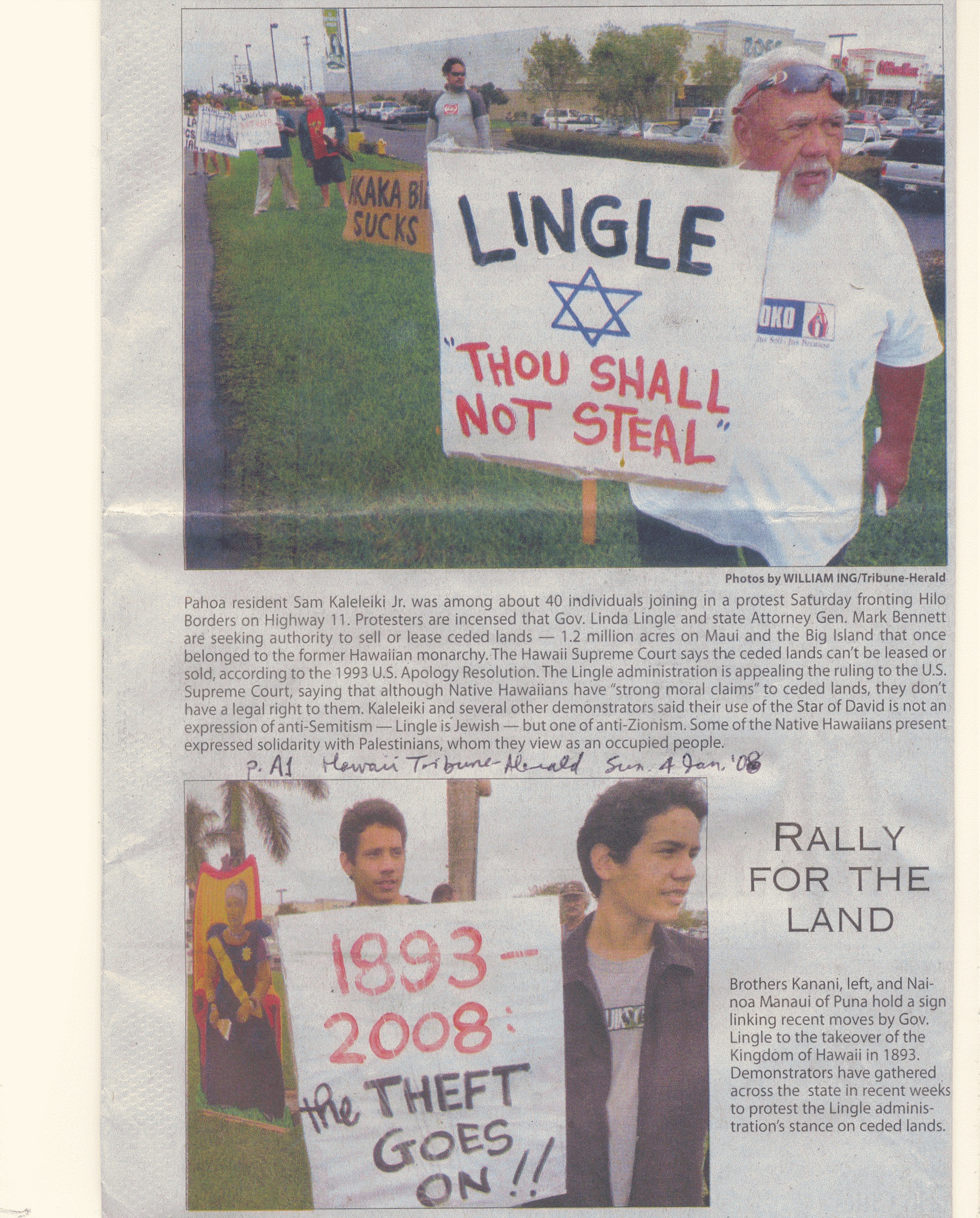
Hawaii Reporter, January 6, 2009
https://www.angelfire.com/big09a/OHADemandsCededLandMoratorium.html
https://www.angelfire.com/big09a/OHA2009BackRentSettlement.html
Honolulu Advertiser, Saturday, January 17, 2009
Thousands expected, and emotions high on overthrow anniversary
Honolulu Advertiser, BREAKING NEWS/UPDATES
Updated at 4:02 p.m., Saturday, January 17, 2009
KHNL TV news, January 17, 2009 8:24 PM ET
Associated Press -
Honolulu Advertiser, Sunday, January 18, 2009
Demonstration held in conjunction with overthrow observance
Honolulu Star-Bulletin, January 18, 2009
The rally marks the anniversary of the kingdom's overthrow
The Garden Island News (Kaua'i), January 18, 2009
Honolulu Advertiser, January 19, 2009
Letters to the Editor
Honolulu
Date: December 21, 2009
Hawaii’s Race Case?: Hawaii v. OHA
The Hawaii Supreme Court blocked the sale of 1.2 million acres of land (29 percent of the state's total area) based on a joint resolution that Congress passed in 1993 to apologize for the 1893 overthrow of the Kingdom of Hawaii. This issue is now before the U.S. Supreme Court. Was it correct, or did the Hawaii Supreme Court rewrite the terms by which Hawaii became the 50th state?
Sauk Valley News, Serving Dixon, Sterling, and Rock Falls Illinois
January 22, 2009
** Also
http://www.mauinews.com/page/content.detail/id/514009.html
Maui News, January 23, 2009
ASSOCIATED PRESS WRITER
https://bigfiles90.angelfire.com/CededNoSellSCOTUSOHAMeritsBrf.pdf
"Having sought this Court’s review on a question
concerning the Apology Resolution, petitioners devote
the majority of their brief, as does the United States as
amicus curiae, to entirely different questions: specifi18
cally, whether any injunction barring the sale of ceded
lands, even if it is based on state law, is precluded either
by the Newlands Resolution (and similar federal statutes)
or by the Admission Act. Those questions, however,
are not within the scope of the question that was
actually presented in the petition for certiorari, nor were
they raised in the body of the petition. Indeed, petitioners’
Newlands Resolution argument was neither pressed
nor passed upon below. With the United States as a willing
abettor, petitioners are thereby engaging in a classic
bait and switch, by attracting the Court’s attention on
one question and then seeking a decision from the Court
on others. That tactic should be seen for what it is: a
brazen effort to disempower the Hawaii Supreme Court,
which petitioners evidently view as an unfriendly forum
in which to litigate state-law issues concerning the status
of the ceded lands. This Court should decline petitioners’
invitation to resolve questions of federal law as a
matter of first impression."
CONCLUSION
The petition for a writ of certiorari should be dismissed.
In the alternative, the judgment of the Hawaii
Supreme Court should be vacated, and the case remanded
for further proceedings.
Governor Linda Lingle State of the State address to joint session of Hawaii Legislature, Monday January 26, 2009
** Excerpt related to ceded lands issue
Honolulu Advertiser, BREAKING NEWS/UPDATES 3:52 p.m., Wednesday, January 28, 2009
Honolulu Advertiser, Thursday, January 29, 2009
Hawaiian caucus facing setback
The Maui News, January 29, 2009, LETTER
Paia
The Maui News, January 30, 2009
=================
Honolulu Advertiser, Friday, January 30, 2009
http://www.supremecourtus.gov/docket/07-1372.htm
http://www.inversecondemnation.com/files/07-1372_respondentamcuafn.pdf
http://www.inversecondemnation.com/files/07-1372_respondentamcuejsandjacl.pdf
http://www.inversecondemnation.com/files/07-1372_respondentamcuprincessabigailkinoiki.pdf
http://www.inversecondemnation.com/files/07-1372_respondentamcunatlcongressofameindians.pdf
http://www.inversecondemnation.com/files/07-1372_respondentamcuhawaiicongressionaldelegation.pdf
http://www.inversecondemnation.com/files/07-1372_respondentamcucurrentandformerhistateofficials.pdf
http://www.inversecondemnation.com/files/07-1372_respondentamcu7hicommunitygroups.pdf
http://www.inversecondemnation.com/files/07-1372_respondentamcu7asianpacificamericangroups.pdf
Honolulu Star-Bulletin, February 1, 2009
Honolulu Star-Bulletin, February 2, 2009
EDITORIAL
Ceded lands conflict should be resolved in sovereignty talks
Hawaii Reporter, February 4, 2009
http://tinyurl.com/49sx9j
http://tinyurl.com/dc7m95
http://tinyurl.com/3323rz
http://tinyurl.com/b6lakw
http://tinyurl.com/7d6xq
http://tinyurl.com/4wtwdz
http://tinyurl.com/56czl
http://tinyurl.com/2a9fqa
Ken_Conklin@yahoo.com
Hawaii Reporter, February 4, 2009
Obama Administration Backs the State in Recently Filed Brief
http://www.wilmerhale.com/seth_waxman/
http://www.wc.com/attorney-KannonShanmugam.html
http://www.hawaiireporter.com/file.aspx?Guid=c4c1a31d-aea7-48d3-beb7-ead04ea40c5a
http://www.inversecondemnation.com/inversecondemnation/2008/04/cert-petition-2.html
http://www.inversecondemnation.com/inversecondemnation/2008/04/cert-petition-2.html
http://www.inversecondemnation.com/inversecondemnation/2008/07/brief-in-opposition-in-ceded-lands-cert-petition.html
http://www.inversecondemnation.com/inversecondemnation/2008/06/another-amicus-brief-supporting-cert-in-ceded-lands-case.html
http://www.supremecourtus.gov/docket/07-1372.htm
KHON2 TV, February 4, 2009
Honolulu Advertiser, Thursday, February 5, 2009
They're designed to halt Lingle's appeal of state high court ruling
Honolulu Advertiser, Sunday, February 8, 2009
Honolulu Advertiser, Sunday, February 8, 2009
Honolulu Star-Bulletin, February 9, 2009
COMMENTARY
https://bigfiles90.angelfire.com/CededScotusStateFinalMeritsBrfFeb2009.pdf
http://www.inversecondemnation.com/files/07-1372_petitionerreply.pdf
or
http://tinyurl.com/d6hygn
** Note from Ken Conklin: The video is available through a direct link to the Kupa'aina coalition blog, and is accompanied by the bloggers' own comments favorable to Carl Christensen and deprecating Ilya Shapiro.
Maui News, February 12, 2009
Panel chairman: No hearing on measures in near future
Honolulu Advertiser, Wednesday, February 18, 2009
Protect Hawaiian Lands blog, February 18, 2009
Protect Hawaiian Lands Gathering & Rally
Wednesday, February 25, 2009
Twin Peaks Look Out (SF)
6:45am gathering / 7:00am Pule Begins (coincide w/ 10am EST start of Supreme Court session)
Civic Center Plaza near San Francisco City Hall (Goodlett side)
12 noon – 1:00pm Rally
Civic Center Plaza
1:00pm-6:00pm every hour on the hour
Civic Center Plaza near San Francisco City Hall (Goodlett side)
6:00pm-7:00pm Rally
Allhawaiinews.com blog, Friday, February 20, 2009
Honolulu Advertiser, Saturday, February 21, 2009
Honolulu Star-Bulletin, February 21, 2009
Gov. Lingle wants the state to have the right to sell large properties
Associated Press
The Maui News, February 21, 2009
Honolulu Star-Bulletin, February 22, 2009
In a 5-0 decision, Chief Justice Ronald Moon wrote that the state cannot sell or transfer an estimated 1.2 million acres of ceded lands held in trust by the state until native Hawaiian claims to the lands are resolved. The decision was that the 1993 Apology Resolution by Congress and state laws establish the state's fiduciary duty to preserve the lands until the resolution of the native Hawaiian claims. The court granted an injunction halting any sale or transfer until the resolution.
Argument: The state should have clear legal title to the ceded lands for the benefit of all the people of the islands. The Hawaii Supreme Court misinterpreted the Apology Resolution, which was "a statement of regret." It does not change previous laws that includes the U.S. government getting clear title to the lands upon Hawaii's annexation in 1898 and the transfer of those lands to the state upon statehood in 1959.
Request: The U.S. Supreme Court should set aside the Hawaii court's ruling banning sales and transfer and order the Hawaii court to dissolve the injunction.
Argument: The Hawaii court relied on state laws and the Apology Resolution for its factual findings that native Hawaiians have "unrelinquished claims" to ceded lands. The Hawaii justices also recognized that the state constitution mandates that the state hold ceded lands in trust "for native Hawaiians and the general public." It would be a breach of the state's fiduciary duty to sell or transfer the lands until the claims by native Hawaiians, who are among the beneficiaries of the lands, are resolved.
Request: The U.S. Supreme Court should dismiss the state's petition challenging the Hawaii Supreme Court decision.
» U.S. government
» Thirty-two other states — Alabama, Alaska, Arizona, Colorado, Florida, Georgia, Idaho, Illinois, Indiana, Iowa, Kansas, Kentucky, Louisiana, Maryland, Michigan, Mississippi, Nebraska, New Hampshire, New Mexico, North Carolina, North Dakota, Ohio, Oklahoma, Oregon, Pennsylvania, Rhode Island, South Carolina, South Dakota, Utah, Vermont, Washington, Wyoming
» Center for Constitutional Jurisprudence
» Pacific Legal Foundation, the CATO Institute, Center for Equal Opportunity
» Mountain States Legal Foundation
» Grassroots Institute of Hawaii, Southeastern Legal Foundation Inc.
» Alaska Federation of Natives Inc.
» Equal Justice Society, Japanese American Citizens League
» Abigail Kinoiki Kekaulike Kawananakoa
» National Congress of American Indians
» Hawaii congressional delegation — Sens. Daniel Inouye and Daniel Akaka, Reps. Neil Abercrombie and Mazie Hirono
» Former Gov. John Waihee, former Chief Justice William Richardson, Senate President Colleen Hanabusa
» Native Hawaiian Legal Corp., Association of Hawaiian Civil Clubs, Hawaii Maoli, Native Hawaiian Chamber of Commerce, 'Ilio'ulaokalani Coalition, Council for Native Hawaiian Advancement, I Mua Group
» Asian American Justice Center, National Coalition for Asian Pacific American Community Development Inc., Organization of Chinese Americans Inc., Asian Law Caucus, Asian American Institute, Asian and Pacific Islander American Health Forum, Asian Pacific American Legal Center
» Sovereign Councils of the Hawaiian Homelands Assembly, Na A Ahuhiwa, Native Hawaiian Bar Association, Hui Kako o Aina Ho o Pulapula, Ahahui O Hawaii
» Native Hawaiians Samuel L. Kealoha Jr., Virgil Emmitt Day Jr., Patrick Kahawaiolaa, Josiah L. Hoohuli, Mel Hoomanawanui
Honolulu Advertiser, Monday, February 23, 2009
Honolulu Advertiser, Monday, February 23, 2009
Advertiser Washington Bureau
Honolulu Advertiser, Monday, February 23, 2009
At issue is whether governor can sell some of 1.2 million acres
KHNL TV; Associated Press - February 23, 2009
Honolulu Star-Bulletin, Tuesday February 24, 2009
http://www.philly.com/philly/wires/ap/news/nation_world/20090224_ap_issueofcededlandscomestotheforeinhawaii.html
and
Las Vegas Sun
http://www.lasvegassun.com/news/2009/feb/24/issue-of-ceded-lands-comes-to-the-fore-in-hawaii/
Associated Press Writer
Honolulu Advertiser, Volcanic Ash, David Shapiro columnist blog
February 24, 2009
http://supremecourtus.gov/oral_arguments/argument_transcripts/07-1372.pdf
Justices' view of '93 apology may be key
High court appears skeptical of its effect on any land claims
Reliance on apology concerns judges
A Supreme Court justice says the state high court used the Apology "as a crutch"
Honolulu Advertiser, Thursday, February 26, 2009
Hawaii Reporter, February 25, 2009
http://www.supremecourtus.gov/oral_arguments/argument_transcripts/07-1372.pdf
Honolulu Advertiser, Thursday, February 26, 2009
High court appears skeptical of its effect on any land claims
Advertiser Washington Bureau
Honolulu Star-Bulletin, February 26, 2009
Reliance on apology concerns judges
A Supreme Court justice says the state high court used the Apology "as a crutch"
Inversecondemnation blog
https://www.youtube.com/watch?v=8XWijwmvGU4
http://turtletalk.wordpress.com/2009/02/26/commentary-on-the-hawaii-v-office-of-hawaiian-affairs-oral-argument/
here,
http://editorial.honadvblogs.com/2009/02/26/on-ceded-lands-we-agree/
and here.
http://planetkauai.blogspot.com/2009/02/my-thoughts-on-ceded-lands-arguments.html
The Maui News, February 27, 2009
EDITORIAL
Honolulu Star-Bulletin, February 27, 2009
EDITORIAL
D.C. Examiner, March 3, 2009
Examiner Columnist
Hawaii Reporter March 9, 2009
leon@hits.net
Wall Street Journal, March 12, 2009
LAW JOURNAL
Honolulu Advertiser, Thursday, March 19, 2009
Disagreement is over which parcels should be handed over to OHA
Hawaii Reporter, March 20, 2009
PBS Hawaii TV, special "Insights" program on ceded lands, March 19, 2009
http://www.pbshawaii.org/ourproductions/insights20090319_ceded.htm
Written by Tim Sakahara - tsakahara@kgmb9.com
http://www.supremecourtus.gov/opinions/08pdf/07-1372.pdf
http://supremecourtus.gov/oral_arguments/argument_transcripts/07-1372.pdf
Honolulu Advertiser, breaking news, Updated at 1:13 PM., Tuesday, March 31, 2009
http://www.supremecourtus.gov/opinions/08slipopinion.html.
http://www.honoluluadvertiser.com/article/20090331/BREAKING/90331051/1352
http://www.honoluluadvertiser.com/article/20090331/BREAKING/90331054/1352
http://www.honoluluadvertiser.com/article/20090331/BREAKING/90331053/1352
http://www.honoluluadvertiser.com/article/20090331/BREAKING/90331052/1352
http://www.honoluluadvertiser.com/article/20090331/BREAKING/90331055/1352
http://www.honoluluadvertiser.com/article/20090331/BREAKING/90331041/1352
http://www.honoluluadvertiser.com/article/20090331/BREAKING/90331037/1352
Honolulu Star-Bulletin, March 31, 2009 breaking news
Grassroot Institute of Hawaii
www.grassrootinstitute.org
Tom McAuliffe, Communications Director
PH: 808.282.8478
eMail: tom@grassrootinstitute.org
Hawaii Reporter, March 31, 2009
http://www.inversecondemnation.com/inversecondemnation/cededlands.html
Hawaii Reporter, March 31, 2009
Honolulu Advertiser, Wednesday, April 1, 2009
Case tossed back to Hawaii justices, who get final word
U.S. Sen. Daniel K. Akaka | D-Hawai'i
Princess Abigail Kinoiki Kekaulike Kawananakoa | Heir to the Kalakaua Dynasty
Jamie Story | president of the The Grassroot Institute of Hawaii, which filed an amicus brief in support of the state in Hawaii v. Office of Hawaiian Affairs
Lilikala Kame'eleihiwa | University of Hawai'i Center for Hawaiian Studies
State Rep. Mele Carroll | Chairwoman of the House Hawaiian Affairs Committee and the Legislative Hawaiian Caucus
U.S. Rep. Neil Abercrombie | D-Hawai'i
Attorney H. William Burgess | who filed an amicus brief on behalf of The Grassroot Institute of Hawaii and the Southeastern Legal Foundation
Jocelyn M. Doane, Derek Kauanoe, Davis Price
Kupu'aina Coalition
Honolulu Advertiser, Wednesday, April 1, 2009, commentary
Honolulu Advertiser, Wednesday, April 1, 2009
Supreme Court says federal resolution doesn't alter state law
Advertiser Washington Bureau
Honolulu Advertiser, April 1, 2009, EDITORIAL
Wednesday, April 1, 2009
Honolulu Star-Bulletin, April 1, 2009
OHA lawsuit on ceded lands keeps issue on front burner
Honolulu Star-Bulletin, April 1, 2009, EDITORIAL
Wall Street Journal, Law Blog, March 31, 2009
What’s an apology worth?
New York Times, April 1, 2009
New York Times, March 31, 2009
HAWAII LEGAL NEWS
A NO-FRILLS HAWAII DIGEST. UPDATED FREQUENTLY, BUT WITHOUT REGULARITY.
KGBM9 TV, March 31, 2009
Written by KGMB9 News - news@kgmb9.com
Planet Kaua'i Blogspot, Tuesday, March 31, 2009
Planet Kaua'i Blogspot, Tuesday, March 31, 2009
- Robert Rantoul, Oration at Scituate (July 4, 1836)
- James Madison, The Federalist No. 47 (quoting Montesquieu).
Hawaii Reporter, April 1, 2009
Honolulu Star-Bulletin, April 5, 2009, Commentary
Honolulu Advertiser, Sunday, April 5, 2009, Letters to editor x 2
OHA vice chairman
Eugene, Ore.
Kihei
Wailuku
Indian Country Today, April 6, 2009
SCOTUS blog, Monday April 6, 2009
http://scotuswiki.com/index.php?title=Hawaii%2C_et_al._v._Office_of_Hawaiian_Affairs%2C_et_al.
Hawaii Reporter, April 6, 2009
Thoughts on the U.S. Supreme Court ceded lands case
BanyanHouse@hula.net
The Hawaii Independent, April 7, 2009
Laura Lehua Yim, Ph.D.
Honolulu Advertiser, Thursday, April 9, 2009
Settlement would require legislative OK to sell lands
Advertiser Staff Writer
Honolulu Advertiser, Friday, April 10, 2009
Hawaii Reporter, April 15, 2009
The Garden Island (Kaua'i), Saturday, April 18, 2009
The Maui News, April 18, 2009, Letter to editor
OHA trustee
Honolulu Advertiser, Wednesday, May 6, 2009
Unresolved is how much revenue Office of Hawaiian Affairs gets
Honolulu star-Bulletin, May 6, 2009
Indian Country Today, May 6, 2009
Honolulu Advertiser, Saturday, May 23, 2009
UH professor believes recent agreement fails to resolve all concerns
May 11-15, 2009
Jonathan Kay Kamakakawiwoole Osorio
Honolulu Advertiser, Wednesday, May 27, 2009
COLUMNIST COMMENTARY
Honolulu Advertiser, Tuesday, July 14, 2009
Honolulu Star-Bulletin, July 14, 2009
Honolulu Advertiser, Wednesday, October 28, 2009
Inverse condemnation blog by attorney Robert Thomas
October 28, 2009
http://www.inversecondemnation.com/inversecondemnation/cededlands.html
http://www.state.hi.us/jud/opinions/sct/2009/25570.pdf
Ken_Conklin@yahoo.com